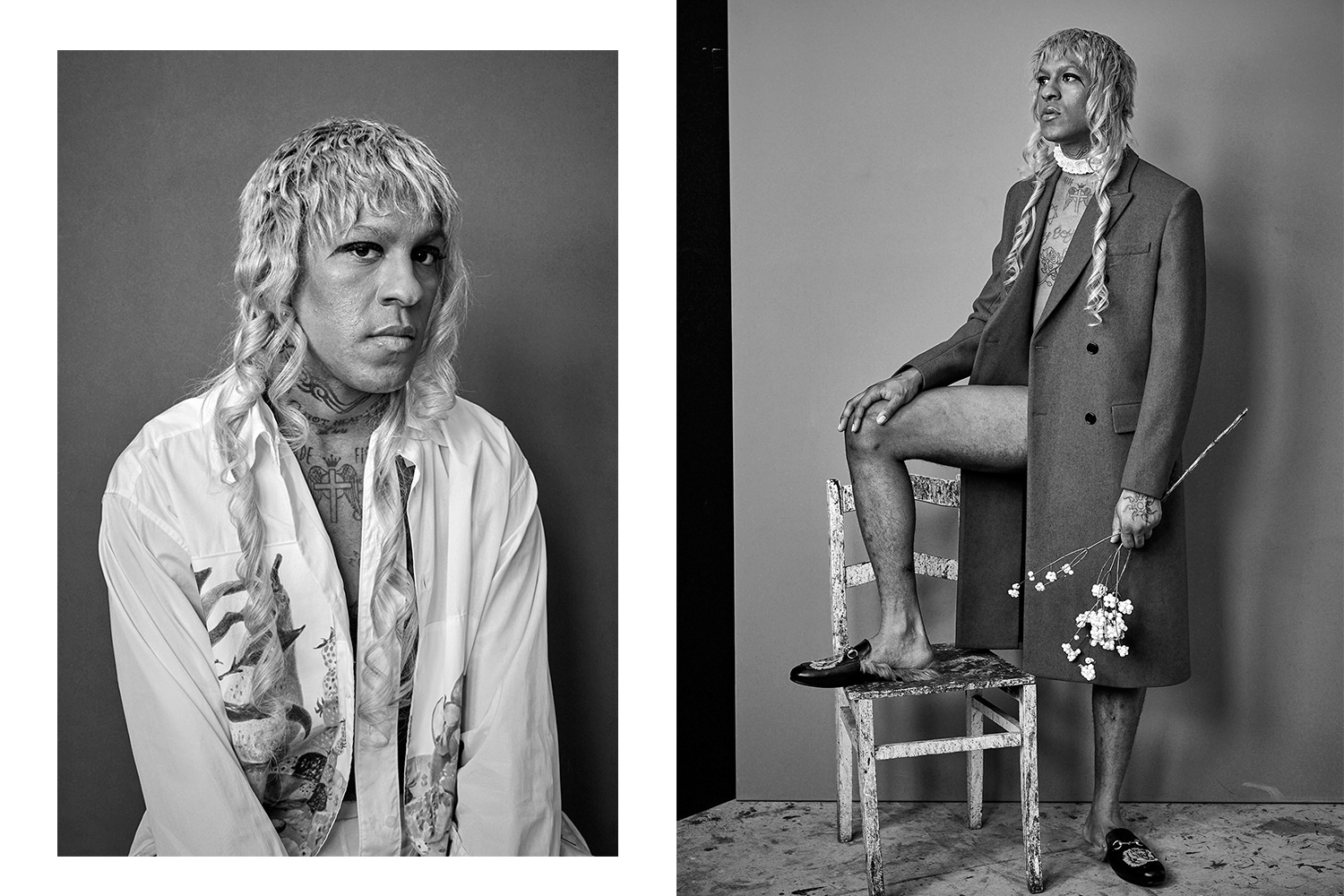
 Left: Shirt by Prada. Right: Coat by Dior Homme, collar stylist’s own, shoes by Gucci.
Photography by Thomas Hauser
Styling by Rachael Rodgers
Makeup by Nora Belovai
Hair by Benjamin Madle
In five years, performance artist turned indie rapper Mykki Blanco has redefined what rap and black art can be while wearing a bra and a wig. Along the way he has amassed a legion of fans (including Björk), churned out a series of singles and EPs, toured the world and recently got signed by Berlin label !K7, on which he released his debut album, “Mykki”. His journey, however, has been anything but a breeze. From tackling racial and gender stereotypes to coming out as HIV positive, the US artist is not one to give up easily. Here he talks to SLEEK’s digital editor Will Furtado about the importance of history in the making of art that is truly new.
“The racial politics of an artist’s work doesn’t really have anything to do with the content through which they’re making stuff”
 Jacket by Palomo Spain, bow tie by Dior Homme, trousers and shoes by Gucci
SLEEK: This year you returned to the limelight and released your debut album after five years in the music scene. What took you so long?
Mykki Blanco: I experienced a lot of different things that kept me from getting a label. Everything from marketing people not taking what I was doing seriously, to homophobia, to even doubting if I could make it and really be the artist I wanted to be. Despite those five years, I consider myself a performer and entertainer who has had to learn to become a musician. I didn’t start making music until I was 25. I was doing visual art, I was doing poetry, I was doing performance art – the idea of being in the music industry was not my idea.
Mykki Blanco is only one of your personas exploring the musical side of your practice. While constantly shifting between music to poetry, how do you view your artistic identity?
Theatre and acting is the heart of everything that I do, and so is writing. Until I began working with my very first manager, I didn’t have any aspirations to be a musician or to be in the music world. Then I started realising that this Mykki Blanco project was the vehicle through which I could express all the multidisciplinary ideas that I had.
You recently got signed to !K7. Your relationship with the label started with Tricky, right? It did. Tricky headlined a show at Berghain and my booking agent at the time suggested I opened for him. I think that was actually the first time he saw me perform. After that he invited me to London to record and be on his album, and then a few months later I got a call from !K7.
“I created projects so diverse that people could no longer put it in the queer box”
 Hat, shoes and socks by Prada. Trousers by Herr Von Eden
Did the music industry and media try to pigeonhole you as a black queer rapper?
They did, especially in the first three years. It was so incredibly annoying because what I was doing was a little queer, but more than anything it was just subversive.
And how did you overcome that?
Honestly, through art history. One of the things I have always known is that I would create projects that were so diverse that people could no longer put it in the queer box. I’ve tried to show that diversity through the visuals, the music, the mixtapes and the EPs I’ve done. And that was a very deliberate decision.
“As a black american, I’m kinda glad that Trump happened”
Last year you launched the label Dogfood. Named after one of your pseudonyms, its aim is to support underrepresented artists and disrupt the image of black American musicians. Why was doing that so important to you?
Because I have so many friends that would not be taken on by the mainstream labels. So when I started cooperation with !K7 records, rather than start working on my own album immediately, I thought it would be a good trial to work with other talented people that lack representation.
When we released the C-ORE album with Dogfood and toured it, we got a lot of exposure. And it was then that I really got how other people were writing about [these artist’s] music. I was like wait, some of this criticism is about the fact that these are black artists that aren’t making hip hop, and they were acting like they don’t know how to write or talk about them. Music journalism has to start to understand that the racial politics of an artist’s work doesn’t really have anything to do with the content through which they’re making stuff . And the same happens in contemporary art, where you have two artists that make a similar body of work, but because one of them is an artist of colour, all of a sudden politics is thrown into it.
Do you think race politics has changed since the 2016 US presidential election?
As a black American, I’m kinda glad that Trump happened, so people can realise how racist his supporters really are. And if you want your next generation to not be that way, or if you want people to actually understand these class and racial divides, we have to address the fact that this is how a large percentage of the country actually feels. So Trump happening was actually a great thing – no more covering up.
“Mykki” is out now and the artist is currently on tour – check dates here
Taken from SLEEK 52