 Nadine Goepfert, The Garments May Vary
Berlin-based textile designer Nadine Goepfert has been reading, watching her sweaters droop and hacking away at tactile matter with very little fanfare. Looking at her work is a journey. There is so much subtext and abstraction – the result of extensive research and free thinking (rather than abstraction contrived for art’s sake). You can trace the thought tangents in her work like veins: each body of work she has created is high-minded and sincere – a rare feature for any article spat out by the art or fashion scene. Maybe that’s why she drives her research method so hard, to keep one foot in and one foot out of those worlds. Most recently she collaborated with Martin Niklas Wieser on his collection ‘Pink and Blue’. The look book has just been released and it is dynamite, his architectural pieces highlighted by Goepfert’s deep textures (tire tread!). We chatted to Goepfert to find out more.
Your approach to textiles and fabrication has a lot more to do with art, in my perception, rather than a focus on ‘trends’ and ‘convention’ the way fashion traditionally does. What is your direction?
I think my direction is relying on textile materials and is more art-based. Besides art, I have quite a big interest in literature and philosophy. Most of the time I start reading and researching, or sometimes I just get fascinated by the different conditions of a material (such as melting), or techniques that are not necessarily related to textiles (like conservation) and try to find a way to translate those phenomena into textile materials. I have always had a big interest in fashion, for instance, Dries van Noten’s textile designs and his way of combining patterns within one outfit. This is not necessarily related to my work, though. I was always more interested in the sociological side of clothing; the daily interaction and relation of personality and garment.
Am I being naive in implying that you have a ‘goal’ in all of this, rather than just accepting what you’re creating as a form of expression?
As mentioned before, a lot of my work is based on research. I see myself in the position of the observer. I see the garments of my collection more as an illustration of my explorations, in the form of textile materials. I want to make people pay attention to their everyday life “performances” – ways of dressing and undressing – and to our relation with objects. Bruno Latour wrote in ‘Eine neue Soziologie für eine neue Gesellschaft’ “It is important to contemplate the question of the social solidarity not only to our consciousness, but considering the defining role within the world of things.” Movements which are considered natural and even part of our body language, are often based on the garment we are wearing. The construction and features of our garments become an illustration of our current situation, maybe even of our mood and character (nervously tugging at the end of a sleeve, fiddling with the collar, wrapping a large cardigan extra tight around your torso).
This year you released “Matters of habit”, a sculpture/clothing collection that carries on from your 2013 project “The garments may vary”. Are there plans to produce this (or something else) as a line?
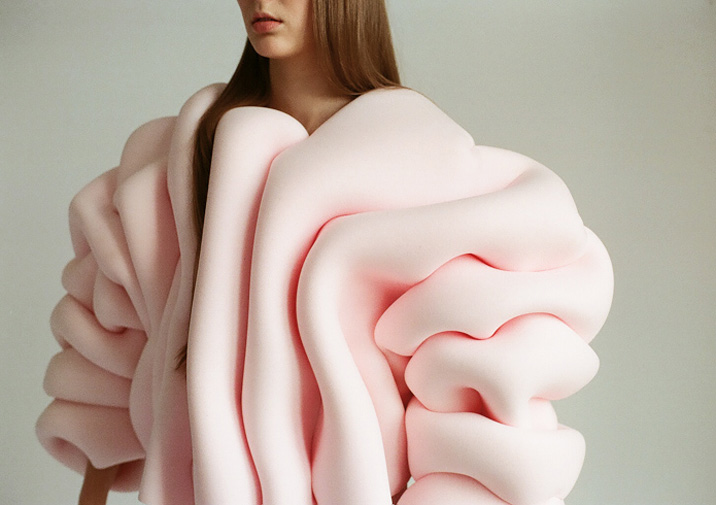
No, I don’t really see them as fashion collections, I don’t see the garments hanging in a store. But there are people that would like to wear the garments I’m making. I got lots of requests for the memory foam pullover, from people who would love to wear it, but as you can imagine due to its materiality and its weight it is really not made for everyday life.
 Nadine Goepfer, Matters of Habit
The idea of considering how the same piece of clothing can change differently, depending on treatment from its owner, is kind of very punk. As if you’re pointing out the impossible ‘perfect’ that fashion pushes on us.
Yes, I would say thats one part of it. First of all, I would make a difference between clothing and fashion. What we see on the runway is definitely not what most people are wearing. And yes, we never going to look that perfect, we got holes in our everyday clothes, fuzz on our black coats, imprints of our hangers and hanging racks, our sweaters get baggy. Roland Barthes distinguishes in “The Fashion System” between the image-clothing (photograph), written-clothing (described, transformed into language), and real-clothing. In my opinion this interaction between person and garment, in all its facets, is what makes a garment a “real garment”.
Let’s talk about your recent collaboration with Martin Niklas Wieser. What drew you in?
What I really like about Martin’s work is that his collections are not necessarily based on research, but more growing out of each other and developing within the process. I also like that he is positioning himself out of the fashion field into some kind of art context, not really relying on the seasonal fashion system. His collections are drawing on some kind of anti-aesthetic that might leave one with some look of inquiry and makes you curious.
 Martin Niklas Wieser AW15. Textile design Nadine Goepfert
What did you create for him?
I found my inspiration for the textile designs in soles of sporty sneakers – their complexity, layering, their shape as well as the rubber structure. In the collection there’s tops in organic shapes with cutouts, and a rubbery tire print.
Since textiles are as much about feel as they are about appearance, what’s the best feeling in the world?
I am not a fan at all of soft materials like cashmere, I prefer something more itchy. Fresh washed bed linen maybe, still a bit stiff…
Interview by Hayley Morgan