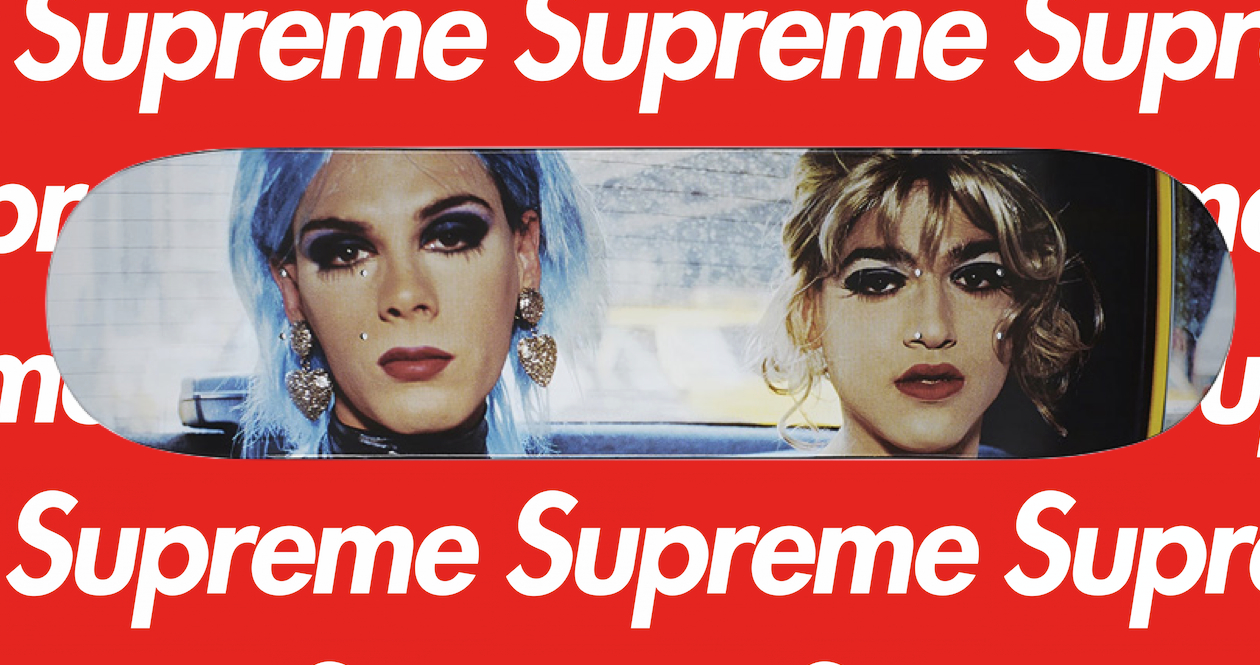
 The news came this week that seminal photographer, Nan Goldin, famed for her intimate and jarring ’80s portraits of the AIDs epidemic and life on the Lower East Side, has teamed up with streetwear giant Supreme for a skate-ready SS18 collection. Naturally, this was met with mixed emotions — silent internet cries of joy, despair and confusion that manifested in comments ranging from “NEED!” to “WTF” to “I don’t how to feel about this”. But what are the implications, on both sides, of fashion’s decision to capitalise on art with marginalised subjects at its core?
As cultural icons in their own right, both Goldin and Supreme are, by implication, attached to a string of powerful connotations that are hard to shake. There’s an incongruity evident here from the get-go, forged more broadly from their positioning in two fundamentally distinct realms — on the one hand a brand, subservient to capitalism, on the other an artist, a slave to the pursuit of “beauty” and “truth”. And even on a less ideological, more intimate basis, one’s a paradigm of millennial streetwear, the other a subversive art world icon.
 The most pertinent link between the two is location: New York, geographically, and the street, as a concept. Conceived in the ‘90s, James Jebbia’s Supreme catered to downtown Manhattan skaters, and, as such, a distinct subculture who tied themselves to hip-hop, rock and alternative music. This original conception of Supreme firmly resonates with Nan Goldin’s gritty portrayal of alternative Lower East Side street life, but streetwear has come a long way from the street.
Backed by the uprising of Wavey Garms, hype beasts, high snobs and Insta influencers, streetwear has been co-opted by the mainstream, and with it, Supreme’s subcultural brand identity has faded. What was once a beacon of youth culture, an exclusive “club” to which alternative kids belonged, and a signifier of taste, is now the pinnacle of streetwear’s new conception. Supreme is the leader in a changing streetwear model that’s become more about creating hype than producing good products, and it’s a trend that’s paved the way for developments across the whole fashion industry. Virgil Abloh’s recent appointment as Louis Vuitton’s Creative Director is a move which sees haute couture taking cues from streetwear. “High fashion has seen the success of Supreme’s game”, The Fashion Law wrote on Tuesday, “create excitement and maintain it all costs”. By drumming up hype through high prices, exclusive releases and influential backing, Supreme is no longer coveted for its cultural value, but for its prestige.
https://www.instagram.com/p/BgyeuLhlXth/?hl=en&taken-by=thefashionlaw
It’s this changing role of streetwear that intensifies the incongruity between brands like Supreme and artists like Goldin, not least because of the profound change in its demographic. Supreme’s streetwear disciples are literally that — global cop-til-you-drop teens who’ll do anything to show their affinity to the brand. Decking themselves in visibly branded apparel is a conscious effort to self-trademark — to be affiliated with a label and its connotations — and Supreme’s Barbara Kruger-inspired logo is about as distinctive as fashion branding gets. Its connotations are tied to streetwear status. And that’s fine. It’s a perfectly legitimate reason to buy clothes, but it means that those who wish to rid themselves of such associations have stopped wearing Supreme. It’s no longer a brand worn by trend-setters, but followers, and one which now seems totally out of place on any self-respecting adult over 25, better suited to lost teens seeking cool status at any cost (or $200 for a resale T-shirt).
So why Nan Goldin? How do her raw depictions of human sexuality and the intricacies of gender fit to a brand associated with a cool-hungry herd of (pre)pubescent boys as desperate as they are politically unaware? It’s not about Nan Goldin herself — it’s one thing having an artist’s work on a t-shirt, but when that work is portraiture, it necessarily implicates its subjects. Goldin’s photographs depict junkies, AIDS sufferers, drag queens, queer and trans communities, misfits by anyone’s definition, while Supreme’s wearers occupy a male-dominated, conformist mainstream. Maybe this is an example of ultimate trolling — Supreme, fed up with their fuckboy fanbase, force an education upon them that’s not only artistic, but also woke. Or maybe it’s just a desperate attempt to regain some of the alternative street-cred it’s lost along the way.
 Whatever the case, it’s perturbingly reminiscent of fashion’s complicated history of appropriating the alternative. It’s a flashback to Nirvana hoodies worn by people who couldn’t name one of the the grunge pioneer’s songs, or those kids who didn’t know that that “sick” graphic on their t-shirt was in fact the cover of a Joy Division album. It raises a question of cultural value, when appropriation becomes devoid of meaning. When Nan Goldin’s work is viewed in an exhibition context or a photobook it is contextualised and its significance explained. So do Supreme have an obligation to retain the work’s cultural and sociological value? Is it irresponsible to reduce Goldin’s art to a mere must-cop wardrobe staple?
Lest we forget Kendall and Kylie’s ill-thought out decision to plaster their faces over classic band t-shirts, leading to public outcry. “The most iconic album of all time and its legacy decimated in seconds” read one Twitter fury. “I didn’t get bullied for 12 years for listening to rock just for Kendall Jenner to wear a Metallica shirt and suddenly make it cool” read another. There’s an understandable contempt and bitterness from those who deem their appreciation as genuine, and it’s something that’s often snubbed as pretension. There’s a smug glee in knowing something before everyone else did, yes, but there’s a bigger issue at play here, and it’s about respect.
But Goldin’s not worried about teenage boys disrespecting her art and she sees reaching out to a new generation as a positive step. “I did this for the kids,” she told Vogue, “I’m looking forward to seeing teenagers skating on my images and wearing them. To my mind, people have become so conservative, especially the millennials – it’s like the 1960s never happened – so I like the idea of them being exposed to my real world.”
Though they can’t ensure it’s fully appreciated, as dictators of what’s dope (at least for its followers) Supreme is, undeniably, exposing a new generation to Nan Goldin. And it’s probable that this move will birth some genuine Goldin fandom, just as Sonic Youth fans latched onto Gerhard Ritcher, and that Consolidated cover earned Barbara Kruger a following from a new niche. And it just might reignite a flame for other culturally significant artists from a bygone era, too.
 The uproar induced by collaborations of this kind are almost always tied to the notion of “selling-out”, and Supreme x Nan Goldin is no exception. Payouts are fundamentally out of line with the enduring ideology of the struggling artist, whereby integrity becomes its own kind of morality, and money is seen as dirty. This view is tired, not to mention at odds with the entire structure of the art market, but there’s still a line between unwarranted greed and artistic integrity, and it’s hard to ascertain when that’s been crossed. For works such as Goldin’s, which offer such powerful insight into marginalised subcultures, there’s bound to be outcry when their cultural significance is at stake. It’s hard to back any project where art is being knowingly undermined, and there’ll be some who, despite Goldin’s willing participation, think this is one of those times.
At the end of the day, Supreme x Nan Goldin is a mutually beneficial partnership — one that sees Supreme desperately seeking to regain their lost underground reputation by synonymising with Goldin’s misfit subjects, and Goldin conforming to the streetwear model, using Supreme to generate hype. We just hope that it inspires some meaningful engagement in the process.