When it comes to making it as an artist, most people in the business believe this requires strong financial backing and regular exhibitions. Additionally, artists are usually expected to have learnt their trade at a prestigious art school. That way they have both the educational and economic cushion to be able to make their name in the world. Yet, for outsider artists, who are self-taught, amateurish and reclusive, the usual rules don’t apply.
What’s intriguing about outsider artists, is that, in theory, they could be anyone. Mostly living away from the normal accepted artistic centres, outsider artists achieved their fame through their folk art. It was mostly made for themselves, harbouring little desire to share it with anyone else. Driven only by their insatiable need to create, their fame was sealed by the remarkable work they left behind. Here at Sleek we have assembled ten of the most famous creators of outsider art.
 An untitled and undated photograph by Miroslav Tichý
Miroslav Tichý
Using only a makeshift camera, the Czech-born Miroslav Tichý took thousands of pictures of unsuspecting women. He quit the Prague Academy of Arts due to the communist takeover and lived modestly on a small disability pension. Yet, for over 25 years he managed to build one of the world’s finest collections of photography, pioneering the use of soft focus in the process. It was only due to the good archiving efforts of his friend Roman Buxbaum that his work eventually became critically acclaimed.
 Untitled and undated work by Henry Darger
Henry Darger
Henry Darger was a hospital custodian who secretly created hundreds of drawings and watercolour paintings. Mixing Edwardian settings of young girls and mythical creatures with scenes of carnage and war, his paintings are both beautiful and horrific. These paintings were made to accompany his still-unpublished novel The Story of the Vivian Girls. At 15,145 pages, it is by far one of the longest unpublished works ever written. All of this was only discovered by his landlord after his death.
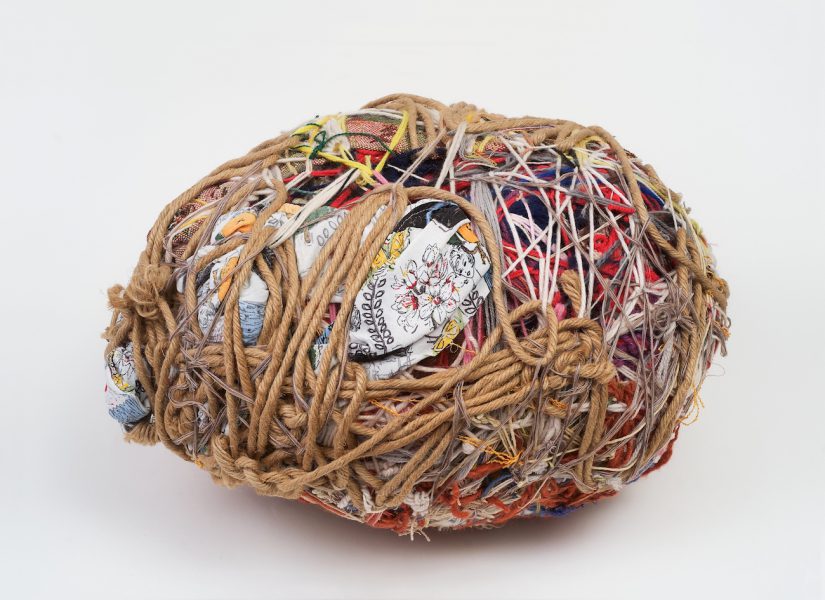 “Untitled,” 2003 by Judith Scott
Judith Scott
Judith Scott was predicted to live only until her teenage years. Born with severe down syndrome, she was left in a state institution for over 35 years. Only when her sister finally became her legal guardian did she discover her artistic talent. Taking a fiber class at the Creative Growth Art Center in Oakland, specially designed for people with disabilities, she was found to have a completely original approach to abstract sculpting. By 1999, she crossed over into the world of mainstream art with her first exhibition. The next showcase of her art will be at this years Venice Biennale.
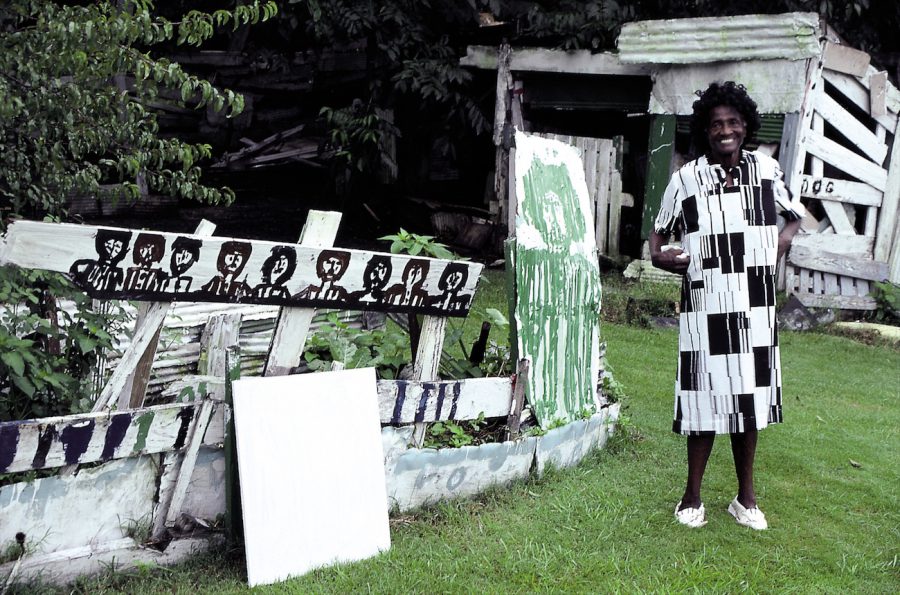 Marty T. Smith in her yard. Photo Credit: soulsgrowndeep.org
Mary T. Smith
She was one of thirteen children to a poor sharecropping family and suffered from a serious hearing impediment. As a result, her only comfort would be found in drawing. She lived as a gardener for most of her life and took up painting after her retirement in the late 70s. Turning her small house and garden into what she called a “highly public form of spiritual autobiography,” art collectors soon took notice of her great talent. Her spiritual and folk art styles, often celebrating her African origins, has led many critics to compare her to Jean-Michel Basquiat.
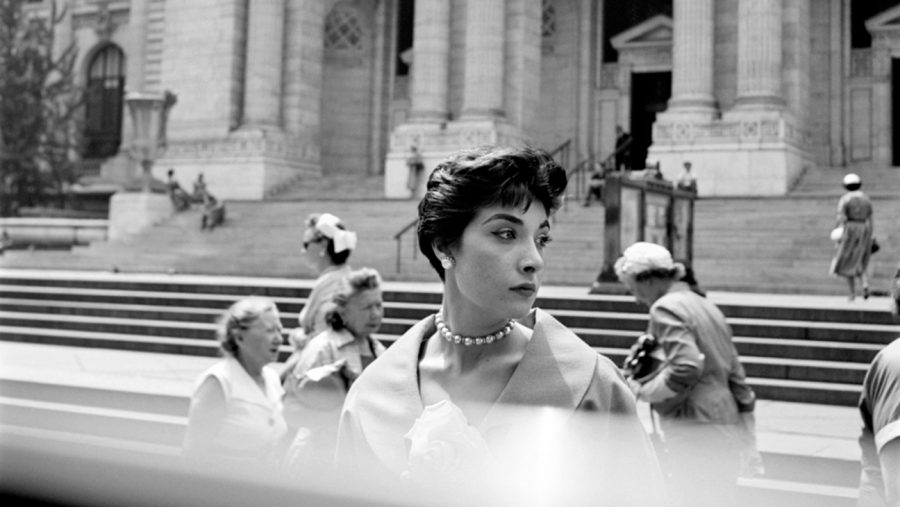 Undated and untitled photograph by Vivian Maier
Vivian Maier
Vivian Maier worked as a nanny, looking after rich kids on Chicago’s North Shore. Yet in her spare time she was a prolific street photographer. She snapped everyday scenes of life in New York, Chicago and Los Angeles. Her work only became hugely popular after her death when a sample of her negatives were bought at an abandoned storage unit auction. It is estimated she took over 150,000 photos throughout her lifetime, making any exhibition of her work quite the challenge for curators.
 “The Ring of the St. Adolf-Fire-Snake, in the Indian Ocean” by Adolf Wölfli. 1920-1.
Adolf Wölfli
Adolf Wölfli didn’t have an easy life, but still left behind an impressive body of work. This Swiss-born artist was sexually abused as a child and orphaned from the age of ten. Committed to a mental institute for molesting children, he stayed there from 1895 until his death in 1930. As a result of his unstable condition he taught himself how to draw — becoming a pioneer of the Art Brut movement. The drawings he left behind are highly complex yet beautiful, incorporating his love for musical notation.
 “Wand of the Genii,” by Eugene von Bruenchenhein. 1956.
Eugene von Bruenchenhein
Eugene von Bruenchenhein is the best example of outsider artist as Renaissance man. His work spanned between painting, sculpture, poetry, ceramics, photography and drawing. Using his wife Marie as his muse, he would construct elaborate stages to photograph her on. In his own home studio, he managed to create thousands of disparate works of art. Yet, despite multiple attempts to sell his work to galleries, it was only after his death in 1983 that his work became better known.
 Untitled and undated work by Madge Gill. Courtesy of Henry Boxer Gallery.
Madge Gill
Born illegitimately, the Essex-born Madge Gill was placed in an orphanage at the age of nine. Later she moved to a farm in Canada, before moving back to the UK and marrying her cousin. After the birth of a stillborn girl, she was severely hospitalised for several months as well as becoming blind in the left eye. Recovering from her illness at 38, she started to draw, inspired by a spirit she called “Myrninerest” (My inner rest). Composing thousands of drawings over the next forty years, she never sold her pieces out of fear of upsetting “Myrninerest”. Yet after her death, her work was rediscovered, and now she is considered one of the best outsider artists.
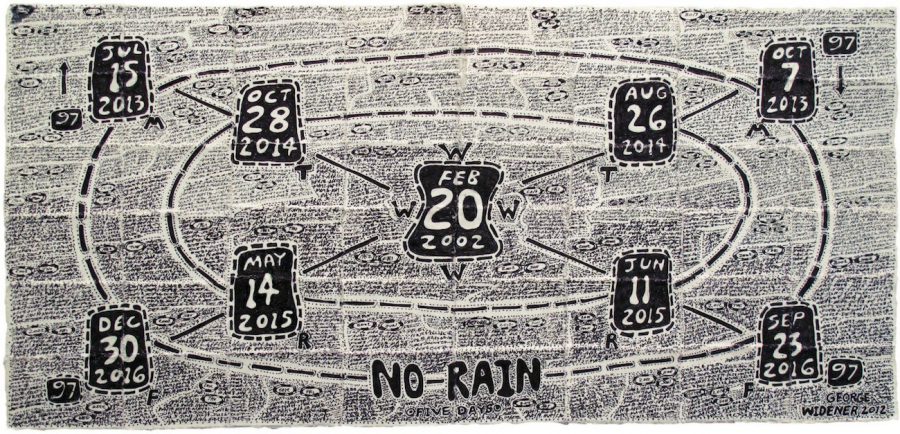 “No Rain, Five Days” by George Widener. 2012.
George Widener
The only living outsider artist on this list, the autistic-savant George Widener uses his mathematical genius to create startling palindromes and calendars. He has both a photographic memory and an intense love of machines. He first used these abilities to work for US military intelligence in the Cold War. Yet, after leaving the military he made the money to fund his art from semi-professional gambling. He believes that his art will be needed for our future robot leaders. As he explains to the Guardian: “They are going to need art too, and I am here to provide it. I felt I could be useful in a certain way, and use my system of dates as a medium for these intelligent machines of the future.”
 “Untitled,” by Howard Finster. 1990.
Howard Finster
A preacher from a young age, Howard Finster said his work was inspired by the word of God. Born in Georgia, he had his first vision of God at the age of three. This combination of God’s word and his upbringing in the swamps of Georgia is most evidently displayed by “Paradise Gardens”, his 46,000 piece strong sculpture garden. He finally gained national fame in the 80s, when his designs featured on the cover for R.E.M’s Reckoning and The Talking Head’s Little Creatures.