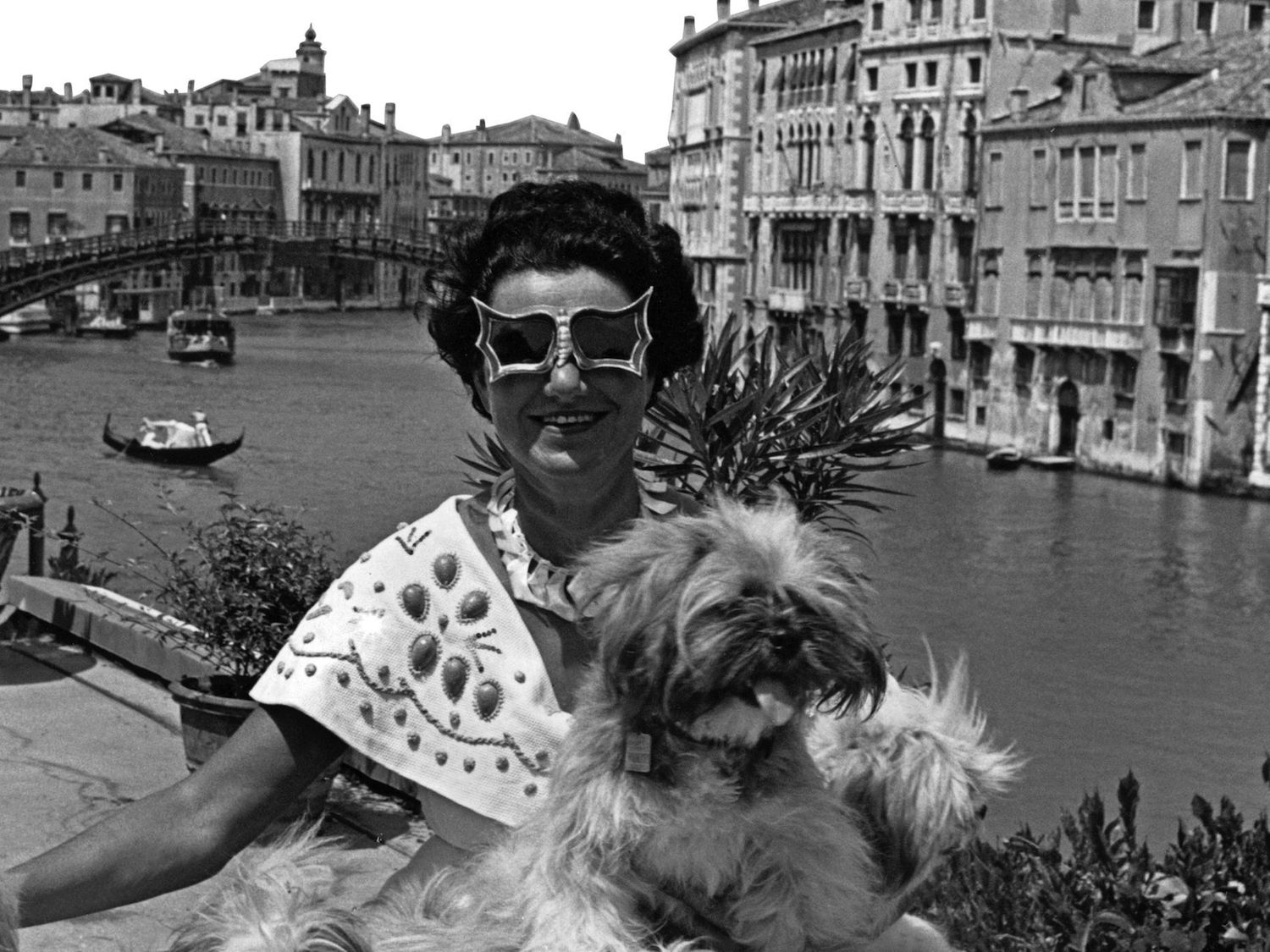
 Peggy Guggenheim, image courtesy of artemodernapordenone.it
Perhaps the most exemplary figure to represent the art world and all of its extravagances, Peggy Guggenheim rose to fame for her private collection of modern art as well as her luxurious lifestyle. Surrounding herself with only the most promising talents of her time, she was more than just a collector – she was a mentor and a true supporter of the arts. Celebrate the eccentric’s wild life with our A-Z guide on Peggy Guggenheim, the legendary lady behind the successful careers of Jackson Pollock and Wassily Kandinsky, to name a few.
A IS FOR ART OF THIS CENTURY
Prior to establishing her famed collection in Venice, Peggy opened Art of This Century in New York. The gallery-museum hybrid focused on exhibiting Cubist, Abstract, Surrealist and Kinetic works by established European artists and their emerging American counterparts.
B IS FOR BOXING DAY 1939
Credited with encouraging Peggy to ditch the Old Masters and focus on modern artists instead, Samuel Beckett first met Guggenheim at a dinner party thrown by James Joyce for Boxing Day 1939. The two are rumoured to have spiralled into a 12-day love affair, during which Beckett offered Peggy the career changing advice.
C IS FOR CORK STREET
Situated at 30 Cork Street, Peggy’s first venture as a gallerist took place at a London space named Guggenheim Jeune. The gallery closed after only one year due to lackluster sales.
D IS FOR DUCHAMP
Peggy met Marcel Duchamp during her time in Paris, and the two remained close friends until his death in 1968. The painter served as the key to an entire network of artists for the collector, introducing her to his inner circle of Paris-based creatives.
E IS FOR EIGHT YEARS
As Peggy’s biographer Anton Gill once said, “Eight years collecting in a lifetime of 80 years.” From 1938 until 1946, Guggenheim set a goal to purchase “one picture a day”, a challenge which she gladly accepted.
F IS FOR FUTURISM
Peggy was an early patron of Italian Futurism, and her Venice museum includes works from one of the movement’s founding fathers, Gino Severini. Additionally, the institution houses works on a long-term loan by other notable Futurists including Umberto Boccioni and Luigi Russolo.
 Peggy Guggenheim in her Gondola. Via guggenheim.org
G IS FOR GONDOLA
Preferring the finer things in life, Peggy was notorious for her extravagance. While living in Venice, Guggenheim purchased a private gondola, which she oftentimes rode with her beloved dogs.
H IS FOR HOARDER
Despite spending only eight years actively collecting art, Peggy wasted no time amassing her cultural empire. Art infiltrated every aspect of her life, both mentally and physically. In an article published on Vice in 2016, an employee from the Peggy Guggenheim Collection, Sara Carson, is quoted as saying: “She had so many paintings she had to stack them in her bathroom, where they got splattered with toothpaste.”
I IS FOR ICONIC FEMINIST
Abortion is a topic that, even today, women are scrutinised for speaking upon. Peggy was never silent about her personal experience with the issue, and spoke candidly about her seven abortions in interviews as well as in her memoir “Out of This Century: Confessions of an Art Addict”. During her time, it was virtually unheard of for a woman of her status to discuss the topic in a such a bold manner, making her a trailblazer for conversations on abortion that are free of social stigma.
 Jackson Pollock – Mural. Via jackson-pollock.org
J IS FOR JACKSON POLLOCK
If it weren’t for Peggy Guggenheim, Abstract Expressionist Jackson Pollock may have never become the famed artist he’s known as today. When the two first met, Pollock was a penniless alcoholic in New York. However, fellow creative Piet Mondrian advised Guggenheim to invest in the starving artist, and that she did. Pollock immediately became Guggenheim’s protégée, and she hosted a solo exhibition for the painter at her NYC gallery Art of This Century in addition to commissioning him to create what is arguably his most well-known work, “Mural”.
K IS FOR KANDINSKY
In the days of Peggy’s Cork Street gallery, Guggenheim Jeune, the art collector took a chance on Wassily Kandinsky by hosting the Russian painter’s first solo exhibition in London.
L IS FOR LHASA APSOS
Perhaps the only thing to rival Peggy’s love for art is the adoration she held for her 14 Lhasa Apsos dogs. Guggenheim was rarely without her litter of pups – even today, visitors to her Venice museum can pay their respects to both Peggy as well as her canine companions at a shared gravesite in the collection’s garden.
 Peggy Guggenheim and Max Ernst. Via huffingtonpost.com
M IS FOR MAX ERNST
When asked why she loved Surrealist Max Ernst, Peggy is said to have replied: “Because he’s so beautiful and because he’s so famous.” Their marriage was Guggenheim’s second – her first being a short-lived matrimony with painter and sculptor Laurence Vail. Her relationship with Ernst was also brief, and the two divorced in 1946, just five years after tying the knot.
N IS FOR NYC
A New Yorker born and bred, Peggy’s family was NYC royalty. Her grandfather, Meyer Guggenheim, built his empire in the mining industry, and her uncle, Solomon R. Guggenheim, founded his famed eponymous museum on Fifth Avenue.
O IS FOR OUT OF THIS CENTURY: CONFESSIONS OF AN ART ADDICT
Never one to keep quiet on personal affairs, Peggy lived her life as an open book – literally. In 1946, she published the autobiography “Out of This Century: Confessions of an Art Addict”. The memoir aired out all of Guggenheim’s dirty laundry, and despite thinly veiled pseudonyms, readers close to the art patron were immediately able to decipher the real who was who among her many well-documented love affairs.
 Peggy Guggenheim in the apartment of Kay Sage, in Paris, 1940. Via Guggenheim Venice Twitter
P IS FOR PARIS
A member of Paris’ scene of bohemians and artists, Peggy lived in La Ville Lumière on and off for nearly 22 years. This time spent in the French capital introduced Guggenheim to her lifelong friend and mentor Marcel Duchamp.
Q IS FOR QUIRKY SHADES
Guggenheim regularly commissioned her friends to design one-of-a-kind jewellery and clothing. The most notable item from her accessories collection – the collector’s flamboyant butterfly sunglasses created by Edward Melcarth. The shades have grown to become an icon in their own right and in 2014 the Italian eyewear label Safilo released a limited-edition model inspired by the original style.
R IS FOR RHINOPLASTY
Despite her high social standing, crew of creative friends and brilliant ability to collect art, nothing ever distracted Peggy too long from her self-described “potato nose”. Self-conscious about her inherited schnoz, she was one of the first to undergo rhinoplasty. Unfortunately, the procedure actually did more harm than good, and her nose was left worse off than before.
S IS FOR THE SUNWISE TURN
Peggy’s first job was as a shopgirl at the Sunwise Turn, an avant-garde bookstore in New York. Unmotivated by money, a young Guggenheim was more interested in taking in as much information as possible. This educational experience would forever shape Peggy’s relationship with art.
T IS FOR TITANIC
Peggy Guggenheim’s father, Benjamin Guggenheim, was one of the ill-fated passengers aboard the RMS Titanic’s maiden voyage in 1912. As the ship sank, the businessman is quoted as saying, “We’ve dressed up in our best and are prepared to go down like gentlemen.” Peggy was only 13 years old at the time of her father’s passing.
 Peggy Guggenheim’s Art of This Century gallery. Via huffingtonpost.com
U IS FOR UNORTHODOX INSTALLATION
Though it was only open for five years, Peggy’s New York gallery Art of This Century is recognised to this day for its unconventional approach to artwork installation. Rather than hanging anything on the walls, the space featured works either suspended in mid-air or jutting out from a pole.
V IS FOR VENICE
After closing Art of This Century, Peggy decided to return to Europe – this time, settling in Venice. In 1949, she purchased the Palazzo Venier dei Leoni, a luxe 18th century palace situated along the Grand Canal. Just before her death in 1979, she donated the palazzo as well as her art collection to the Solomon R. Guggenheim foundation on the condition that her home be turned into a year-round museum. Today, the Peggy Guggenheim Collection is the most visited museum of modern art in Italy with around 350,000 visitors per year.
W IS FOR WWII
Peggy Guggenheim was of Ashkenazi Jewish on both sides of her family, leading her to face many tribulations in the months leading up to WWII. Forced to flee her home in Paris a mere days before its invasion by Germany, Guggenheim returned to New York in 1941.
X IS FOR X-RATED FUN
Exhibiting a voracious sexual appetite, Peggy is said to have had a thousand lovers throughout her lifetime. Guggenheim touches on this subject in her autobiography and even describes the exact moment of sexual awakening as occurring while admiring frescoes in Pompeii. “They depicted people making love in various positions, and of course I was very curious and wanted to try them all out myself.”
Y IS FOR YEAR OF THE DOG
According to Chinese zodiac, Peggy was born during the year of the dog, a sign known for honesty and strong opinions. Personality traits aside, however, this could explain her lifelong obsession with her Lhasa Apsos dogs.
Z IS FOR ZODIAC
Peggy’s birthday is August 26, making her a Virgo. A sun sign, Virgos are known perfectionists and are said to enjoy helping others – a trait that is most evident in her approach to art patronage.