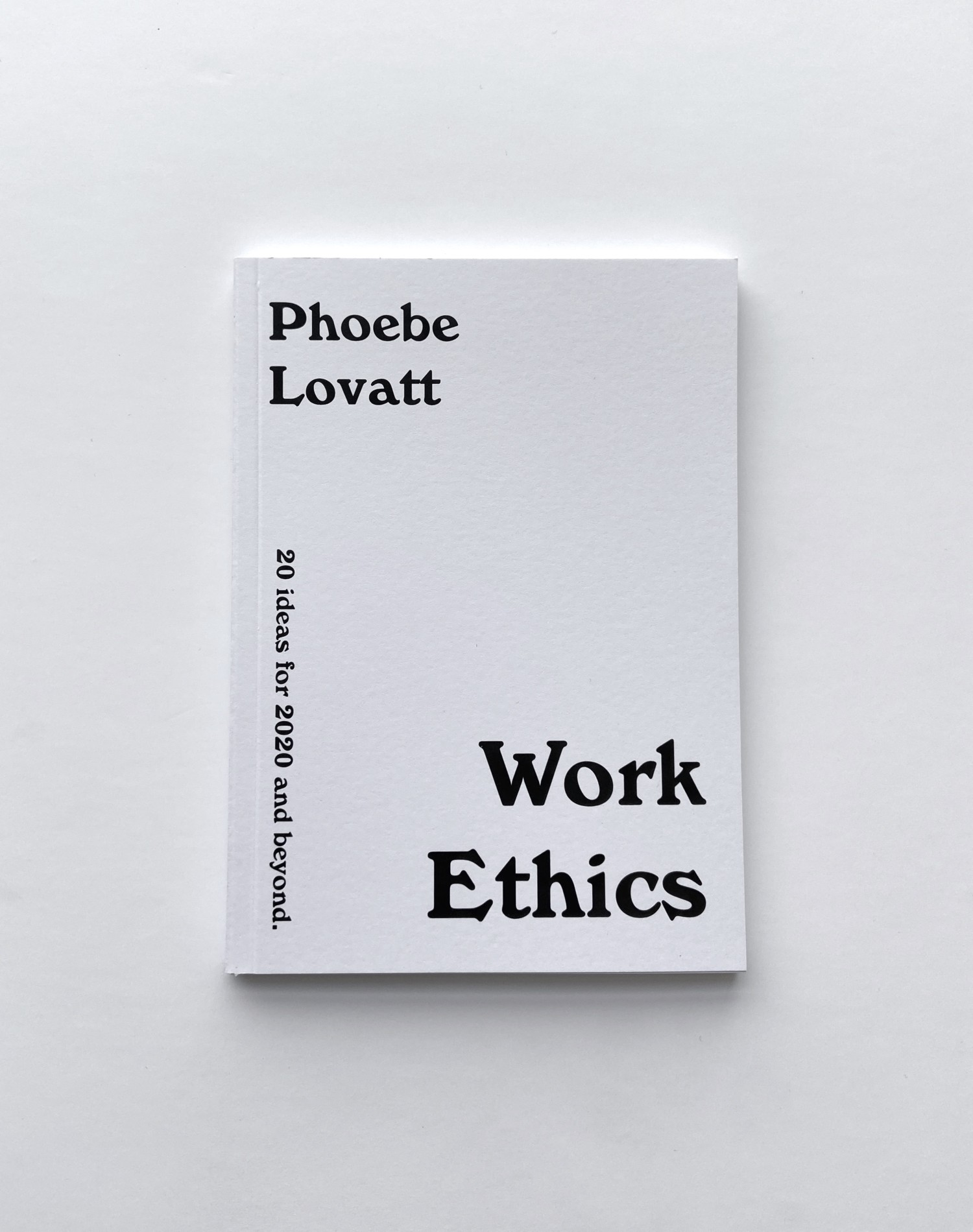
Courtesy of Phoebe Lovatt
If at any point during the last eight months, you’ve felt blindsided or ill-equipped to respond to the changes you’ve faced at work, chances are you’re probably not alone. Countless jobs were lost as companies both established and emerging faced a merciless battle to survive. Those who retained their jobs, suddenly couldn’t tell the difference between their office and home as WFH-mania swept the planet and work-life balances became increasingly blurred. To writer and moderator Phoebe Lovatt, society had found itself at a point nothing short of ground zero.
Instead of dwelling in a state of despair, Lovatt saw this as an opportunity to rebuild our work culture from the rubble. She has written a book entitled Work Ethics: 20 Ideas for 2020 and Beyond which proposes a new framework intent on encouraging a more ethical way of working. The 54-page book is split into five pillars of focus that covers freedom, care, service, simplicity and creativity. The book’s forward-thinking approach caught the eye of Virgil Abloh, who posted an image of the book on his Instagram Story. Abloh professed that whilst he was very much drawn to the book’s content the font used on the front cover alone warranted its purchase.
The ideas and values that Lovatt has proposed are not just confined to the text—thought has been applied to create a positive impact beyond the book’s borders. Work Ethics is independently published on 100% recycled paper and profits from the book’s 1st edition are equally donated to The Sunrise Movement and The Black Curriculum. Both charities promote values that work in conjunction with those put forward in the text, meaning that without even opening the front cover, readers have already taken a small step to collectively creating a more positive future.
SLEEK spoke to Lovatt to find out more about the book and what she hopes readers will take from it:
Oftentimes, the term ‘self-help’ book carries a distinct set of connotations, both positive and negative – would you classify Work Ethics as a self-help book and if not, how would you categorise it?
I wouldn’t classify Work Ethics as a self-help book. To me, that genre connotes a very prescriptive set of actions one should take in order to change some aspect of their lives, and I would not presume to be the oracle to tell people how they might do that in such insane times! As I’ve been keen to clarify, I think the defining aspect of this moment is that no-one really knows what will happen next. It could go a million ways – that’s terrifying, but also hopeful. The idea behind Work Ethics is that we urgently need a new philosophical and psychological framework for rethinking our approach to work and career. We’re stuck in this growth-based, productivity-obsessed paradigm that’s damaging to ourselves and our planet. This short book is my attempt to offer some ideas for how we can evolve beyond it.
Are the ideas that you put forward in the book told from a personal perspective or are they more rooted in updating the context around existing theoretical approaches to work ethics?
A combination of both. I’ve been writing and thinking about work for over five years now, and obviously that has given me a few more personal thoughts on the topic than most. But I don’t know if I really believe in ‘new ideas’ per se – just new arrangements and formulations of existing ideas. The arrangement and collation of the ideas in Work Ethics is very much my own, but I’ve borrowed from thinkers from Marcus Aurelius to Toni Morrison (and footnoted accordingly!) Certainly, those ideas are not explicitly focused on ‘theoretical approaches’ to work, but I’ve still found them relevant to the subject. I suppose the entire book is an attempt to explain why they’re useful.
I know that there are five key principles of focus that you’ve split the book up into, but if readers could take just one thing away, what would it be?
That the ascetic, exploitative ‘work ethic’ currently dominating our culture is one that urgently needs to be replaced with an ‘ethics of work’ based on care for ourselves, our communities, and the natural environment.
You can learn more about Work Ethics: 20 ideas for 2020 and beyond by Phoebe Lovatt here.