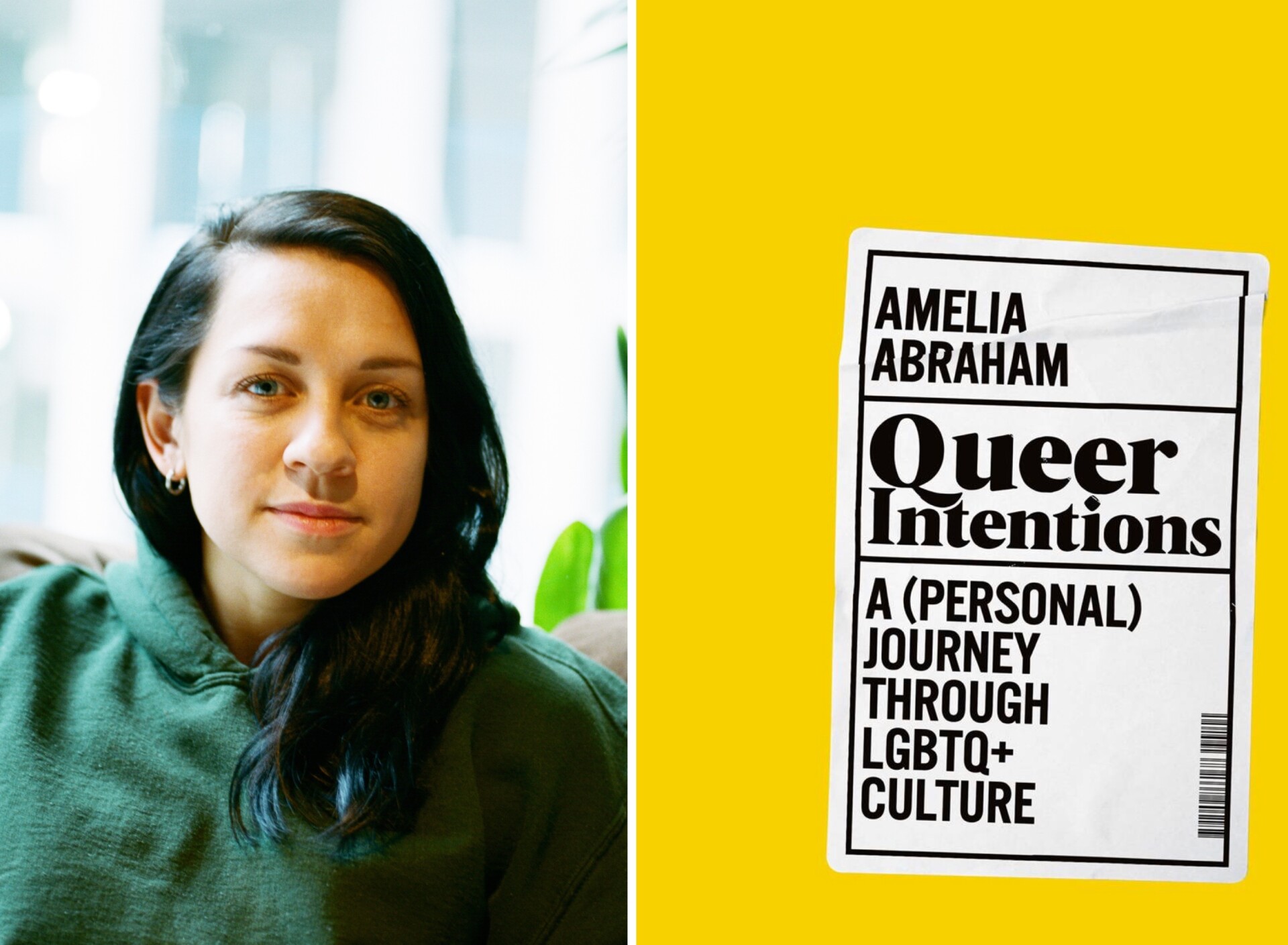
Portrait: Undine Markus.
It’s this time of the year again, when exuberant Pride parades take over cities around the world and brands swap their Instagram profile pics for rainbow colours in an effort to demonstrate how “woke” they are. Only this year marks the 50th anniversary of the original Pride event which, well, was less of a street party and more of a relentless riot. Stonewall, as it continues to be commemorated every June, marked the beginning of the modern LGBTQ+ rights movement which, in the age of same-sex marriage and RuPaul’s Drag Race, may feel like mission accomplished.
But who’s left out, and at what cost? Those are some of the questions that drove author and journalist Amelia Abraham to write her debut book Queer Intentions: A (Personal) Journey Through LGBTQ+ Culture, recently published by PanMacmillan. Following a significant breakup (mind you, it involved moving to Iceland for ten days), Abraham— who is also an editor at Dazed Beauty — went traveling around the world for over a year, meeting fellow LGBTQ+ people, hearing their stories and trying to make sense of their personal narratives within a broader set of imperatives and sensitivities. From the world’s largest drag convention in LA to the UK’s first same-sex marriage, via the underground gay clubs of Istanbul and a sex workers’ community centre, the British writer navigates with intelligence and humour the radically-different realities that queer communities and individuals face around the world. Somewhere between a personal essay and experimental reportage, this book might not answer all of your questions (spoiler alert: it will open up many new ones) but it will certainly make you tear up and laugh along the way.
SLEEK spoke to Abraham about her book, the problem with RuPaul and why we should just all be kinder to one another.
The beauty of the book to me is in the mix of personal experiences, sometimes mundane, with much bigger topics. How did the methodology come about?
It’s that old cliché of saying ‘the personal is political.’ The mainstreaming of queer culture was something that was affecting my life. In the sense that, you know, I would see two women kissing in an advert and think: that feels insincere, like our sexual identity is being co opted. Or for instance, I might feel a little bit confused if someone said to me something like, ‘oh, but you know, you won’t get married and have kids’. And I suppose it was in my personal life that these bigger questions about what’s happening to the LGBTQ+ community more broadly kept arising. Then, because it’s my job as a journalist to turn things that are happening to me or that I see into, like, articles (laugh), I guess that’s how it happened. It made sense to me to try and connect the dots between these different things and look at how they related in terms of the moment we’re living in culturally. So, this moment of unprecedented acceptance in the West, and also ask the question: where does that not apply? Or to whom does that not apply?
The chapter about drag culture felt particularly timely, as it continues to become increasingly mainstream. Someone like RuPaul is at once highly celebrated but also quite problematic, and his trans-exclusionary comments, for instance, have got him in trouble in the past. Others will say that drag too often relies on a form of misogyny, a mockery of femininity. After writing your book and meeting its various protagonists, what’s your perception of drag culture?
Firstly, speaking as a cis woman, I’ve never felt particularly offended by drag. I have sometimes in my life seen drag that feels like it’s mocking femininity, not playing with it cleverly but rather parodying it. I’ve never been offended by that, I just thought that it wasn’t very good drag! I think good drag should be smarter than that. And I think that a lot of the people I know who do drag are quite feminine men. Or they’ll be trans or non binary people, who I guess are making comments on the way that their own femininity has been oppressed. I don’t think you have to be a cis woman to have experienced that.
And then I guess on the point of the popularisation of drag. Interestingly, I don’t really love RuPaul’s Drag Race myself. Like, it’s fine, I’ll watch it, but I find sometimes that the depiction of gay people feels a bit two dimensional. Everyone’s just sassy and catty — it’s taken us a long time to get away from that stereotype. And sometimes it can feel a bit played up on the show.
I'm not trying to tell anyone what to think, I'm just trying to elucidate both sides.
In the book, you recount your visit of DragCon in L.A., a RuPaul branded, three-day event, which you compare to a Disneyland.
RuPaul’s DragCon was quite a glaring Disneyfication of drag and it did jar slightly to see something that was once so underground and subversive, so capitalised upon and so heavily commercialised in this space where people are selling so much merchandise and queuing for hours to meet the queens they love. However, I suppose DragCon, as a concept, is like a cynic take for the wider conversation of the whole book, the question of whether it is radical when something gets mainstreamed and more people are introduced to it. Is it radical that Christian Republicans and straight people are going to this drag convention and children are dressing up as drag queens? Some people would say, “that’s so radical,” and some people will say “that’s the opposite of radical.” And I think that’s the interesting nuance in the whole drag conversation but also what I’m trying to explore in the book. I’m not trying to tell anyone what to think, I’m just trying to elucidate both sides.
I liked that quote from your mum, when she asks, speaking of your journalistic investment in queer culture: “Why don’t you write about something else? You sound like a broken record!”
(laughter) Has anyone ever said that to you?
Not really no. But I don’t think I’ve been loyal enough to queer writing that people would feel the need to ask me that! Do you think now that you’ve written this book you can give her some peace of mind and move on to something else?
I guess it’s funny, isn’t it, I made this joke, like “that’s it, I’m never gonna write about LGBTQ+ culture ever again,” and then your book comes out, and everyone suddenly wants you to write and talk about LGBTQ+ culture. So I have found myself doing more, if anything. But I suppose what’s interesting is that the conversation is always evolving and there always seems to be new things to talk about and write about, you know? There are some conversations I feel like we’ve been having over and over again, one of which is about the corporatisation of Pride. And maybe I’m interested in conversations that feel newer, because I’ve talked about that a lot, but these are ongoing issues. And yeah, I guess I will keep writing about it, but I do want to write about more things too.
I have a lot of friends who are journalists, or writers or filmmakers who specialise specifically in making stuff about the queer experience. And I think that, you know, sometimes that can feel a bit cynical, especially with those who have had difficult experiences as queer people or trans people or people of colour. And they end up endlessly talking about their own oppression, for a living, and that can be really damaging to their mental health, particularly with trans friends.
However, I think there’s also something very beautiful in people deciding that they want to write about LGBTQ+ issues or race issues for a living, because obviously, it’s your experience, but I think it’s also a way to turn shame into something else.
If we expect other people to treat us with dignity and equality then we need to treat each other like that for sure.
You’ve visited some radically different places for this book, from LA to Sweden and Turkey. How would you describe the most drastic disparities that you encountered within the community? Is it more across geographical territories, social class? All and beyond?
I think definitely both. Anyone who is cognizant about intersectionality will already be familiar with how different people’s experiences can lead them to have a tougher time than others. For instance, we do see general socio economic trends that people from rural places might find it more difficult to be LGBTQ+, or people from religious backgrounds or people who are working class. It’s not like a fixed rule, it’s not a guarantee. But we do see these kinds of trends. In terms of what I learned while I was traveling, something that really surprised me was the levels of hypocrisy that I witnessed. So, for instance, I thought it was quite hypocritical that Serbia can have a lesbian Prime Minister, but then, no organisation, nor the government will fund the country’s Pride event. I thought it was quite hypocritical that there were famous trans and gay pop stars in Turkey, while the government essentially banned the Pride parade, or any other type of LGBTQ+ gatherings there. And even in slightly more, quote, unquote, progressive countries, I find it hypocritical same sex marriage is legalised in every state of America, but ‘don’t ask don’t tell’ has been rolled back in the military. There’s also a lot of hypocrisy within the LGBTQ+ community, there’s a lot of discrimination within our ranks. I think, if we expect other people to treat us with dignity and equality then we need to treat each other like that for sure.
Queer Intentions: A (Personal) Journey Through LGBTQ+ Culture is now available from PanMacmillan.