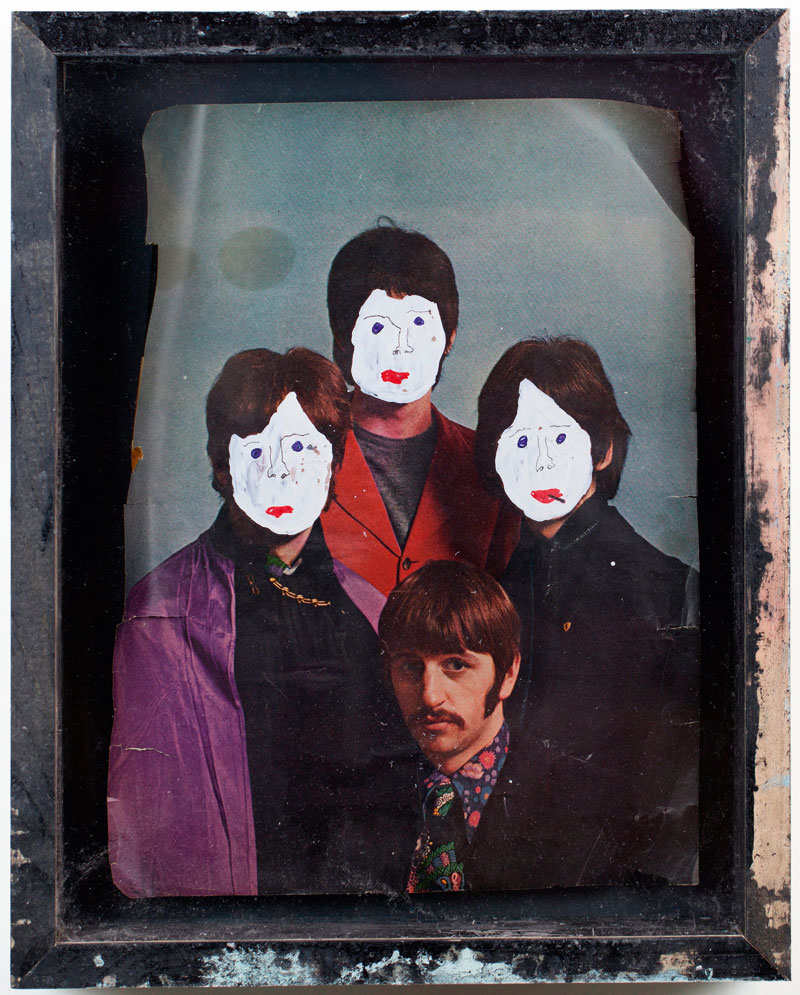
 Bruce High Quality Foundation, Self Portrait (The Bruces), 2001-2012. Shadow, box, mixed media. 41.91 x 33.02 x 8.89 cm. Courtesy Contemporary Fine Arts. Photo: Oto Gillen
Art, activism, and education the Bruce High Quality Foundation Way.
Text by Francesca Gavin
New Yorkers have a thing about conceptual art collectives. Gorilla Girls, COLAB, Art Club 2000 and The Bernadette Corporation paved the way, but the Bruce High Quality Foundation are the most contemporary manifestation of this group mentality. When they originally emerged a decade ago there was an element of petulant teenage humour in their approach to art making. This was partly due to the subversive political angle of their works and perhaps exacerbated by their relationship with dealer Vito Schnabel (Julian’s son), who dragged the rich and famous to their openings. A decade on, however, BHQF are proving themselves to have substance behind the stunts.
The pseudonymous collective bubbled up in 2004, allegedly around a group of Brooklyn-based Cooper Union graduates who joined together to make a giant plaster head and audition for gallerist Jeffrey Deitch’s “Artstar” reality TV show. From the start their work was an obvious critique of the mechanisms and structures of the contemporary art world.
The “art by committee” they have created since has included films, collages, paintings, performance lecture, installations, blowup sculptures, alternative bienniales and an art school. “In most ways the Foundation is still forming itself. It has been important for us to never pin it down, to never say explicitly that it is one thing. We rely on the mystery to help guide us. Anonymity is a tool that allows us to change,” they explain by email from New York (a face-to-face was obviously out of the question). “We don’t really think of ourselves as a collective. We think of it as a Foundation, both in its institutional framework, and in its capacity to ground a practice, to provide a base for the building of the new.”
BHQF base their practice around a fictional artist, one “Bruce High Quality”, setting themselves up as a foundation to honour the history of the artist who died during 9 / 11. “We needed a character, a namesake. We needed a myth. Actually, we only needed the idea of the myth. There are no stories about Bruce High Quality. There is nothing known about him beyond the fact that he died. Everything we do is to preserve his legacy, but the legacy is based on nothing. Bruce is a ruse that provides us a framework for thinking through what we do.” The group state 9 / 11 as the date when they began to create work – and there is obviously a political significance to its date as well as their use of twin towers imagery in their work. “It’s a historical marker, the moment America lost its innocence, it’s our generation’s assassination of JFK or MLK or RFK,” they suggest. “In truth we don’t know what it means. It’s just the truth.”
Other more obvious political works have included an installation based on a BP gas station, where an illuminated scale model was powered by limes and lemons which disintegrated over the course of the exhibition and were eventually sanitised in a “toxic clean-up performance.” They have reworked the blow-up rat sculpture which used to represent scabs (workers who break a picket line) at union protests into talking sculptures. “The Bruce High Quality Foundation is a social sculpture – it’s literally a work of art constructed from the relationships between people. In that sense, politics are inevitable,” they enigmatically observe. Before politics in the wider sense, however, BHQF’s work is more about the politics of the art world. Much of their work draws on, plays with, prods, reimagines and recreates art historical references. At times literally – performance reconstructions of Robert Smithson’s “Floating Island” drawing and Géricault’s “The Raft of the Medusa”, for example. At other times this is physical, such as the dumb but enchanting “Public Sculpture Tackle” (2007) where a BHQF member threw himself on to and climbed over Manhattan’s public sculptures. Meanwhile their 2009 performance lecture, which parodied Joseph Beuys’ “How to Explain Pictures to a Dead Hare”, was where they raised the question of imagining an alternative art education system.
 BHQFU curriculum planning notes. Courtesy of Bruce High Quality Foundation
Around that time, Bruce High Quality Foundation first set up their own free university. It ended up disbanding after two years but returned in a more established, larger and much more resonant form on September 11 2012. This was during the background of the protest and votes of no confidence at Cooper Union, where its traditionally free education is being replaced with tuition fees. The university classes take place on the third floor of 34 Avenue A on the edge of the Lower East Side. The single-room space at the top of steep-as-hell stairs is filled with makeshift chairs and stools, made by hand from found materials. Under the painted metal Victorian ceiling, the school has brought together a fascinating roster of classes including “You Watching Me Googling You”, about surveillance and documentation, “Math Wipe”, on the beauty of science, and a visiting lecture series which has included people like iconic Interview magazine editor Bob Colacello. The programme, organised under the auspices of BHQFU Dean Haley Mellin, is conceived collaboratively at the start of each term to keep things experimental and relevant.
“BHQFU was really born from wanting to extend the collaborative experiment of BHQF to more people. We had a lot of friends looking at MfA programmes because they felt the need for a critical community to really grow their practices. We felt that there would be a way to do that without putting artists in debt and without reinforcing a ‘professionalised’ approach to what an artist’s life is.” The school is open to anyone – though some of the courses need to be applied for – and 300 people or so come to the space each week for events and courses. The interesting – and you could say admirable – thing about the university is how the group is putting their money and time where their mouth is. Rather than just posing as rebels, they are creating a viable alternative to the system they critique using their own income.
Artist and writer Brad Troemel organised and oversaw BHQFU course “Chat Room”, which brought influential art pioneers like Seth Price, John Kelsey and Boris Groys into the classroom. His aim in running a course at BHQFU was to foster conversation in a more productive way than on a Facebook comments board. “Art historian David Joselit had this really great quote – ‘use it, don’t lose it’ – referring to the flow of capital in America. Rather than opt out of it, this flow of energy, make that into something better,” Troemel explains. “I applied the idea of ‘using it not losing it’ to the Bruce High Quality Foundation itself. They are using this money to create something entirely new in New York – an opportunity for people that could potentially serve to counteract the very system of debt that got all of us there in the first place. “I see this is a really interesting, enlightening and positive approach of how to figure out problems. As somebody who – at Pratt Institute and elsewhere – works in these art departments, I think it would be easier to start from scratch than reform a pre-existing upper art institution. New institutions may be one of the only ways to answer questions of debt and the over-influence of gallerists and museum trustees.”
In recent years BHQF have broken beyond out of hipster ghettos and shown at respected international galleries such as Contemporary Fine Arts in Berlin and Galerie Bruno Bischofberger in Zurich, while a retrospective of their work takes place at the Brooklyn Museum this summer. It’s easy to look at their visual work and berate it for its sense of lazy rebellion: their CFA show was full of classic downtown hipster humour, for instance a Warhol- like series of prints of the twin towers, a salon hang of found images covered with Tipp-Ex-white comedic naive faces, entitled “Self Portraits”. Yet behind the pop humour is something more serious, stirring at the intersection of politics, performance and philosophy. The “High” in High Quality signals high intentions: their myths and stunts that increasingly betray a serious desire for social, and perhaps even economic, rearrangement.
The Bruce High Quality Foundation: Ode to Joy, 2001–2013
A retrospective at the Brooklyn Museum
Until 22 September, 2013