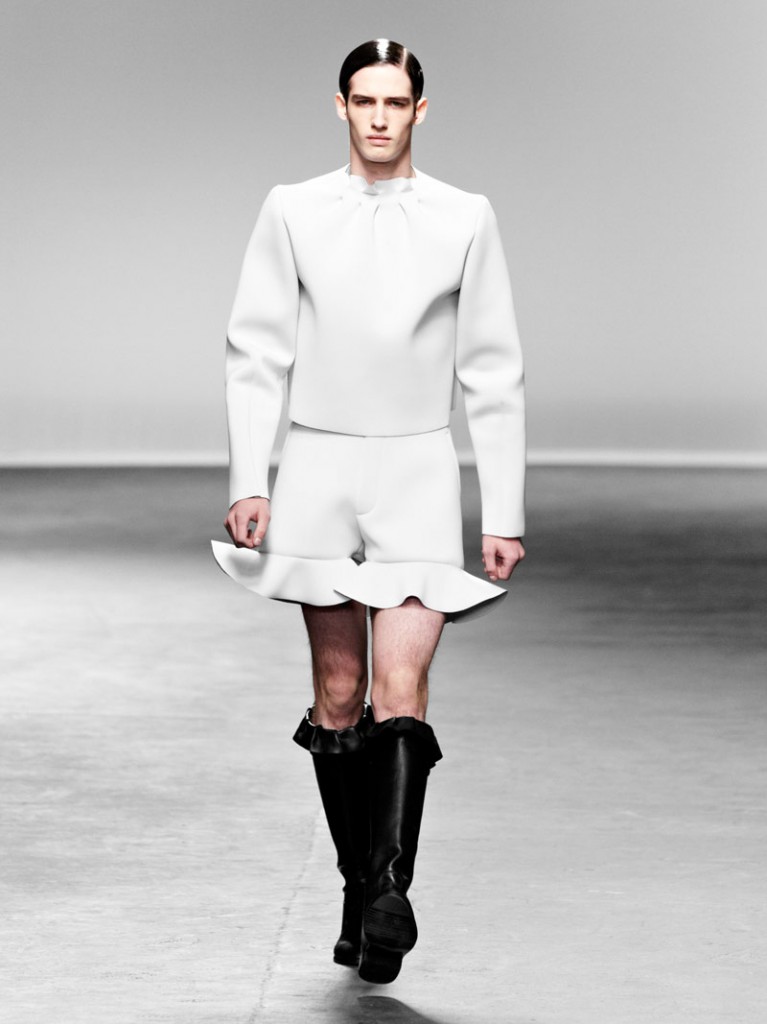
 J.W. Anderson Men AW 13
Fashion Emancipates the Man
The emergence of the Girlfriend Look isn’t about “turning men into women,” according to the young designer Dimitri Arvanitis. In fact, he calls for nothing less than a revolution in the male wardrobe: “men are not nearly as free in their choice of clothes as they think,” the recent Antwerp Royal Academy of Fine Arts graduate says. “It’s time for men’s fashion to become emancipated.”
For Arvanitis this means a fashionable business look with baroque opulence mixed with a hint of the TLC-style 1990s video aesthetic. In his final degree show, minimalist straight-cut blazers, cropped jackets and crop tops meet pleated trousers, short shorts and tracksuits. Severe high-necked blouse collars peep out from beneath box-like, figure-hugging upper layers. Added to these, paintings by Rubens are printed on transparent PVC, and royal blue, ruby and rosé are added to discreet black-and-white, flowing fabrics combined with evening elegance. Generous use is made of animal products such as fox fur, rabbit fur or calfskin.
Yet despite the generous use of feminine fabrics and shapes, what Arvanitis presented was clearly a men’s collection, whose tension lay in the breaking of boundaries between typical male and female elements, and creating something new from the interplay. He succeeds because his fabrics and garments don’t appear as womenswear, but instead make sense as a fashion reference in men’s clothing. “My dresses only look like women’s clothes at first glance,” Arvanitis explains, “but actually they serve as the basic pattern for a classic men’s suit. Only without lapels.”
This is precisely where the difference between travesty and fashion, between clothes-swap and the Girlfriend Look, is visible. Just as women’s jeans in the Boyfriend Look simply reprise the jeans of her partner, they are in fact femininely transformed because they are cut for the female body. And the same is true for garments of the Girlfriend Look. Female connotations, once presented within the context of men’s fashion, are drained of their symbolic power and charged with a new, masculine significance. The required revolution in men’s fashion is therefore an expansion of the canon of menswear in order to help men gain the freedom of fashion, something that has been played with since the dawn of modernity.
In the process the boundaries of gender are dissolved, albeit not completely. Because the new, expanded style still requires the binary system of female and male gender division, tension can only be generated by exceeding the corresponding limits. This also becomes clear in the new muses de jour: Lea T., Casey Legler or Andrej Pejic. They fascinate because they combine feminine and masculine characteristics and evade a clear gender classification.
The fact that social ideas of male or female can be negotiated within fashion changes nothing, of course. The same is true for the fact that these boundaries are becoming ever more fluid and as a result men and women’s collections continue to become closer to one another. So far, a fine distinction remains, at least in terms of the biological barriers of the body.