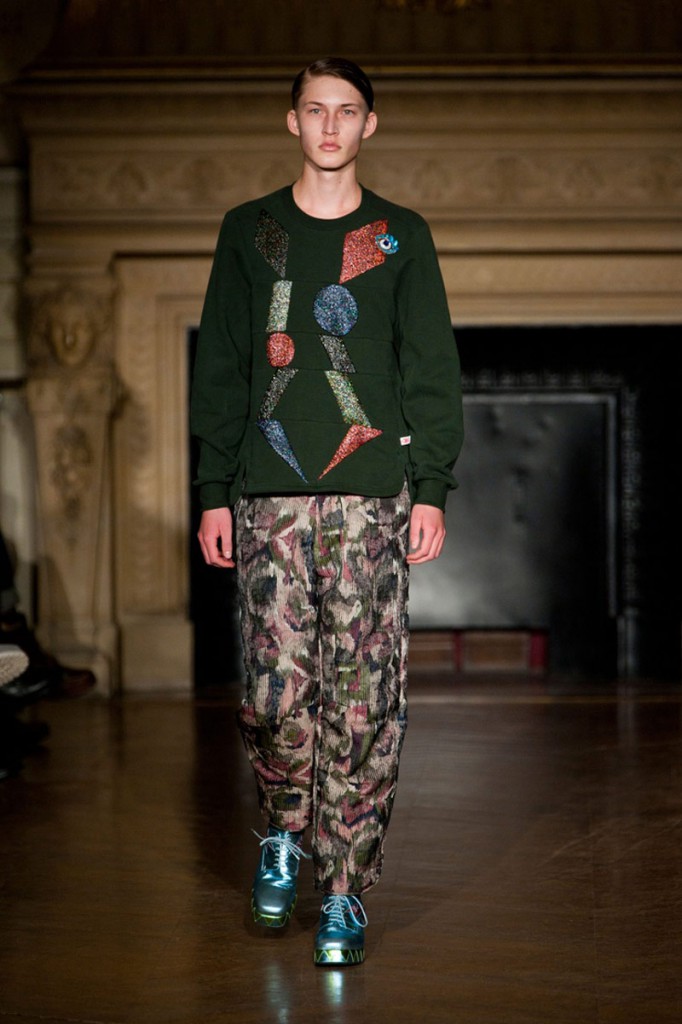
 Walter Van Beirendonck AW13
Unconscious Oppositions
But what is also interesting in this context is that none of the designers mentioned above make a very conscious use of female references. On the contrary: for Arvanitis, for instance, they are but one tool of many. “When I design, I mostly do not even consciously think about whether I am using elements that have a feminine reputation. What’s important is the freedom to be inspired by what I want. And to investigate the question of whether I would wear it myself.”
Christopher Shannon takes a similar view. This Liverpudlian favourite of London men’s shows has already collaborated with Topshop and Eastpak among others, is represented in venerable department stores such as Harvey Nichols and Liberty London, and found a global audience with his jersey line Kidda via ASOS and Urban Outfitters. For him, the work is primarily about creating something that feels new, and represents an opinion. In doing so, he wants to remain faithful to his line. “For me it’s about making work that I want to make, not about an agenda to do with feminising men,” the young designer says, before adding, “I am drawn to elements that may make men feel slightly unsure, but I also think I’m good at making them less threatening – shall we say more desirable or curious.”
Feminine connotations are what could lead male wearers to feel “slightly unsure” and yet also feel okay about themselves. This was the case with Shannon’s acclaimed SS14 collection, which is an homage to his early party years in Liverpool and Manchester. It is characterised by a targeted use of pink and sunny yellow, animal prints and mille fleur, and not least by the colourful, glittery hair of the models.
What is revealed in the attitude of Shannon and Arvanitis? If you don’t want menswear to always fall back upon the same vocabulary, then you need to resort to feminine elements, if not consciously but because it is inevitable. Apart from shirt, trousers and the jacket in all its variations, is there much left in fashion when considering what is “typically male”? Fashion, as we know it in the western world, since the modern era, is a purely female construction. If it is essentially female, one could say that men’s clothing only becomes men’s fashion in the moment in which it differs from the uniform of the suit and when female elements are incorporated.
From Utopia to the Mainstream
The idea of a revolution in men’s fashion – regardless of motive – is therefore not just a fantastic utopia. Ultimately, those collections that stand for a liberated men’s fashion are mainly from younger, lateral-thinking labels, but the tendency is emerging even among established fashion houses; in practically every Autumn/Winter collection there is currently at least one look that clearly includes references to women’s fashion. In this, the major labels aren’t very different from the youngers ones: Hermès showed a pink sweater and Jil Sander showed a sleeveless frock coat reminiscent of the over-long elegant vests currently found across the women’s collections. Dolce & Gabbana, in contrast, presents floral prints and embroidery and Dries van Noten does paisley and sequins. Z Zegna even extends to fetish: here the models wear flat peep-toe boots that help to give the male foot an unfamiliar sex appeal.