 Waterbearer, 1986
Gelatin silver print, vinyl lettering. 149.9 x 203.2 x 5.7 cm. overall
Courtesy the artist; Salon 94, New York; and Galerie Nathalie Obadia, Paris/Brussels © Lorna Simpson
Lorna Simpson’s retrospective at Jeu de Paume presents the artist’s unique work on language and identity
Producing meaning, and the relation between signifier and signified, might be the realm of semiotics, but the pairing of text and image in the iconic work of Lorna Simpson can hardly be contained in linguistic studies. Juxtaposing photographed gestures and reenactments with language, speech or even poetry, Simpson creates meaning in the gap between picture and speech. She sends the viewer on a long roundabout through the semantic fields that she herself sets up, making one aware of their own experience, assumptions, imagination or even ideas about representation. Or, as Okuwi Enwezor put it: “Language is employed like a lever to pry open the lid of the unconscious… much of Simpson’s work is not simply annexed to text/image relationship, it is fundamentally audiovisual.”
A long overdue retrospective spanning some 30 years of Simpson’s work – the first show of this scale in Europe for the American artist – is currently on view at Paris’ Jeu de Paume. Set up chronologically through the museum’s five galleries, the exhibition sheds light on turning points in Simpson’s varied body of work, but also on the thematic continuities in her oeuvre. Her breakthrough works from the late Eighties feature mostly black female figures in white clothing, faces turned away from the camera, or cropped entirely out of the frame. Preventing the gaze from gravitating towards a facial expression creates the gap that allows for meaning to emerge via her crafted texts. Viewed in this context, a work like the 1985 “Gestures/Reeactments” – her first photo/text piece – becomes emblematic of what would be Simpson’s conceptual focus for the next three decades.
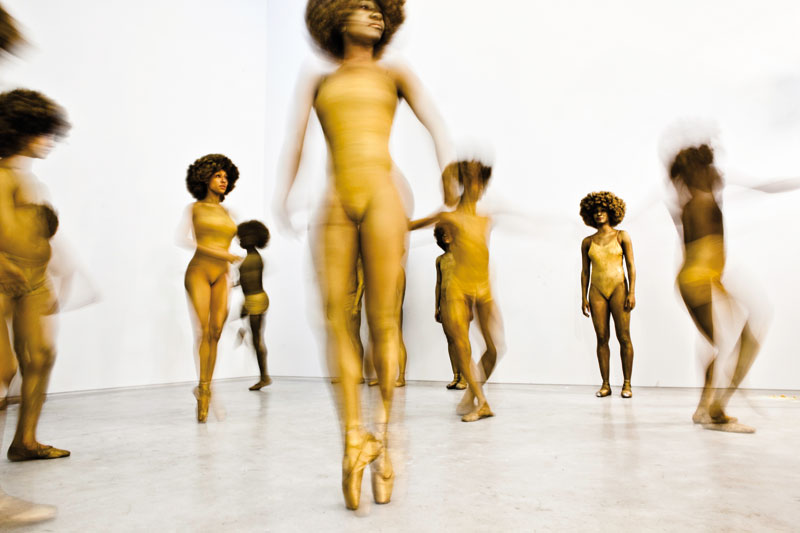
Tackling the complicated representation of the black body in America, Simpson draws on fact and fiction, gender relations, history and memory. In the Nineties, Simpson started printing her photographs on felt and excluding human figures from them entirely. There is some use of metonymy and surrogates for the body while addressing themes of racial and sexual identity (the “Wigs” series, 1994-2006), or spatial glimpses that invoke film noir (“The Staircase”, 1998). Though often mistaken for autobiographical, Simpson’s appearance in her work is actually rare, and mostly performed in the form of reenactment. This show includes two such appearances, which are interrelated. Her extensive work “1957/2009” is an epic collection of scenes restaged from found vintage photos, where Simpson is mirroring both female and male characters, dress and settings and shows her recreations next to the original material. Especially for this exhibition, she created a new video installation that delves further into the technique of mirroring as a (surrealist) form of representation. “Chess”, 2013, shows a five-way portrait of the artist in front of a chess board, making an allusion to the famous portraits of Picasso and Picabia (taken by anonymous photographers) that place the artist in front of two slanted mirrored panels. Staging herself in the video as some of the aforementioned reenacted characters, Simpson creates a complex portrait of herself as an artist.
Lorna Simpson Jeu de Paume, Paris Until September 1, 2013 www.jeudepaume.org