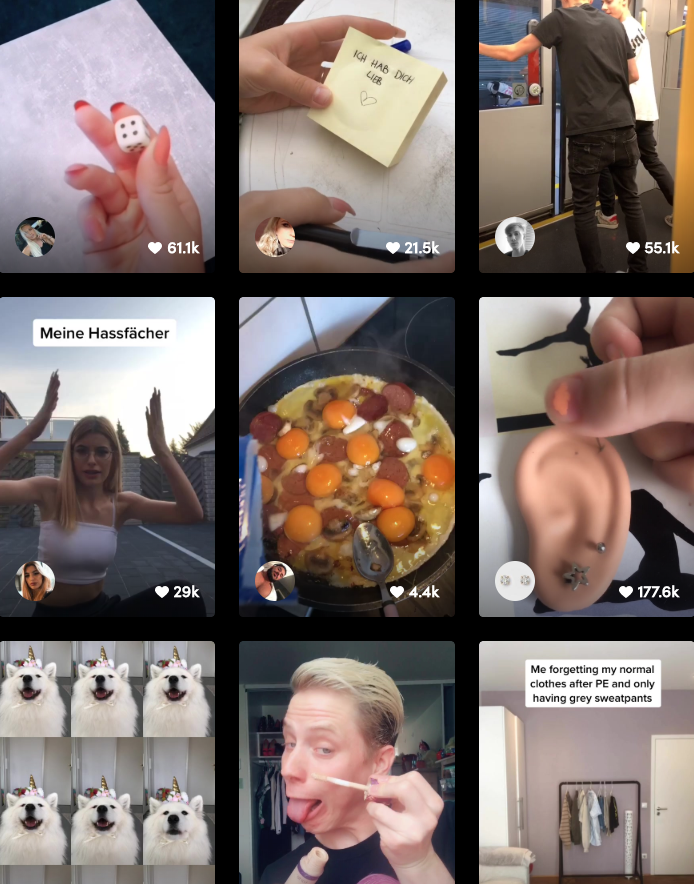
TikTok homepage.
“I don’t blame adults for having trouble understanding current online platforms,” explains 16-year-old Marta Langston, a high-school student from California, whose Instagram bio reads “Hell is a teenage girl”. Nothing about Langston seems particularly out of the ordinary, except for the fact that her videos have been liked more than 2.8 million times on the social media video app, TikTok. “Our generation has been given an environment where news and trends travel quicker than ever before, and it can be a lot to keep up with if you aren’t immersed in it. TikTok is a very new application, and I believe that it will still take some time for adults to fully understand what it’s all about,” she says.
For the technologically confused adults Langston describes, TikTok’s appeal is baffling. The app is absurdly simple in premise: users (termed ‘creators’ by the app) upload videos of themselves, no longer than 15 seconds to the platform—many of which are of them lip-synching to pop songs. That’s all. And yet with more than 1 billion downloads worldwide, and valued at over $75 billion, one year on from its launch last August, young people clearly find TikTok to be very fresh and very enticing.
“After the demise of Vine in 2017, the world of social media was definitely missing something important,” explains Langston in reference to TikTok’s stratospheric rise. And, in order for TikTok to succeed, “Vine had to die,” agrees TikTok star Vicky Banham, who boasts an eye-watering 1.3 million followers and 7.8 million likes on the app. To both Langston and Banham, Vine offered much needed lightheartedness online. Since Vine shut down “the internet has lacked a realistic and genuine form of entertainment,” says Langston. “We all felt it.” The rise of TikTok, therefore, was both inevitable and necessary. “People have mourned the lack of short, unfiltered, unprofessional comedy videos for a couple of years now,” she continues. “A user-friendly app for short videos did not really exist—there was an open spot to be taken.”

Marta Langston's TikTok
A scroll through TikTok makes its appeal a tiny bit more obvious. For those not familiar, the app is an endless stream of lo-fi, messily edited, comedy and music videos—a veritable safe space for users to be weird. What is most apparent, however, is how radically different it feels to Instagram. Where the photo-sharing app populates our screens with carefully curated content—stylised breakfast flat lays, glossy faces and perfect homes—TikTok is slapdash, random, ordinary. Meticulously staged shots of influencers standing in front of hot pink walls are replaced with teenagers in oversized hoodies, swinging their cat in time to the 1954 song, Mr Sandman. It is at once zany and exhilarating; a balm of unfiltered silliness in the face of unbearable Instagram perfection.
In a gleaming online world of filters and Facetune, it’s not too much of a leap to say that TikTok’s greatest strength is its clumsy and unedited aesthetic. “It naturally encourages a carefree and fun environment that I think teens are drawn to,” confirms Langston. “It’s a refreshing change from the anxious strive for perfection that we see on Instagram.” Even the app’s tagline (“Make your day”) lays its intentions bare: its goofy content isn’t designed to promote envy or FOMO, but to generate pure, unadulterated happiness. As Banham says, “Everyone is there for a good time and a laugh. Everyone is, and is allowed to be, different on TikTok, whereas I feel that if you don’t fit a certain style on Instagram it’s not as easy to grow.”
"People have mourned the lack of short, unfiltered, unprofessional comedy videos for a couple of years now."
But Banham’s mention of “growing” calls into question TikTok’s most significant obstacle. Despite its colossal usership, for now, TikTok clings to a potent sense of ‘authenticity’—somehow it hasn’t been entirely infiltrated by commerce in the same way as Instagram has, or at least not yet. “I think TikTok is definitely fun and joyful, but it absolutely has the ability to create careers, and is already doing so,” notes Banham. “People are only now just seeing the potential in TikTok—brands are coming on board, publishers are sniffing around and creating content.” Earlier this month, for example, the US restaurant chain Chipotle launched a #GaucDance TikTok challenge, encouraging users to upload dance routines to Dr. Jean’s Guacamole Song. If the campaign sounds absurd, it’s because it is. And yet, with 430 million video starts in the first six days, the #GaucDance became TikTok’s best-performing branded challenge in the US to date. While Chipotle celebrated (their guacamole sales soared as a record 800,000 sides of the dip were served in one day),TikTok users worried that their safe-haven of inanity was being encroached upon by corporations.
Langston, however, is still optimistic, believing that viewers will reject profit-driven content. “For most of TikTok’s popular users, myself included, this started out as a silly little hobby to cure everyday boredom,” she says. “It’s very important to me that I keep the same intention I began with, which is to have fun. I believe that if my intentions changed to self-indulgence, it would begin to show in my content, and my followers would notice.” One can only hope that Langston is right. While the lo-fi innocence of TikTok is unlikely to last forever, for the time being why not revel in its weirdly addictive nonsense?