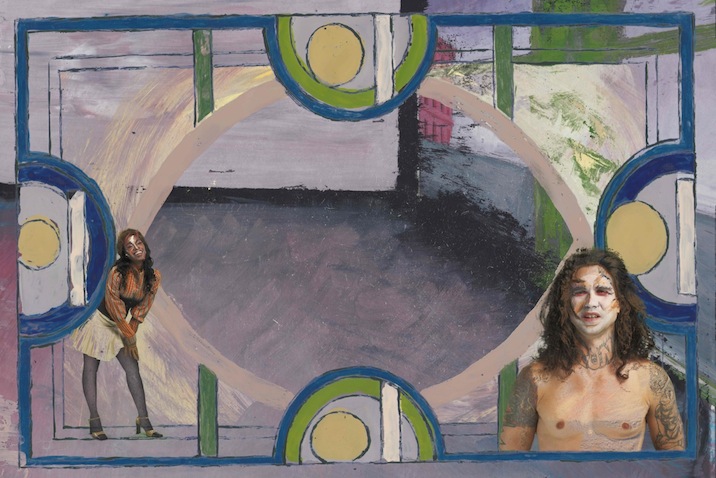
 Juliana Huxtable, Untitled (ASSASSINS CREED II), 2016. Courtesy the artist.
What does it mean to create space, what does it mean to be public as an artist? These are the questions the ninth in the Curators’ Series at David Roberts Art Foundation (DRAF), “Ways of Living” in London asks. Organised by Arcadia Missa who started off as a “self-organised space in austerity Britain” in 2011, the notion of self-organising and institutional critique runs through this exhibition.
Arcadia Missa commissioned recent and new works by young artists, to be displayed alongside 20th century works, borrowed from the David Roberts Collection. I’m reminded of Walter Benjamin’s infamous quote, that there is “a secret agreement between past generations and the present one”. The accompanying text written by co-directors Rózsa Farkas and Zhoe Granger reminds us that the socio-political austerity latent within the new work also has its historical precursors.
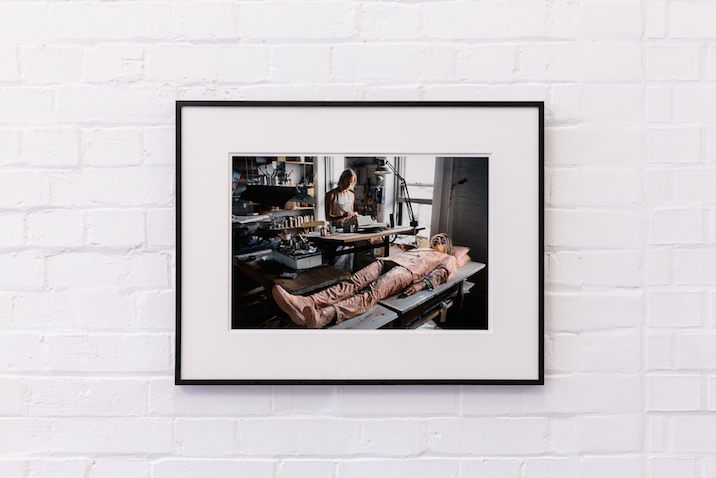 Peter Hujar, Thek Working on the Tomb Figure, 1967 in Curators’ Series #9. Ways of Living at DRAF. Courtesy the The Peter Hujar Archive, Pace/MacGill Gallery, New York, and Fraenkel Gallery, San Francisco Photo: Tim Bowditch. Curators’ Series #9. Ways of Living (15 Apr – 23 Jul 2016)
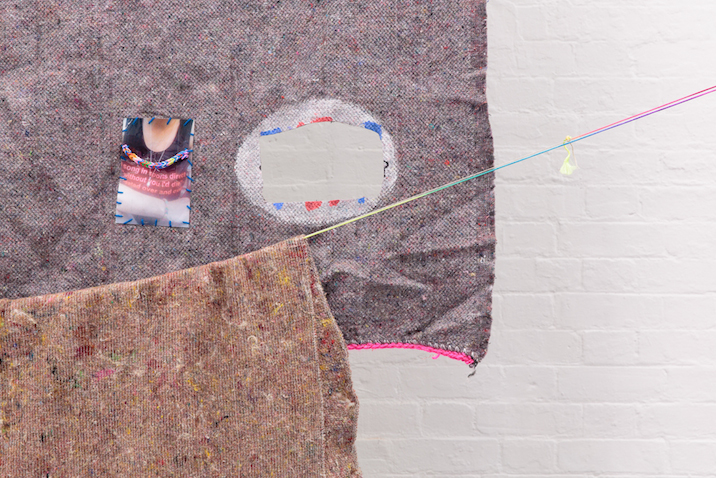 Holly White, Blanket Display (No One’s Going To Go There Anymore), 2014 (reworked 2016) (detail) in Curators’ Series #9. Ways of Living at DRAF. Courtesy the artist. Photo: Tim Bowditch
Curators’ Series #9. Ways of Living (15 Apr – 23 Jul 2016)
However, the continuum and conversation in “Ways of Living” also stems from the way the work is created – driven by collaboration, discussion and an interest in live immediacy. Despite the challenging gallery space – a long corridor – a dynamic discourse between the two sets of work is palpable, as they correlate and gel easily. Beatrice Loft Schulz’s graffiti, which continues from one end of the space to the other, acts as a string, the gesture navigates the spectator from piece to piece. “Untitled (Assassins Creed I)” and “Untitled (Assassins Creed II)”, new work from Juliana Huxtable, is adjacent to Peter Hujar’s photograph of Paul Thek from 1967, “Thek Working on the Tomb Figure”.
Huxtable used her friends as models, encouraging them to derive a sense of character from behaving instinctively to their outfits. This intimate conversation between artist and friend, photographer and model, is also embodied in Hujar’s work. Living and working in 1970s New York, Hujar’s oeuvre has been defined by his immersion in queer and transgender communities. The familiarity and trust within his photographs of Candy Darling, David Wojnarowicz, Susan Sontag, and indeed his partner, Thek, are poignant documents to that era.
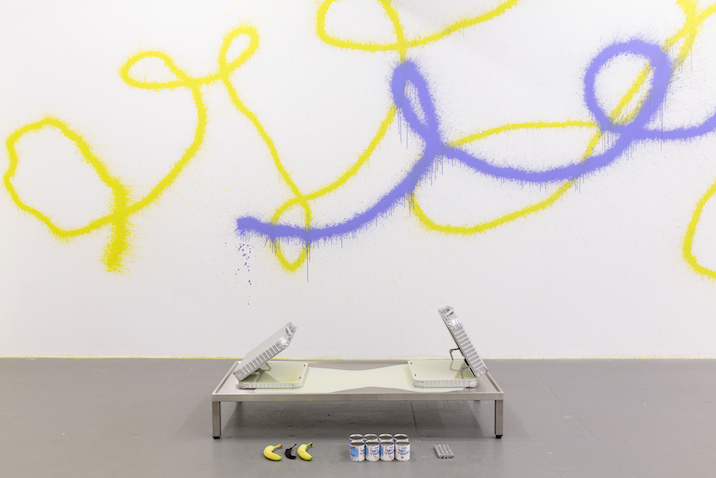 Anne Imhof, Untitled, 2015 and Beatrice Loft Schulz, satin seed stipple arsehole hair plait, 2016 (detail) in Curators’ Series #9. Ways of Living at DRAF. Courtesy Anne Imhof and Isabella Bortolozzi, Berlin / Beatrice Loft Schulz. Photo: Tim Bowditch Curators’ Series #9. Ways of Living (15 Apr – 23 Jul 2016)
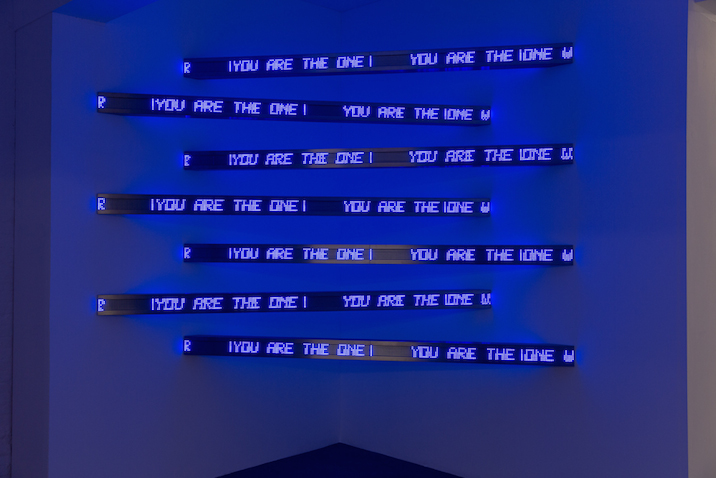 Jenny Holzer, Blue Cross, 2008, in Curators’ Series #9. Ways of Living at DRAF. Courtesy the artist and David Roberts Collection, London. Photo: Tim Bowditch. Curators’ Series #9. Ways of Living (15 Apr – 23 Jul 2016)
Holly White’s video “The Estate Agent” (2014) provides a witty science-fiction take on the government’s demolition of social housing. However, through the absurdity shines critical clarity, evoking the placard in Adrian Piper’s “This is Not the Documentation of a Performance” (1976) exhibited next to it, which warns against the fetishisation of direct action. Jesse Darling’s white washed squat windows evoke themes of alienation and social cleansing. In some ways, the video from Sharon Hayes’ 2009 performance “I Didn’t Know I Loved You”, acts as the theory underscoring the relationship between Darling, White and Piper – reiterating the relevance and impact of showing political work from a past time and place, in the present moment.
The choice of work throughout eschews homogeneity; shifting in scale and material, from the minutiae of Eva Hesse’s small spontaneous 1965 gouaches to Hannah Black’s large steel “Black Quadrilateral” (2015). Jenny Holzer’s “Blue Cross” (2008), an immersive LED installation, encourages us to become aware of the duality of language as both oppressive and potentially liberating. The final work in the show, Adrian Piper, “My Calling (Card) #1 Meta-Performance” (1987-88), reiterates the importance of participatory critique, collective action and safe spaces. Watching Piper call out institutionalised racism reinforces the relevance of the work, and the exhibition overall, in current society. Through visiting “Ways of Living”, one becomes a participant in Farkas and Granger’s encouraging and productive methodology, exploring alternative group shows and new dialogues.
“Ways of Living” is at David Roberts Art Foundation (DRAF), London, until 23 July 2016
Philomena Epps is a writer and publisher based in London