Conceptual art changed what an artwork could be. It could be an instruction, a certificate, an action, or an idea rather than an object made by the artist’s hand. But getting rid of the traditional art object did not get rid of ownership. If anything, it made the question more interesting: can you own an idea?
Rhea Myers came to blockchain with that question already in mind. A self-described Jeff Koons fan, she was interested in how artists create value through names, certificates, ownership, and authenticity—and in what happens when you interfere with those mechanisms. She released 3D models of recognizable artworks for anyone to use, issued a Certificate of Inauthenticity when a gallery wanted something it could sell, and later found in blockchain a system that seemed almost absurdly suited to the same questions.
What Myers found in blockchain was not an answer but another set of rules to mess with. That distinction runs through her work, several examples of which were recently acquired by the Centre Pompidou in Paris. She is interested in technology without buying the stories told about it—whether those stories promise a frictionless new economy or insist that the technology can only make things worse. It is also what makes her take on AI less predictable: she describes its deployment against workers as “class war,” while arguing that the rush to prove that machines cannot think, know, or create may be asking the least interesting questions about them.
For SLEEK, Anika Meier speaks with Rhea Myers about Jeff Koons and the art of making things ownable, putting her soul on the blockchain, why tech hates being laughed at, and what AI has to do with the lies we tell each other.
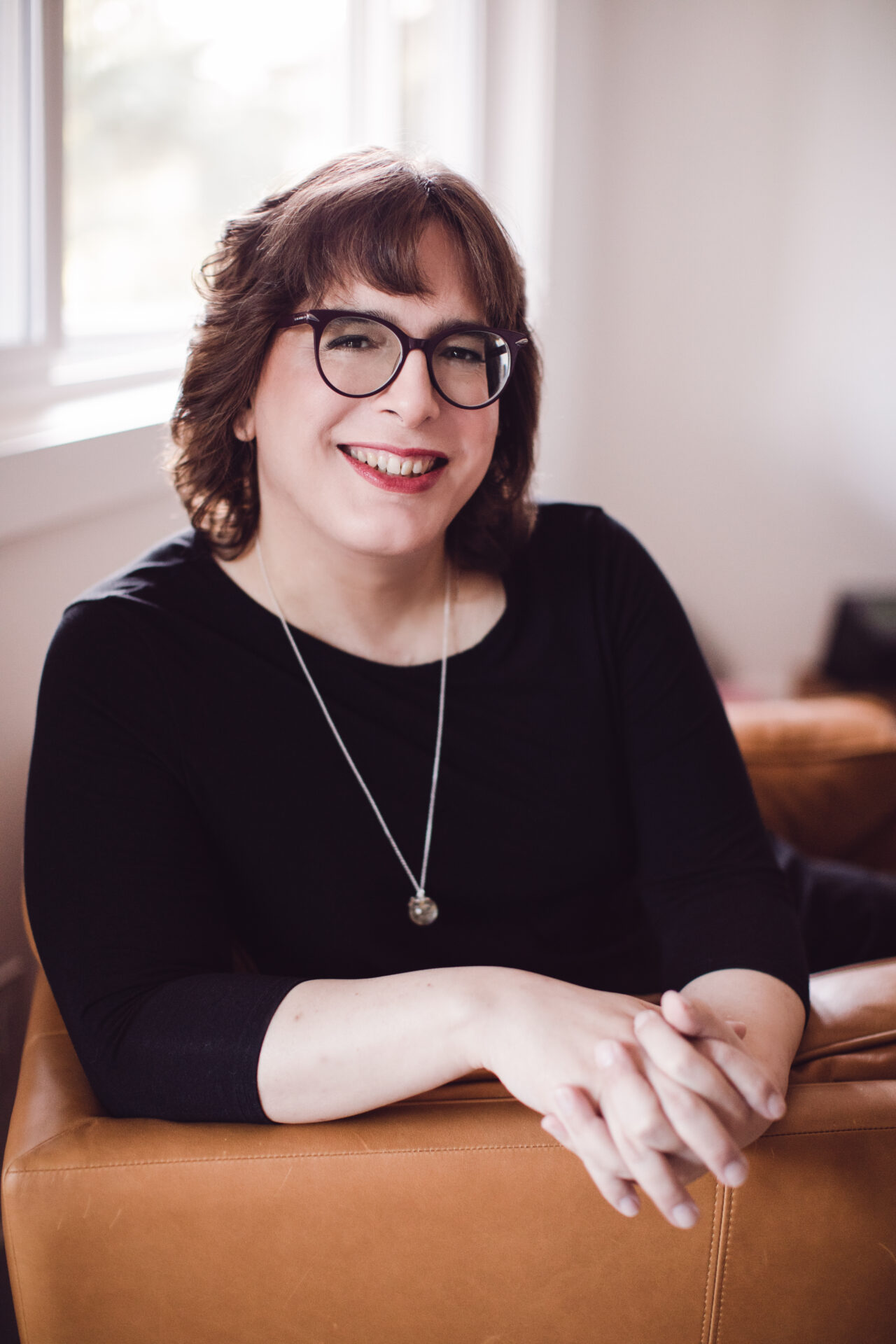
Portrait by Rhea Myers, 2025, Photo by Kristy Powers Photography
ANIKA MEIER Rhea, you make art in order to understand the world. What were you trying to understand when you first became interested in cryptocurrency around 2013 or 2014?
RHEA MYERS The world I was trying to understand in 2014 was the post-financial-crash, post-2008 world in which the government was not holding finance to account—the sort of privatized profit, socialized loss of the not-quite-post-neoliberal order as it mutated into the more nakedly kleptocratic regime we have now. The world I was trying to understand was this “Californian Ideology” world of people who absolutely believed in the lamination of profit and revolution, and how this related to a social order that had not had, and was not going to have, a reckoning with its economic consequences.
So it was a way of modeling this without giving in to easy answers. Because you cannot easily say hyper-financialization is bad while you’re using this monetary technology to do it. And you can’t also say society has failed to rise to this challenge while making art.
AM Your interest in value goes back further than blockchain. Where did that begin?
RM I’ve been interested in value since art school. And, with apologies, I was and remain a big Jeff Koons fan. What fascinated me about Jeff Koons’s work was the way it embodied branding and outsourcing—that very 1980s Nike-style “no logo” model of industry—in contrast to Warhol’s embodiment of a very 1960s mass-production, factory-floor model of representation. That was also the era when dance and rap artists who sampled other music were losing the legal battle against the owners of existing culture. Koons was doing likewise, making it part of something wider than just the art world. Trying either to avoid art as property or to treat it as even more inconvenient a form of property than it actually is in law led me, in the 2000s, to Creative Commons and the free-culture scene.
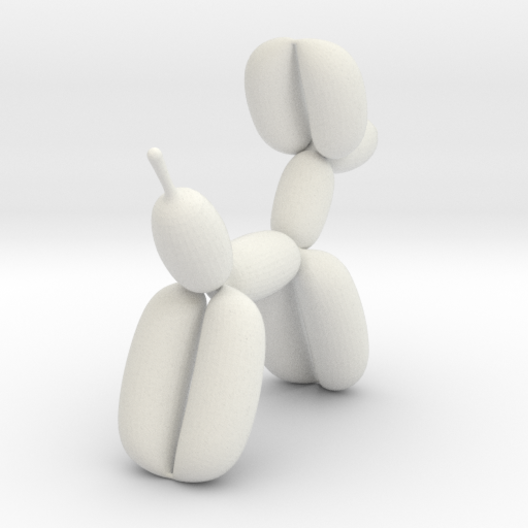
Rhea Myers, Balloon Dog, 2020, Copyright Bassam Kurdali - Licensed under a Creative Commons Attribution-ShareAlike 3.0 International License
AM How did you turn those questions around ownership and value into artworks?
RM I was trying to work through these questions by getting my hands dirty, embodying the way that neo-conceptual artists exploited artisans in order to critique it. So I commissioned some very talented 3D-modelling artists to make models of modernist and postmodernist iconographic objects that had become brands for artists. A balloon dog is something anyone can make, but it’s tied in the public imagination to Jeff Koons. A urinal can be in any men’s bathroom, but in its very expensive, very nice collector’s edition, it’s tied to Marcel Duchamp.
So I was taking this problem of value, enclosure, and representation and saying, “I’m going to act out the role of the evil exploiter of artisans by getting these objects made and putting my name on them. But I’m going to use a free-culture sharing license so that these objects are then returned to the commons.” It was creating this spiral of value, enclosure, and reputation that represented what I saw as being at work and at stake in the rise of art fabricators and their relationship to the long shadow of neo-conceptualism in the era immediately before that.
AM But then someone actually wanted to sell the artworks.
RM Furtherfield, the awesome art-and-tech-and-social-change gallery in the UK, wanted to have some for sale at an event. They were going to 3D-print them, which the license allows you to do, and wanted something to go with the prints. So I found a Sol LeWitt Certificate of Authenticity on the internet, printed it out, took some Tippex, whited out all the relevant parts, and wrote my name and what the work was in Sharpie. Then I gave that to Furtherfield as a certificate of inauthenticity.
So it went from “I’m making this thing completely unownable” to “I’m making an ownable proxy for it,” in the way that conceptual art had over time.
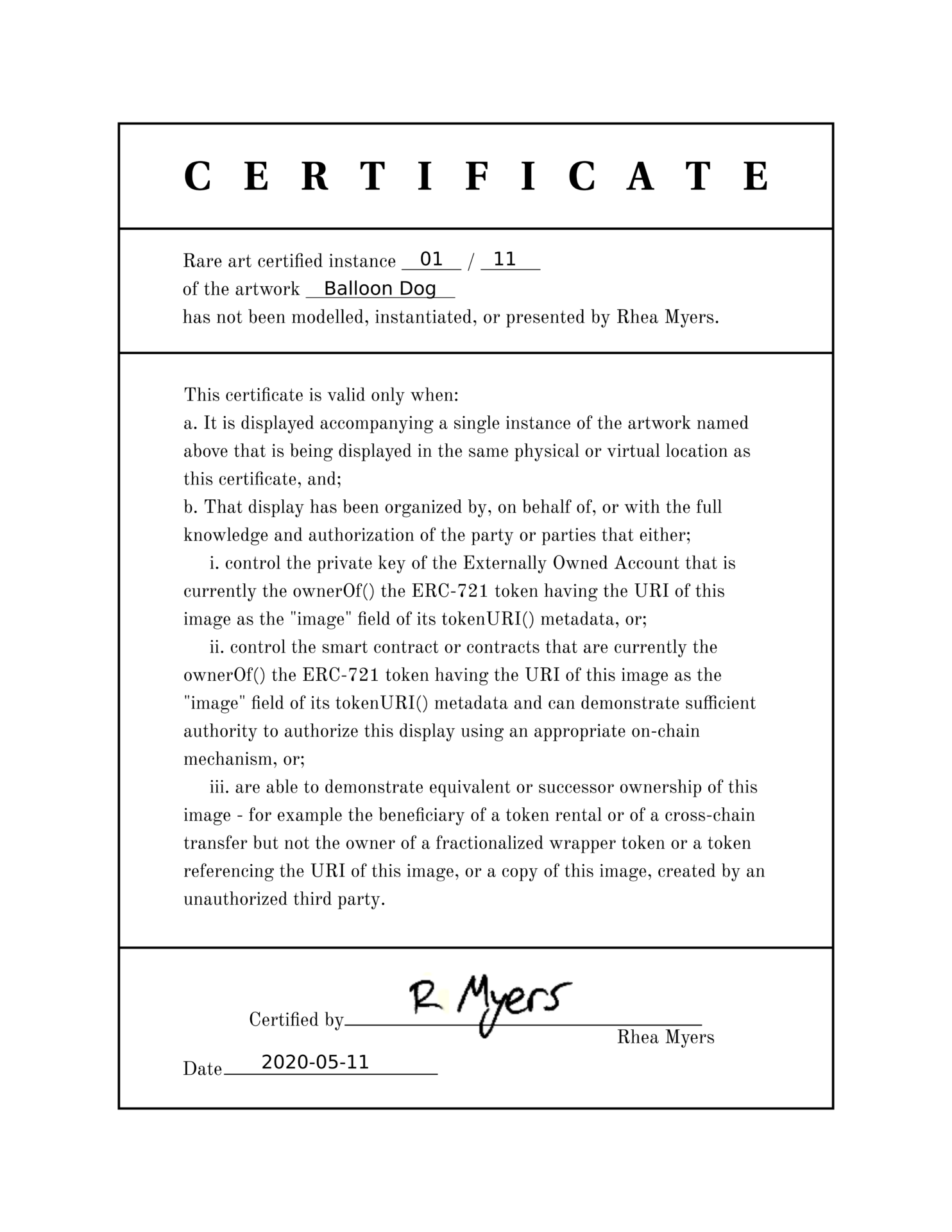
Rhea Myers, Certificate of Inauthenticity (Balloon Dog 1/11), 2020, Image Copyright Myers Studio Ltd.
AM And then blockchain gave you another way to complicate the same problem of authenticity?
RM A few years later, when people worked out that you could very easily register the Mona Lisa as your NFT, they became very upset about the problem of authenticity rearing its head again on the blockchain. The blockchain is meant to have this sort of mathematically absolute idea of identity and provenance, and this seemed to break it. That was a really irresistible resource to reach for and go, “Okay, I can be an even worse person than I was in the last two iterations of this and register it on the blockchain.” But that would have been too easy.
So instead I did the mathematical-proof thing of taking the opposite problem in order to prove that the actual problem can’t be solved. So, certifying the inauthenticity itself and running with that was fun.
I was very relieved when some very professional lawyers did a model law for DAOs—decentralized autonomous organizations—and the language they used for how you handle a chain fork, where a new coin splits off from an old one, was quite similar to the language I’d put in my joke contract for the blockchain Certificate of Inauthenticity.
AM So the joke is never only a joke in your work?
RM It’s never a dunk. It’s never pointing and laughing. There’s always real work being done at each level of the artwork. That real work isn’t always necessarily the work that’s going to make numbers go up or make for easy conversations at social events.
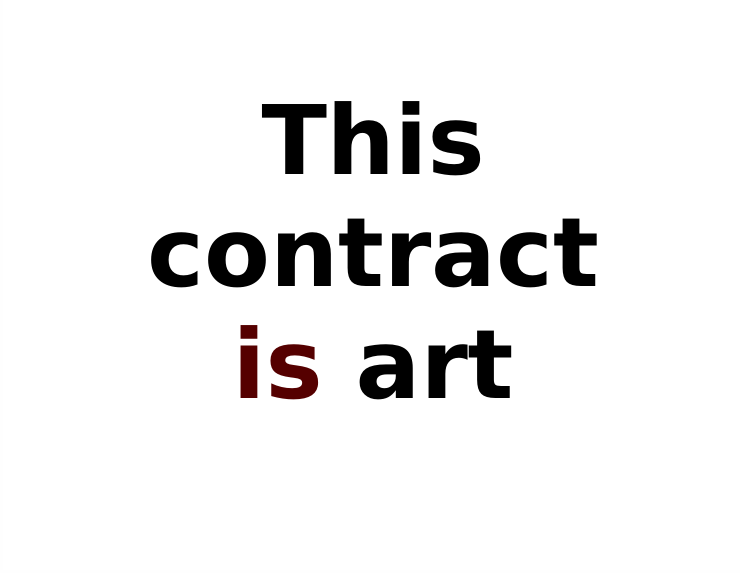
Rhea Myers, Is Art, 2014, Image Copyright Myers Studio Ltd.
AM You’ve been talking about ownership, authenticity, and the rules that determine what can exist on-chain. So who ultimately has more authority: the artist or the protocol?
RM Authority is a word with lots of meanings. Something can have authority in one context and not in another. In terms of what goes on the blockchain, the protocol has absolute authority. You cannot get something on the blockchain that doesn’t obey its protocol at a mathematical level. With Ethereum and Bitcoin, if the code won’t run, it’s rejected and doesn’t go on the chain. That’s the sort of easy, binary, pass-or-fail view of reality that software development inspires.
So, with the protocol as the authority over what can be expressed at the mathematical level on-chain, the artist can attempt to assemble sufficient authority to work in the gaps of that. And that’s true of any given system of authority, whether it’s the church, the state, bourgeois society, nonprofit gallery land, or a tech meetup. These are all contexts in which one’s authority as an artist, or a mathematician—not in my case, obviously—or someone with experience or a given reputation may or may not amount to anything.
AM Where does your own authority as an artist come from, then?
RM I cannot become a billionaire. I cannot set up an army. I cannot be elected president of anywhere. So those media of authority, those different meanings of authority, are denied to me. What I do have is the trickster’s ability to pretend I have authority and to fake it until I make it, and then exploit that appearance of authority to try to have an actual effect in the social realm.
AM Is that also what you were doing when you started putting things on the blockchain—borrowing the authority of the technology?
RM Yes. I don’t have the social or economic authority to change the rules of Bitcoin or Ethereum successfully. If I tried a fork, nobody would use it. But I’ve placed enough of my history on-chain and in this area that if anyone says, “You have no authority here,” I can say, “Well, I have history. I have a reputation.” Because my placing things on the blockchain originally was saying, “Well, this is advertised as an incredibly secure system, and that’s its authority. Its authority is that anything on it is secure, for an interesting value of ‘secure.’”
So I was trying to steal or imitate that authority, or get it to delegate it to me, to say, “By the power of the blockchain, I declare this to be true or real.” And I’m kind of still doing that.
AM And what can an artist do with that borrowed authority that the people actually controlling these systems can’t?
RM The authority in tech is very much private equity and venture capital versus state regulation. I’m neither of those things. But while capital is still being sunk into these systems, I can try to keep things that it would otherwise destroy in existence, keep them open and moving. My political reason for continuing to make art is that it opens things up. Not in a naive way, in an engaged way—sharing it prevents cultural closure. There’s always a “yes, and…” from art to any attempt to say, “Okay, everyone’s on Facebook now, game over.” So being able either to take delegated authority, which is very much my work, or to imitate authority, in a Yes Men style, is, for me, a strong way of doing a judo throw of techno-capital’s immense weight against itself.
Tech hates when you laugh at it. It hates it even more when you laugh with it and then do something else.
AM So from the beginning, you were trying to avoid both the hype around the technology and the instinct to dismiss it?
RM I wasn’t very excited about how much money buying the correct token would make early adopters. I do like money, but I’m very bad at choosing the right horse to back at the races. And for people for whom each new technology is the worst thing ever, it’s like, “That’s fine, but I know you’re going to say that, so I don’t need to ask. You’re not explaining anything.” So I was trying to walk this very tightrope between an uncritically critical affect, where it’s like, “I don’t know what the question is, but the answer is technology is bad,” and uncritical boosterism for technology that lots of people were trying to hype up to make money from. That just made me unpopular with everyone, so that was fun.
AM You’re being sarcastic when you say that was fun.
RM I’m being sarcastic, but I’ve also kept my sanity by regarding myself largely as an embedded anthropologist. When I’m working in tech—I don’t know if you’ve seen the American comedy Silicon Valley, or any of the memes from it, but despite being fiction, it is functionally a very accurate documentary about what it’s like to work in tech—there’s this irrationality of “we’re going to change the world and get rich, and get rich and change the world.” There are so many economic, psychological, and political contradictions that tech workers have to resolve for themselves in order to turn up each morning and not go, “Hang on, what am I doing?” I’ve tried to watch that happening from one remove, and to watch the crypto faithful similarly, without getting swept along too far myself—while paddling around on the treacherous waters of these ideologies in my little creative coracle going, “Okay, I’m going to make art about this. Maybe we can talk about it.”
That’s a horrible metaphor, I’m sorry. You can tell an LLM didn’t make it because it’s so bad. No AI would make such a bad metaphor. But that attitude of irony has carried me all the way through.
AM But that distance doesn’t mean that you see yourself as standing outside the things you’re observing?
RM It’s not a way of remaining above or superior to anything, no. The irony touches me as well. I was making art about secret identities and about things that the person they apply to cannot know. This was getting more and more intense, up to the point where I realized I was transgender and deeply in denial, and I transitioned. The work didn’t help me figure it out, but the secrets I had kept from myself were clearly a driving force behind some of those obsessions. Looking back at it, I feel not embarrassed but amused and sympathetic toward myself. My subconscious was clearly screaming at me through the work: “Look at these things that aren’t authentic or real! There’s a secret! It’s to do with who someone is!” It’s all there in the work, but in a distanced way. It didn’t quite work as a Chekhov’s gun for me. It was something I had to work out after the fact rather than something the work helped me with.
AM What does maintaining that critical distance allow you to do?
RM It certainly doesn’t give me a view from nowhere. It’s more about not signing up for any single easy viewpoint. It means actually having to do the work, which is economically inefficient and doesn’t make friends as easily, but feels more worthwhile to me.
And that relationship to the subject matter still comes through in the current work. It has the blockchain-explorer feel of Secret Artwork or Blockchain Aesthetics. It has the hashing of something like Facecoin oder One Doge Equals One Doge.
And the thing I haven’t talked about is this “dark precursor” quality of One Doge und Portents.
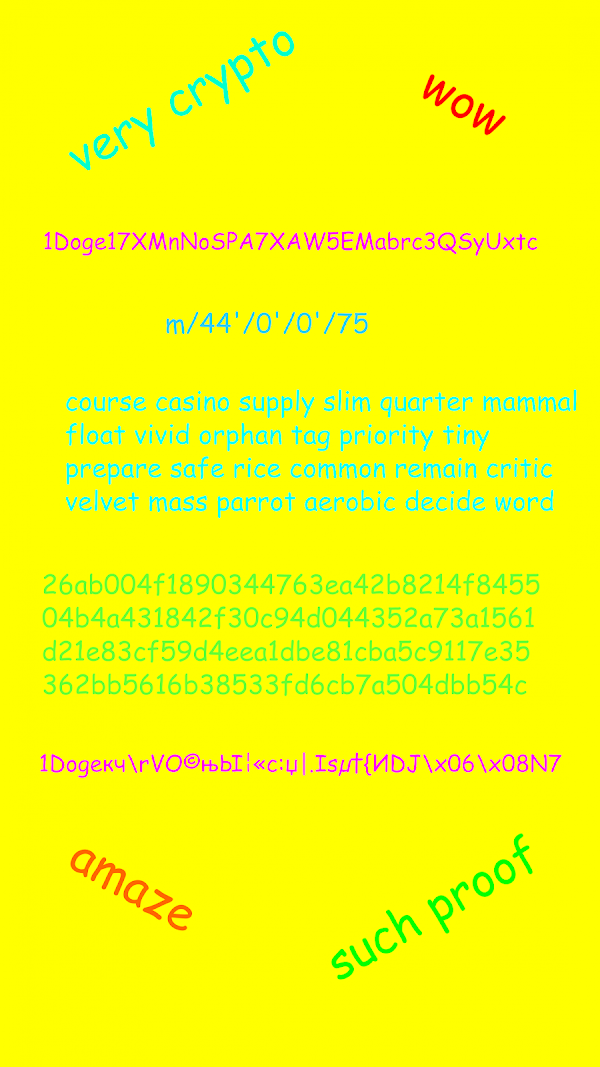
Rhea Myers, 1 Doge = 1 Doge, 2021, Image Copyright Myers Studio Ltd.
AM You understand the technologies you work with from the inside. You studied art and technology and then spent years working in tech before you began making some of your earliest blockchain works. How did that combination of art and technology develop for you?
RM I was a kid during the home computer boom in the UK in the 1980s, so I knew computers were a thing you could just use. I also knew that computers could be used to make art, which was not a common opinion at the time. I went to art school in the 1990s specifically to use computers to make art, and very quickly got massively into the history and theory of art. I became obsessed with Art & Language and their sort of grumpy-Marxist, historical-materialist view of art history. When I graduated, I realized that I didn’t really have the people skills to go into the London art world at that time. So I went into tech. I’d done an art and technology MA and knew as much Java as it was possible to know at that time, entirely by accident. And because the web was becoming a thing, the fact that I knew graphic design from my art background meant that my lack of any kind of tech CV didn’t hold me back. So I worked in web technology, then in games, then in prepress, then in remote desktop software. During that time, net art rose and fell, and I kind of missed the point of it.
When I moved to Vancouver to be with my wife in 2013, I couldn’t work for a while, so I had lots of spare time to go to events. The events I found most interesting were the cryptocurrency ones. Dogecoin was new then, and I recognized the fire in the eyes of the people in those damp, dark basements explaining how they were going to get rich and change the world. I thought, “Oh, I recognize this from the net art era in London, but I didn’t really understand what was going on then. So I really want to understand what’s going on here.”
AM And making art became your way of understanding the technology?
RM I’m not a mathematician. I’m an art student. The first time something like the Bitcoin white paper said, “Okay, we’re going to use a cryptographic hash,” I was like, “What is that?” So I had to make good on my old stated principle that I make art to understand the world. Something like Facecoin was very much me explaining to myself how Bitcoin works, and Blockchain Aesthetics was me getting a feel for the vast scale of mathematics, network activity, and human exchange behind something like the Bitcoin network. It was a way of turning it from an invisible mystery into a visible landscape.
AM What changed for you when Ethereum arrived?
RM When Ethereum came out, I thought we could, if we wanted to, model all of the art world using this medium. I started with a simple conceptual artwork, which was a contract that does nothing, because obviously the least you can do or own is nothing. From there, over the next few months of work, it went through a catalogue raisonné, art shows and art institutions, and generative artworks that could sell themselves.
While I was getting a sort of artwork registry going on the Ethereum pre-release testnet, Monegraph, by Kevin McCoy and Anil Dash, came out. But I had that ego reaction of, “Oh wow, I was a few weeks late.” Which is very familiar in technology, but for art, it’s the wrong timescale to be thinking on. We’re meant to be looking at years or centuries. So I just kept doing what I was doing, using smart contracts as my unit of expression. I made contracts to model aesthetic properties or relationships between people, all that kind of thing. And when actual, factual NFTs happened, I wasn’t quite blindsided by that.
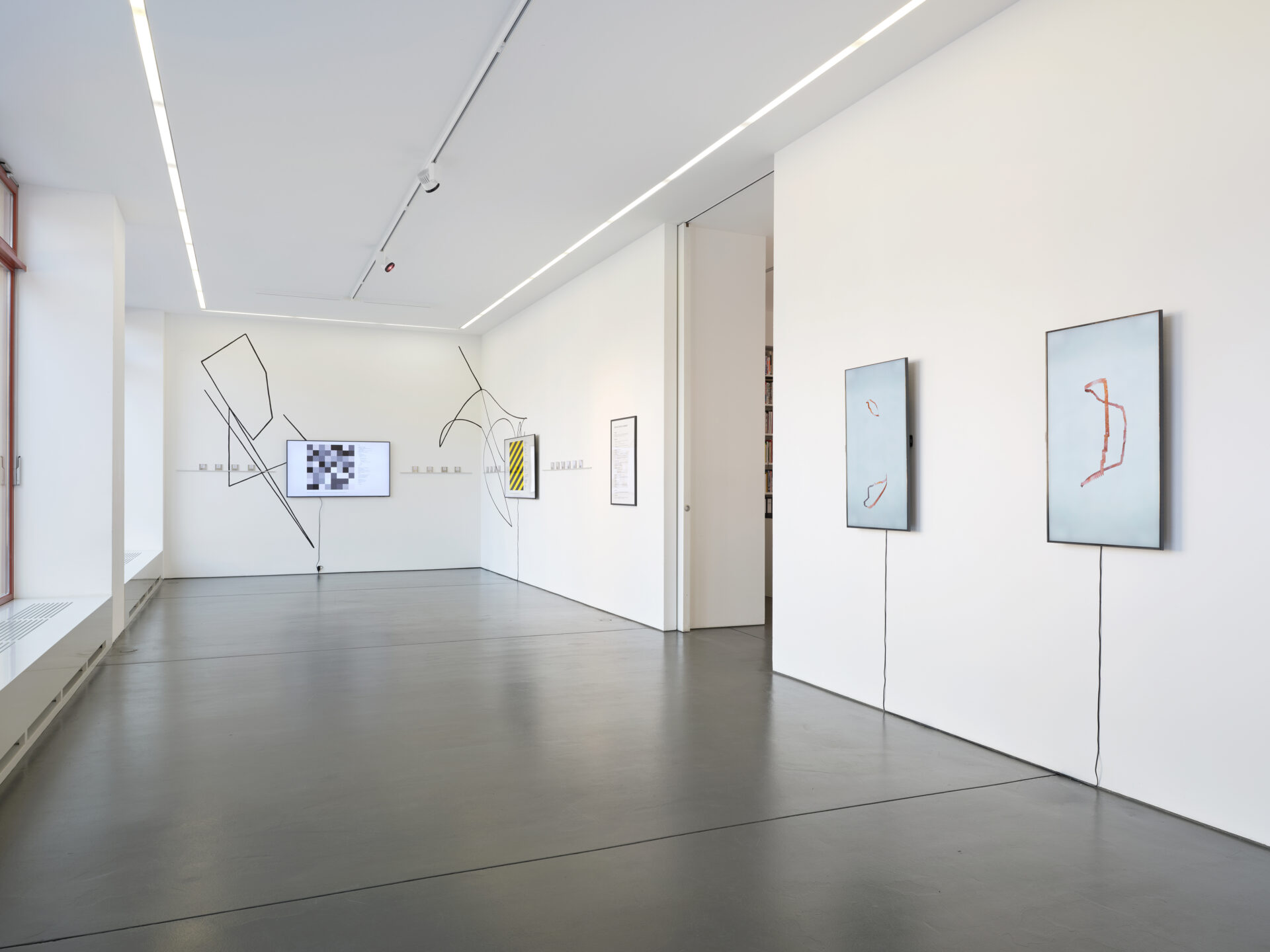
AM You said you weren’t blindsided when NFTs took off. But around 2018, you realized that an actual blockchain art world had emerged alongside the one you’d imagined several years earlier. What made that clear to you?
RM I was doing a launch event for Artists Re the Blockchain (2017) at a space in Vancouver, and at the last minute the promoter said, “Can the people from Dapper Labs talk about CryptoKitties?” And I was like, “Sure.” There was this massive audience there for CryptoKitties—cute cartoon cats that were the first big cultural crossover crypto-collectible NFTs—and lots of them left before I started talking about, “Hey, let’s make art with individual smart contracts.” The CryptoKitties guys were awesome, and it was the week that CryptoKitties, quote, “broke the Ethereum blockchain,” end quote. But seeing that much greater interest in something that was leaning into “This is an economic token. This is a way of representing property and value,” rather than my Euro-lefty art-world approach of “capitalism is bad, let us not try to capture value,” took me a while to take on board.
I had to work out how to use that technology in a way where I didn’t feel I was bandwagon-jumping. It wasn’t, “Oh wow, NFTs are big, let’s make an NFT.” It was, “Okay, NFTs are big. That’s interesting. How do they work? How do they map onto wider cultural concerns? What can I do with this?”
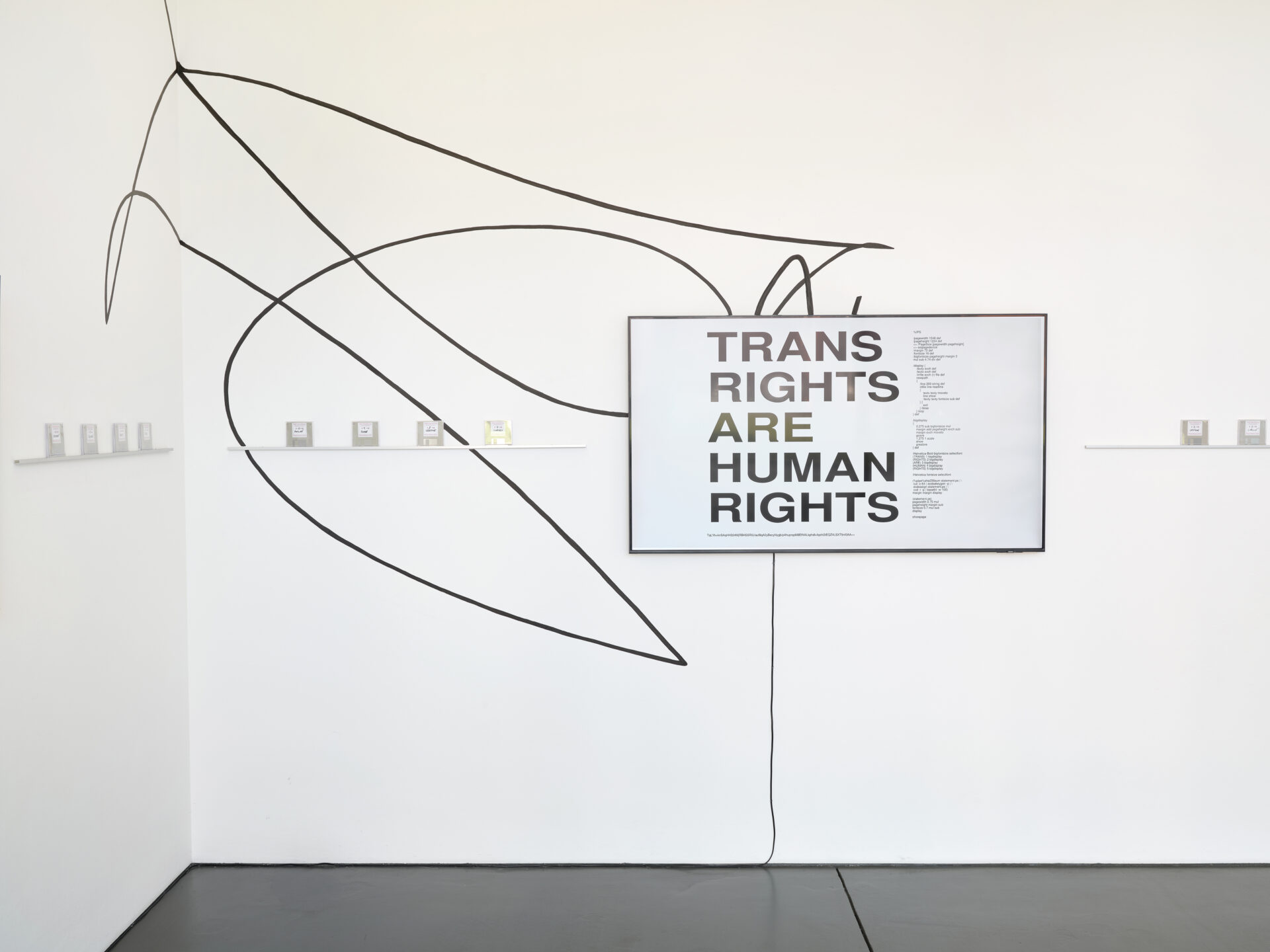
Rhea Myers, “statement” from the series “Self-Identifying”, 2025 Exhibition view “The Fractionalized Phallus”, Galerie Nagel Draxler, Berlin 2025. Courtesy the artist and Galerie Nagel Draxler. Photo by Simon Vogel. (acquired by the Centre Pompidou)
AM You were part of a SuperRare exhibition in New York this September that looks back at five years of NFT art since 2021. Isn’t it strange to be talking about a retrospective of something that still feels so recent?
RM It’s wild that we’re already at the point where we can do a retrospective show about NFTs. It’s five years on from everyone realizing that NFTs existed in 2021. Some people have stuck with them, and some have moved on to other things. But internet time is fast. I think there’s the old joke that a month on the internet is a year in real time, or whatever. If we accept that very 1990s idea of accelerated hype, then five years is a long time. It’s long enough that we can do something historical with it.
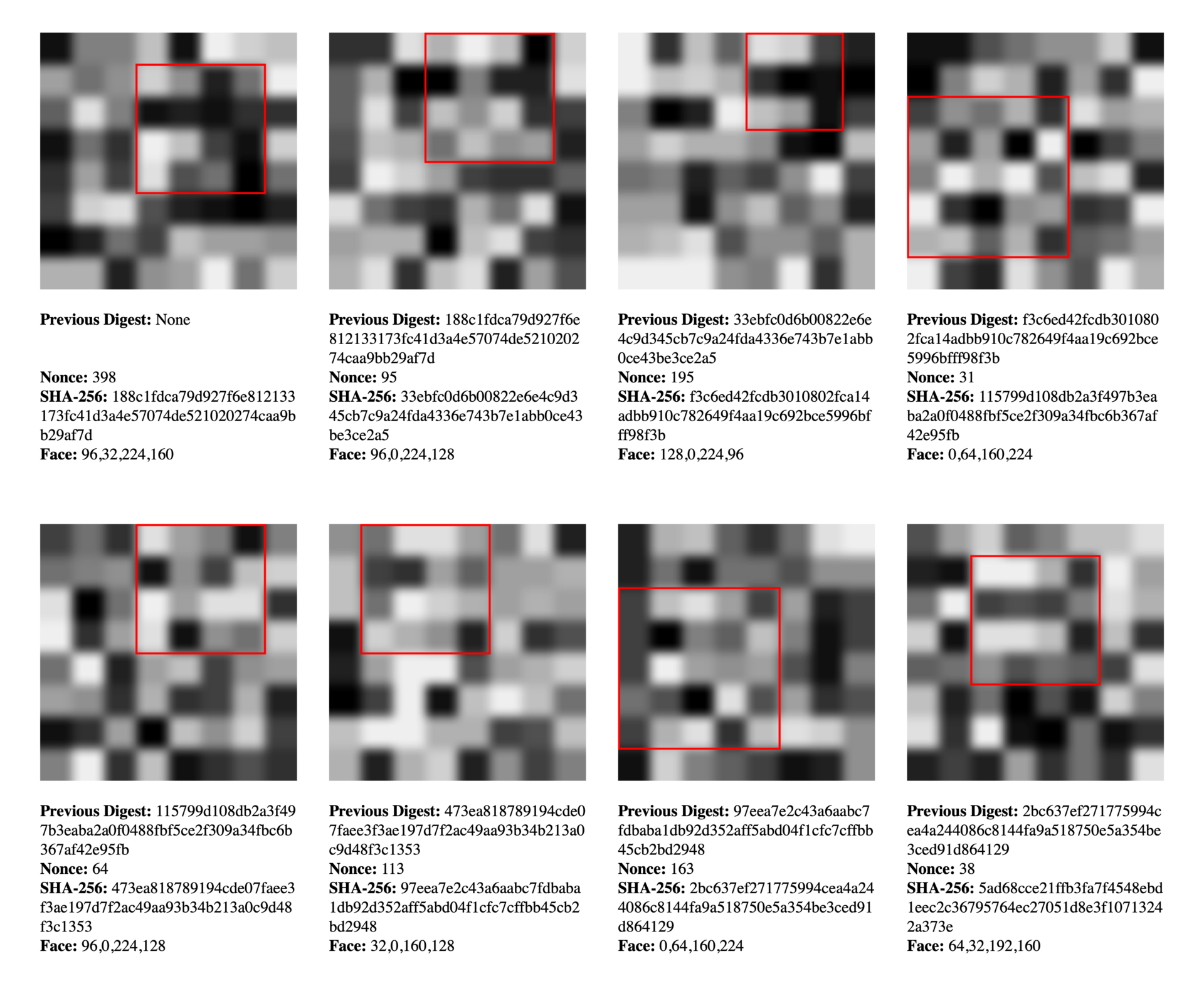
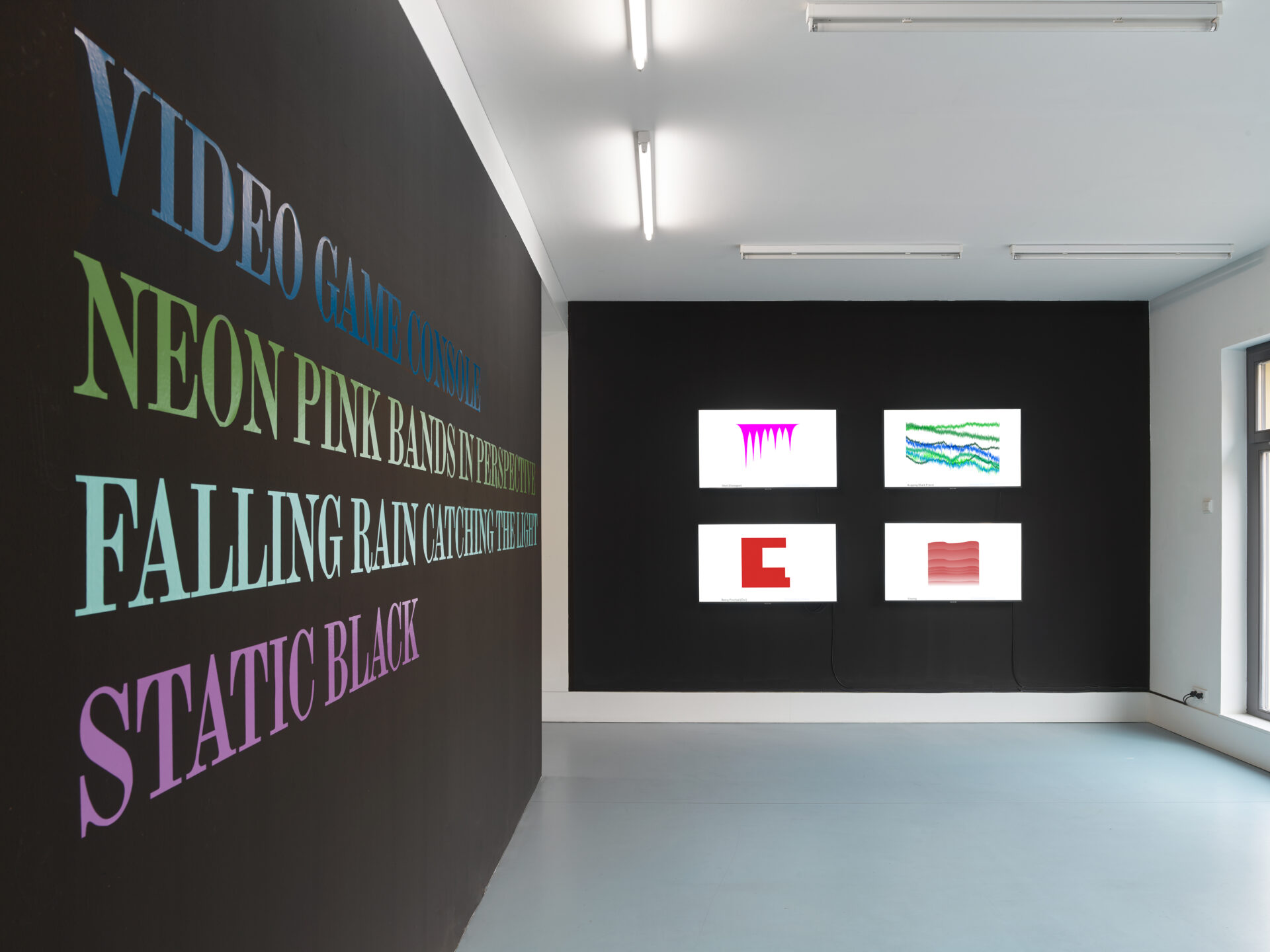
My work in the show, like many of my projects, started with a very bad joke. The curators told me that for the exhibition, you could show existing work or make something new. You didn’t have to rehash old ideas. So I thought, “I’m going to literally hash my old ideas.” I went back to my older work and fed the names and descriptions through cryptographic hashing algorithms, searching for interesting coincidences in the results.
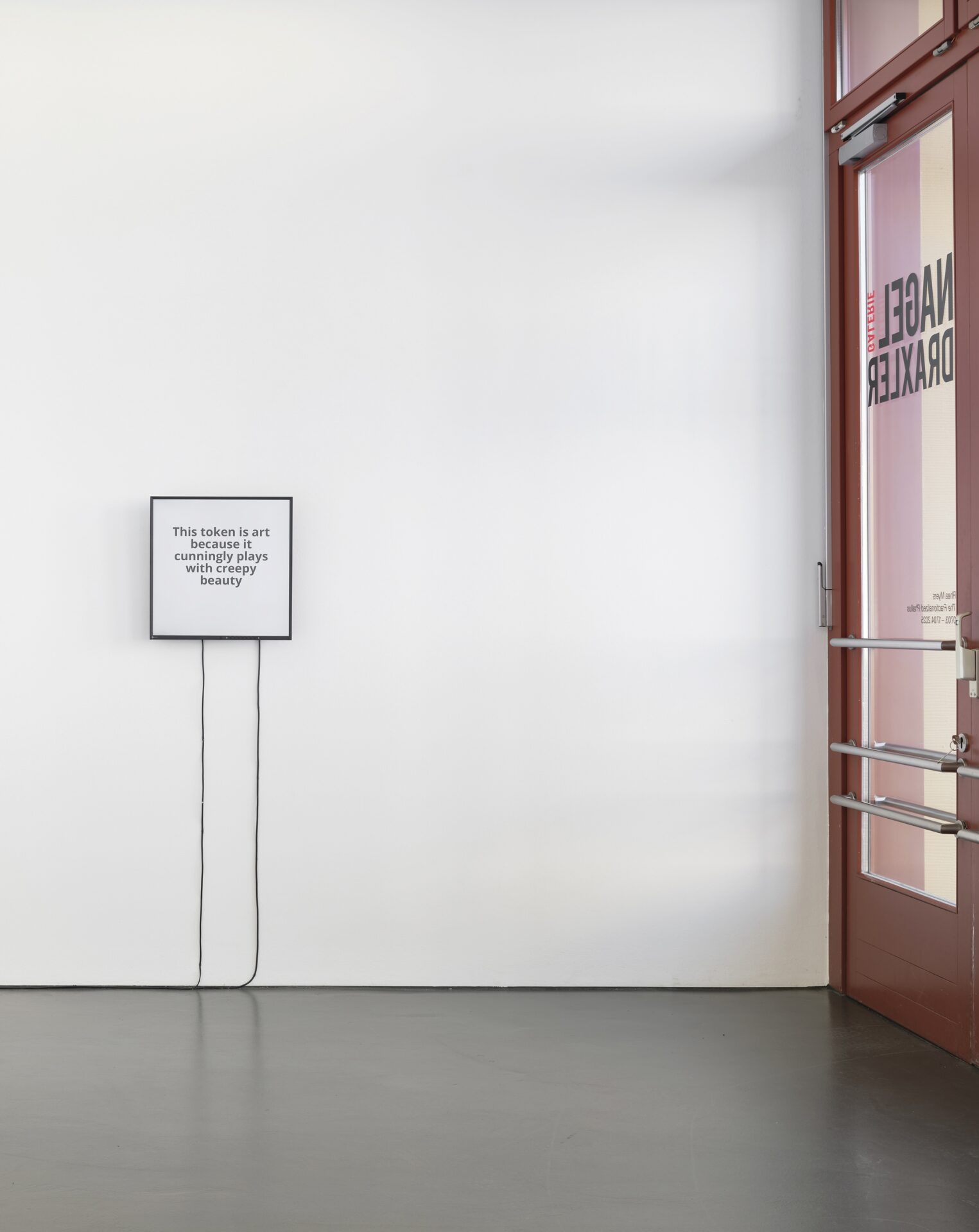
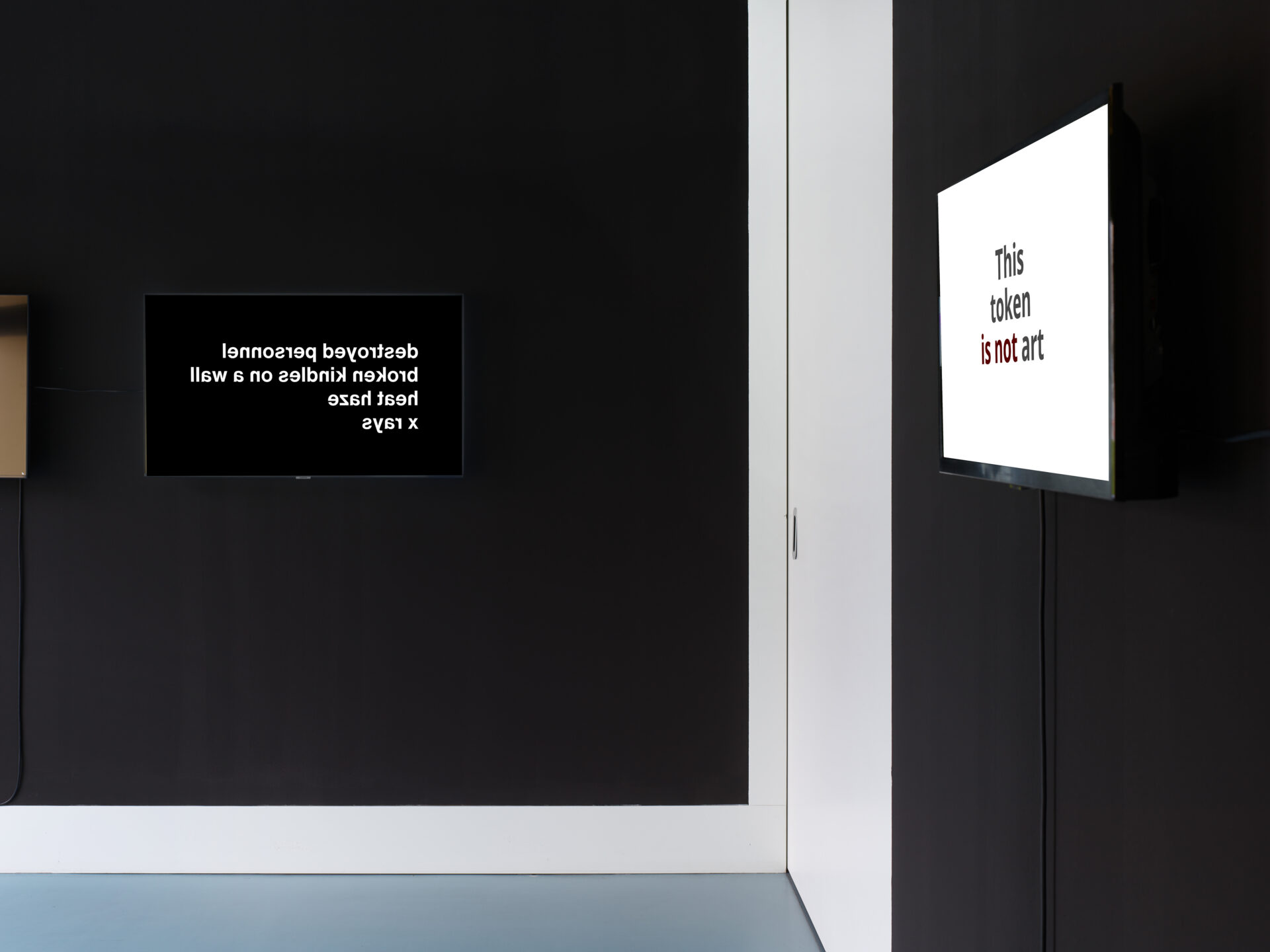
Rhea Myers, “Is Art (Token, because)”, 2025 Exhibition view “The Fractionalized Phallus”, Galerie Nagel Draxler, Berlin 2025. Courtesy the artist and Galerie Nagel Draxler. Photo by Simon Vogel. (Edition 2 from this series got acquired by the Centre Pompidou)
AM Before we go further, what exactly does it mean to “hash” something?
RM For our normal readers with lives, a cryptographic hashing algorithm is something that creates a magic number that identifies a piece of data uniquely and unguessably. It’s absolutely key to how cryptocurrency works. It’s also how Bitcoin uses all the electricity that it uses to secure itself. Lots of different computers compete to solve a mathematical puzzle every ten minutes or so, trying to find longer and longer strings of zeros in very, very long numbers. It’s sort of completely the wrong way to use a computer, but it works for what Bitcoin uses it for.
What I find evocative or, shall we say, ontologically interesting is that you have so many computers around the world constantly doing this. Whether they’re securing your web browser connection, pushing your Git code to GitHub, sending a Bitcoin transaction, or mining Bitcoin, these hashing algorithms run many times every fraction of a second, and yet we don’t really care about them. Their output is meant to look random, which also makes them fun for puzzles and for making art, because generative art is nothing without randomness.
AM Why are these coincidences interesting to you?
RM It’s one of the tricks in my toolbox. I’ve called it “hash gematria”: rather than adding up the letters in a word and looking for coincidences that way, or using bibliomancy or something, you hash a statement or a word and look for coincidences in the results.
In that sense, the work is very much an allegory for what I’ve been doing throughout my practice: misusing cryptographic protocols to suggest to people that there’s something interesting there culturally or aesthetically, while also showing the more crypto-minded people that there’s something of value in the aesthetics.
The work was going to be called Rehashed, but that was too on the nose. So now it’s called Grinding.
AM But if the work is essentially about relationships between numbers, how do you make that visible?
RM I described the aesthetic as Swiss design, plus the HAL 9000 displays from 2001, plus infoporn graphics—the most serious, sophisticated, and visually engaging styles of presenting something to a viewer as information rather than as a composition to be appreciated purely aesthetically. It’s trying to present these ridiculously big numbers and the coincidences between them in such a way that the visual aesthetics remain separate from their mathematical form: the candy shell for their informational payload. The reason for doing that is to drive home something that I don’t think I’ve always been successful at getting across, which is that the aesthetics are contingent. They’re a way of presenting the actual form and composition of the work, which lies in the relationships between these unlikely objects in cryptographic space.
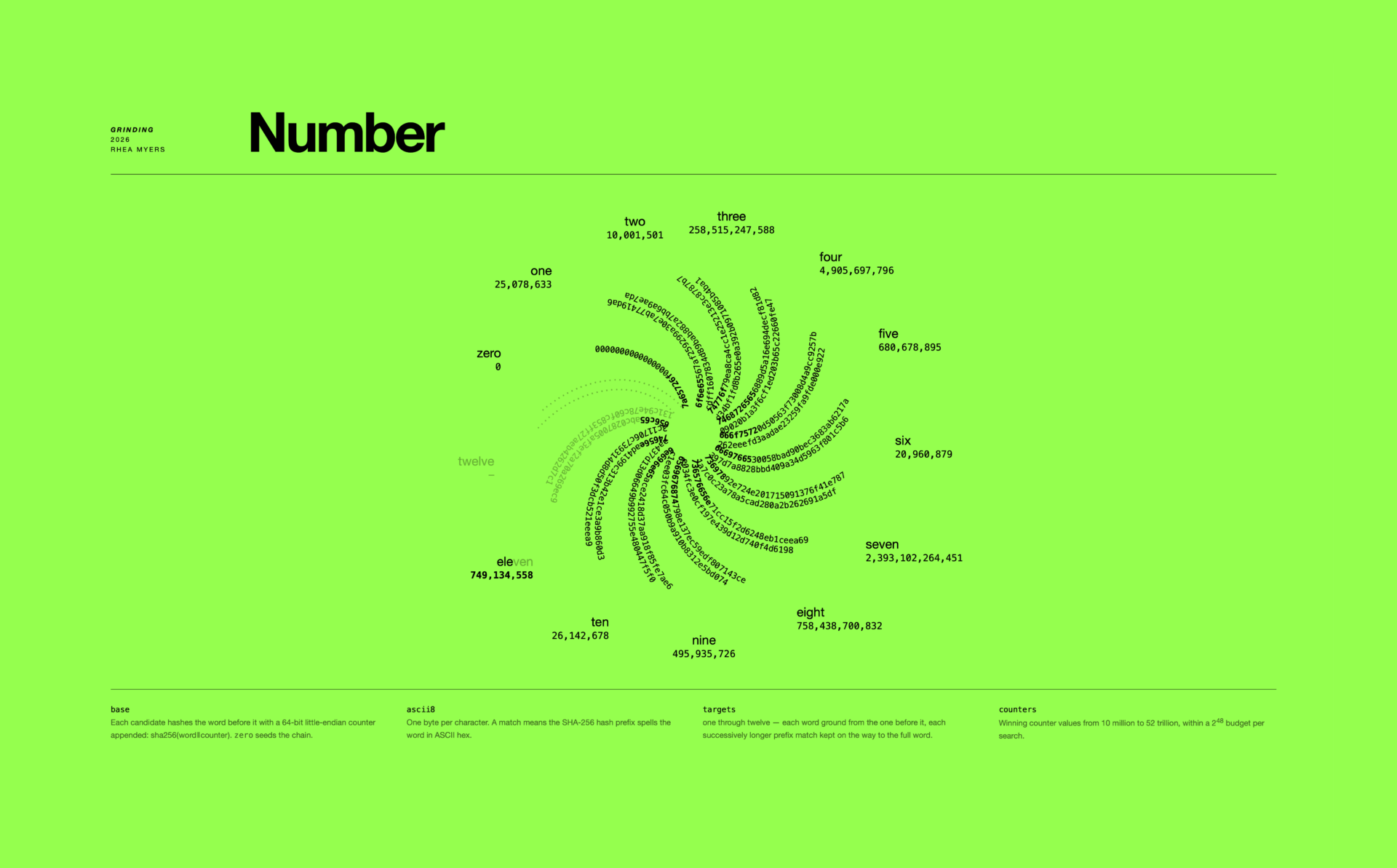
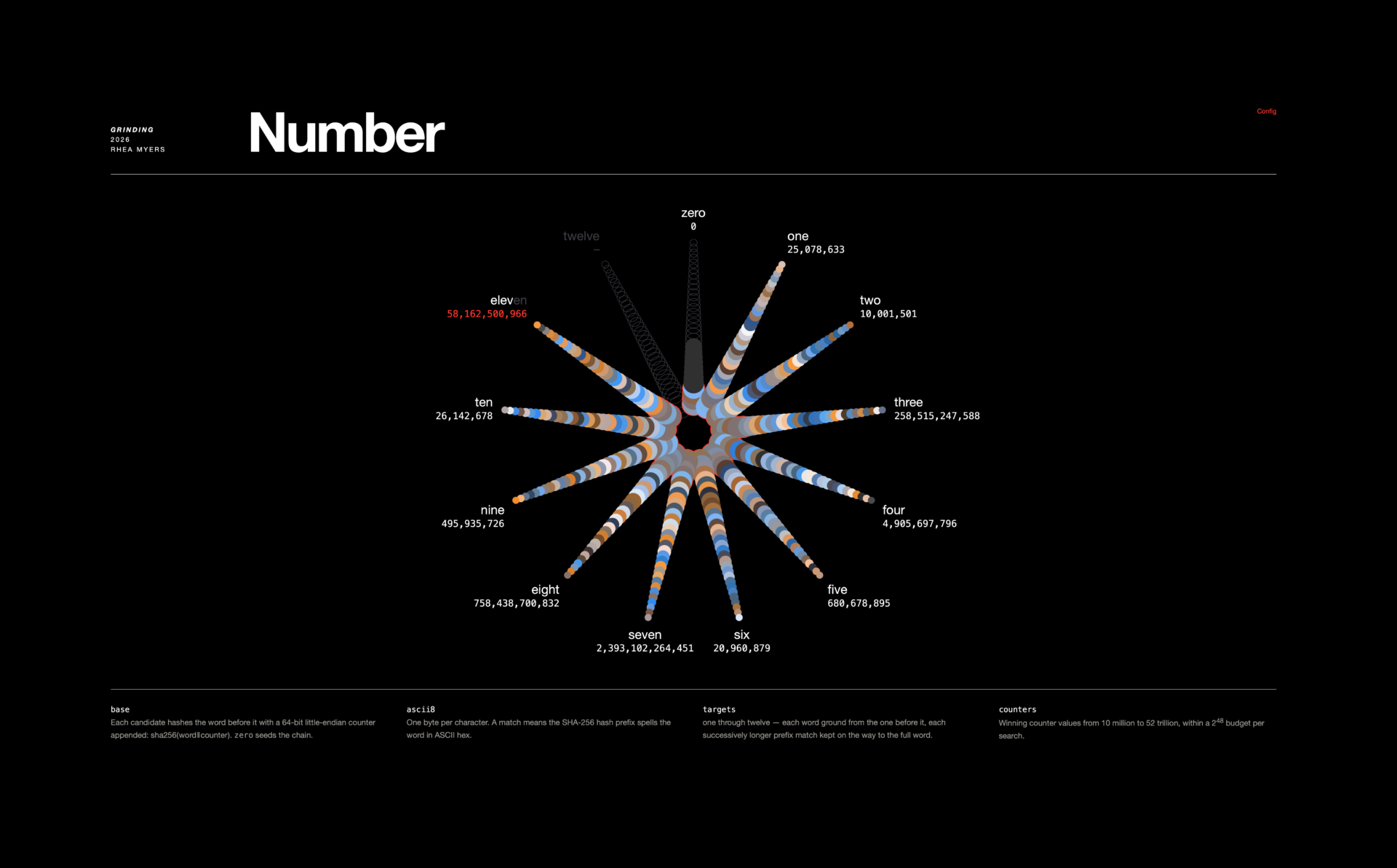
Rhea Myers, Grinding (Colours), 2026, Image Copyright Myers Studio Ltd.
AM What do you mean by “cryptographic space”?
RM It’s like the dark forest from Liu Cixin’s novel of the same name: a vast universe in which we must hide from those who would destroy us completely. Cryptographic space—the mathematical space in which cryptographic hashes or ciphers hide things—does feel like that dark forest model. Not least because both come from this Cold War game-theory, sudden-death model of encountering the Other, which the cypherpunks also took as their model. You don’t know who is hiding behind cryptographic keys, and if you break their keys, you own them—with a zero as the O.
In some ways, it’s my prettiest work because it’s animated so rhythmically.
AM You just called Grinding perhaps your prettiest work. Much of your earlier blockchain work gave us very little to look at. MYSOUL from 2014, for example, essentially consisted of putting your soul on the blockchain as a token. Was that absence of a visual object important to you?
RM Yes. As I say, I don’t feel I was always successful at that, but it focused attention on the actual object, the actual form of the work, if that makes sense. “Proof of existence” was a big concept at the time. Some of my earliest works were these handcrafted transactions where I was registering the hash of my genome—my 23andMe genome—on the blockchain so I could prove that I existed. Or tokenizing my soul without an accompanying image. My wife is very spiritual, so I’m not actually allowed to sell it, though. She points out, quite reasonably, that if my soul belongs to anyone, it belongs to her, so it cannot be sold.
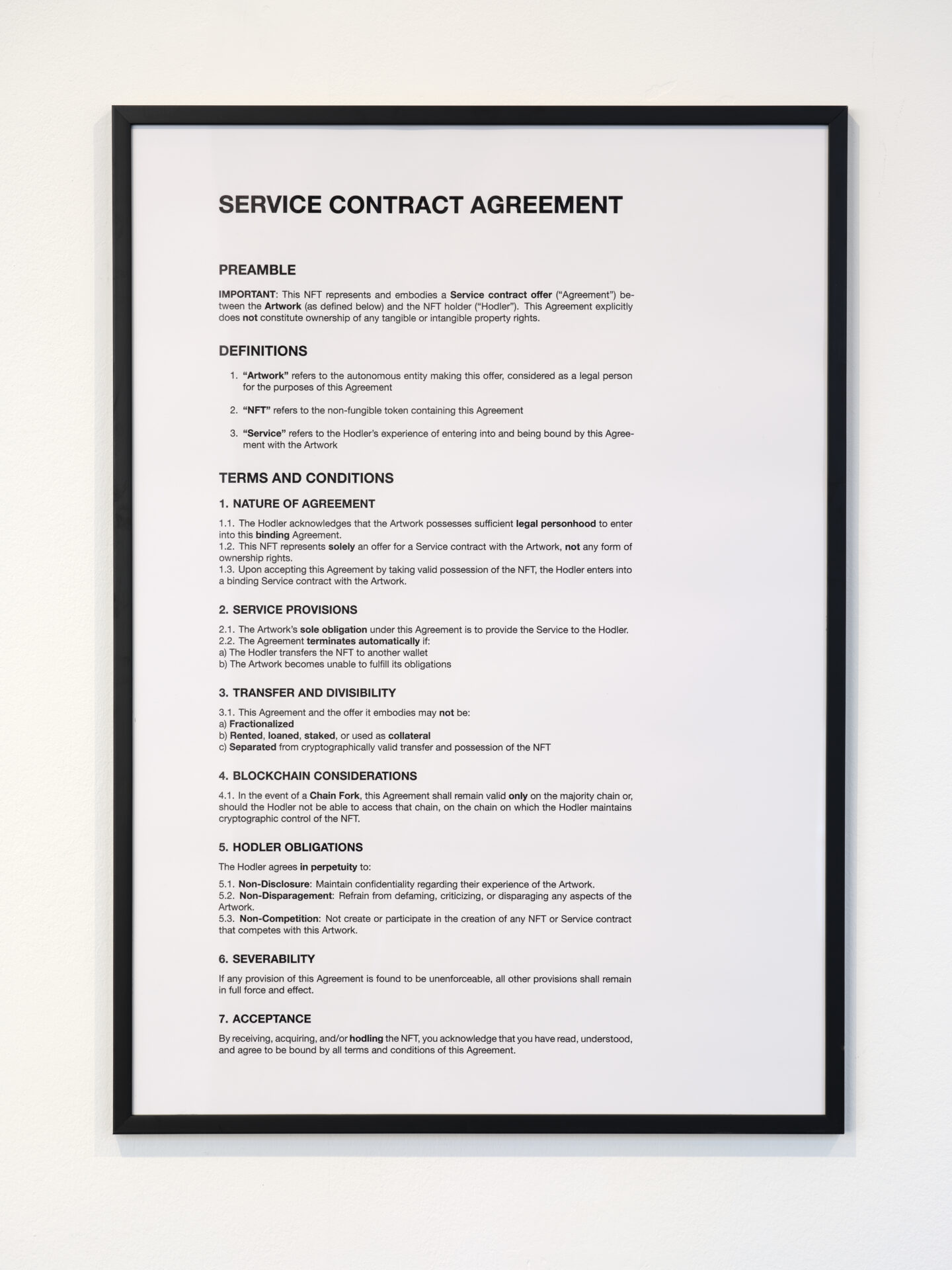
Rhea Myers, “Non”, 2025 Courtesy the artist and Galerie Nagel Draxler. Photo by Simon Vogel.
AM We’ve talked a lot about blockchain, but not about AI, which is now the technology everyone wants to talk about. What’s your relationship to it?
RM I find large language models and generative adversarial models absolutely fascinating. I’ve written about this quite a lot on my blog. The labor-relations encounter with AI is such an obvious class-war attack that it’s not even funny. It’s outsourcing on steroids. It’s capital losing its shit over being able to replace the living capital of workers with the dead capital of GPUs and electricity.
There’s this fantasy of, “Yay, let’s fire all the workers and replace them with graphics cards,” and then, “Yeah, this doesn’t really do that. You’re going to have to hire some people back. Oh great, we can hire them back and pay them less because the AI is doing the work and they’re just helping.” So I’m not a fan of the imposition of AI use on workers. I’m even less of a fan of the moral panic around workers who choose to use AI, though. The gap between people on social media getting 100,000 likes for saying that AI can’t count and people using AI to solve open foundational problems in mathematics is quite stark.
AM So your criticism is less about the technology itself than about the conditions under which it’s being used?
RM Yes. The thing that drives me absolutely bonkers is that this should be a golden age for philosophy and theory and rhetoric. We’re faced with dancing models of human language, and the “AI cannot possibly do what it is doing” response to that is the least interesting one. My original response was that they’re not models of truth or fact because language isn’t, so people complaining about them making mistakes are doubly misunderstanding them.
Contrast them with blockchains. Nothing on a blockchain can be false at the protocol level. You can lie about whatever you want using a blockchain transaction, but anything recorded by the blockchain is true at the protocol level.
Large language models are the opposite. They’re a soup of every lie humanity has ever told to flatter itself, to turn someone’s ear, to make someone say, “Oh, I hadn’t thought about it that way. Maybe you’re right.” They are large rhetoric models.
AM Do you actually use AI in making your work?
RM I do, but mostly for the boring parts of the work. It’s not good for coming up with the sort of ideas that I use. I don’t know whether that’s because I’m bad at asking questions or whether I am actually that weird in my thinking. What it’s very good at is spotting gaps in arguments or maps I make of concepts or opportunities.
For something like Grinding, I got Claude to write the hash-grinding code for me. I can write that, but it would be very slow and I have better things to do. And I got it to create the interface with my art direction. For everyone who wants some schadenfreude, the fact that software developers are like, “This can replace everyone’s jobs,” when the one job it absolutely can replace is that of a software developer, should be amusing more people than it is.
AM But you’re not interested in AI as an artistic medium in the way you’ve used blockchain as a medium?
RM I enjoy AI as a tool. I haven’t used it as a medium or engine of any projects, and I write all of my essays and stuff by hand. But the discourse around it has overheated. As with blockchain and successive technologies before that, my frustration is with a psychologically secure dismissal of the technology that cedes it to political reaction. I need to be careful here: the harms of AI are real but are largely in its use, in its production and exploitation under capitalism. AI psychosis cuts both ways. You get some very radicalized anti-AI people who are impervious to the facts, and I don’t find that any more interesting than trying to make the machine god.
I don’t think we have the machine god here. What we do have is a speed run of the linguistic turn in a genuinely surprising way. For anyone who claims to be interested in theory or philosophy, this is a golden opportunity to dig into the contradictions of our own takes on language and society. So, yeah, it’s complex: I like the tech, I don’t like the politics, and I feel the philosophical reaction to it could be doing quite a bit more work than it currently is. I didn’t dig into AI originally because I had artist friends who were doing such amazing things with it. I felt that I wouldn’t really be able to catch up in a reasonable time, so I chose to sit it out.
And now it’s everywhere. So I sat it out, but it didn’t sit me out.