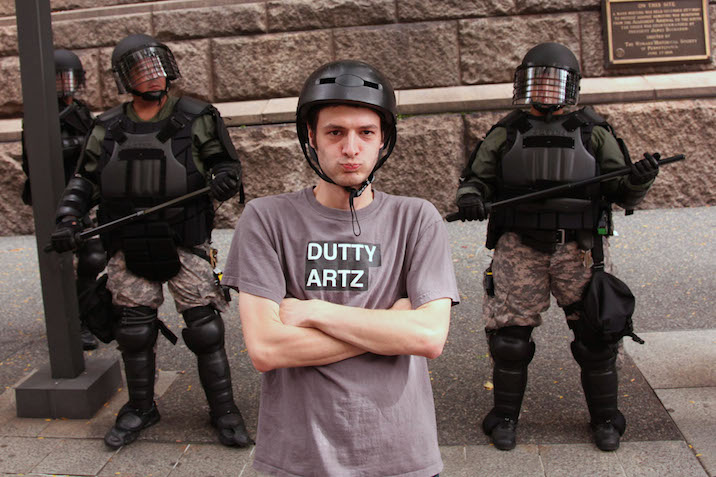
 Molleindustria Paolo Pedercini / Aktionsbild
A new exhibition at the Berlin Akademie der Künste examines perception and illusion in a multi-media playground of computer games, interaction and Oculus Rift.
There exists a generally happy, if not occasionally uneasy, coevolution between humans, machines and the digital realm. “Vertigo of Reality”, currently showing at the Akademie der Künste in Berlin, reveals this transformation, the possibilities it intimates and the position of art within this realm. With almost 50 participating artists, the four main themes – closed circuits, participatory works, game art and the “media threshold” – share a common core: the works would not exist without the participation and observation of their beholders.
The work focusing on closed circuit technologies includes pieces from esteemed artists Nam June Paik, Marina Abramovi?, Dan Graham and Richard Kriesche, who represent a shift in artistic production towards evaluating the relationship between the viewer and the work. One example is Bruce Nauman’s celebrated post-minimalist closed circuit video work “Live – Taped Video Corridor” (1970). The upper screen placed on the floor at the end of long, dead-end hallway shows the back of the visitor approaching; on the lower television a pre-taped shot of the empty hall plays on loop. Watching the screen, the beholder observes their own body from behind, walking away at a slightly faster pace than they are actually moving. This illusion, created by the angle of the camera lens, produces an unsettling feeling of a reality that has temporarily slipped.
Meanwhile, participatory works by artists Tino Sehgal, Christian Falsnaes and British photographer and “walking artist” Hamish Fulton deny the physical medium while requiring direct participation from the visitor.
An exploration of these two aspects of art – digital observation and physical participation – natu- rally lead to the third theme which includes both: gaming art. Featuring artists such as Cory Arcangel, Bill Viola and Pierre Huyghe, the focus here is on the gaming experience and the act of entering into a structured system. For example, in the highly critical “Frontiers” (2008), the Austrian group “gold extra” presents a 3D multiplayer game, putting players into the role of either a refugee or authority figure at the borders of Europe.
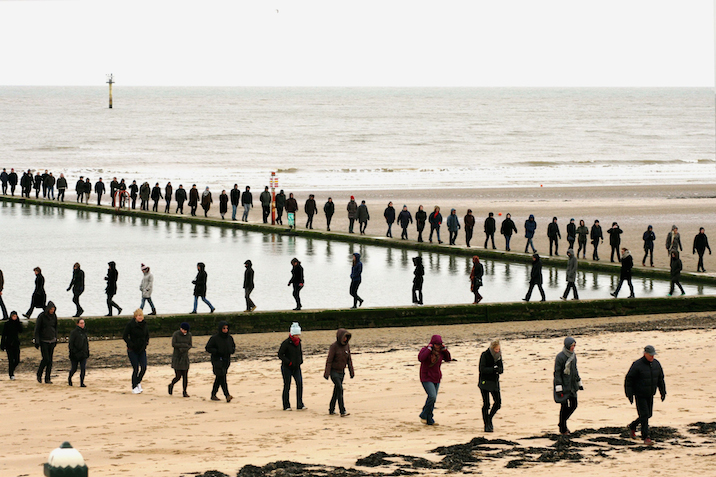 Hamish Fulton, Walk 2: Margate Sands, 2010. Photo: Dan Bass. Copyright Hamish Fulton / Maureen Paley, London.
The final exhibition theme explores the so-called “media threshold” that mediates space “in-between” a digital work and the real-world participation of the viewer. Artists here include Julian Oliver, Danja Vasiliev and Trevor Paglen as well as the recently deceased Harun Farocki, and works explore the grey area between games and military surveillence reflecting contemporary concerns, including military surveillance, hacking, digital manipulation and the dark underbelly of the internet.
Integral to “Vertigo of Reality” is the extensive lecture series that includes discussions, lectures, screenings, artist talks and performances. Promising to offer a greater understanding of what art or the aesthetic experience really is, the symposium “The Metabolism of the Social Brain: Between contemporary Art, Neuroscience and Philosophy” will explore the brain as a “complex multi-strata process of reality simulation,” questioning who really owns our consciousness.
In the progression from mechanics to electronics to software, technology becomes an agent for new methods of creation. Where once the user had to bend to the machinery, now the software is shaped to the very specific needs of the user. “Vertigo of Reality” posits that understanding how media, as an extension of ourselve, delivers information to society is of the utmost importance, inviting beholders to not just engage with the complexity of artworks, but also to understand their own role within a world where escaping media and observation is almost impossible.
“Vertigo of Reality” (Schwindel der Wirchlichkeit) is on from September 17 to December 14, 2014
Text by Alicia Reuter
Read more art reviews and interviews in our Showroom section
Read more about Berlin Art Week