
Kinga Rajzak in Dior Haute Couture by John Galliano Fall 07.
“Fashion had seen nothing like it for years,” wrote Tim Blanks in July 2012, establishing the merit of Raf Simons’ slick new Dior in the opening sentence of a Style.com review. The Belgian designer’s first couture outing was produced in just eight weeks – an undertaking highlighted in the subsequent documentary, Dior & I – unveiled in the 16th Arrondissement in a series of salons coated in a million fresh flowers, watched firsthand by his peers: Marc Jacobs, Azzedine Alaïa and Donatella Versace. Six and half years later, the collection and corresponding hype remain a defining moment of Simons’ short tenure at the house.
For his predecessor John Galliano (1997-2011), designs of raging opulence – coupled with the introduction of the iconic Saddle bag in 1999 – have long secured him an elaborate chapter in the House of Dior’s history. More recently, the appointment of Maria Grazia Chiuri, as the first woman at Dior’s helm, has ensured the brand’s relevancy in a changing fashion scene. The reproduction of Chimamanda Ngozi Adichie’s ‘We Should All Be Feminists’ on white T-shirts in her SS17 debut, is undoubtedly a moment that’ll only further prove symbolic later down the line.
“I think it’s hard to gauge which of Dior’s successors has had the biggest cultural impact,” asserts Connie Karol Burks, one of the curators behind the V&A’s latest blockbuster exhibition, Christian Dior: Designer of Dreams, the most comprehensive exhibition on the fashion house ever staged in the UK, which opened last weekend. “I mean obviously John Galliano had a huge impact with his very exuberant and extravagant designs, really a moment of excess of couture. And I think we have to highlight Maria Grazia Chiuri as being the first woman to take the house. It’s exciting, she’s really brought couture to a modern and younger audience and taken her own twist on it, making it relevant to women today.”
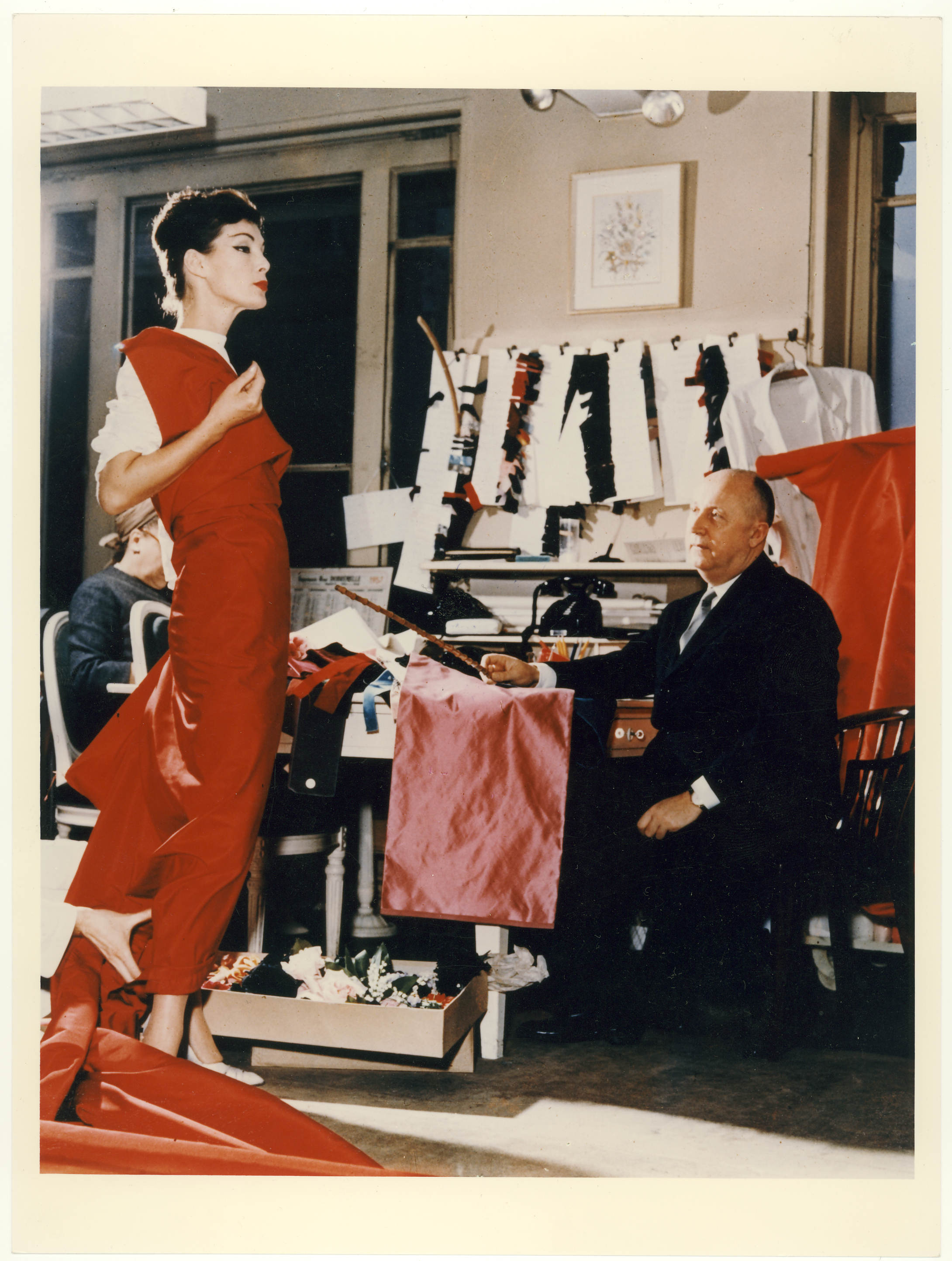

Left: Christian Dior with model Lucky, circa 1955. Courtesy of Christian Dior. Right: Christian Dior by Maria Grazia Chiuri, Haute Couture, SS18. Photo © Laziz Hamani
The latest embodiments of the Dior house codes, the three designers — Simons, Galliano, Chiuri — are all present in the new show, which focuses on couture, exploring the history of the house and the lasting influence of its namesake, as well as the correlation between Christian Dior’s original vision and that of its latterday leads. Those who immediately guided the house following Dior’s passing from a heart attack in 1957, are similarly represented, with designs by Yves Saint Laurent (1957-1960), Marc Bohan (1960-1989) and Gianfranco Ferré (1989-1997) physically close in proximity to the contemporary parties.
“The thing that stands out for me is Marc Bohan,” Burks continues. “He was at the house for 29 years – an incredible feat – and he took the house through the cultural shift of the ‘60s and ‘70s and kept it relevant; kept the house alive. Yet, he’s not a name that a lot of fashion people know. We use a quote in the exhibition from him, ‘never forget the woman’ and he made clothes that women really wanted. There’s a lot of lifelong clients who began when Christian Dior was at the helm but maintained their custom well into the Bohan years.”
Opened on 16 December 1946 with three ateliers and a staff of fifty eight, Christian Dior, the couture house, would make its catwalk debut the following February. “It’s quite a revolution, dear Christian,” announced Carmel Snow, editor of Harper’s Bazaar (US) at the time, “Your dresses have such a new look!” Nipped in at the waist and with full skirts that fell below the knee, the silhouette was an instant triumph, but proved a controversial anomaly arriving post-WWII, when austerity-generated restrictions were in place. As a result, posters blasting the message “Mr. Dior we abhor dresses to the floor” greeted the designer in Chicago in 1947, carried by protestors unimpressed by this exhibition of excess.
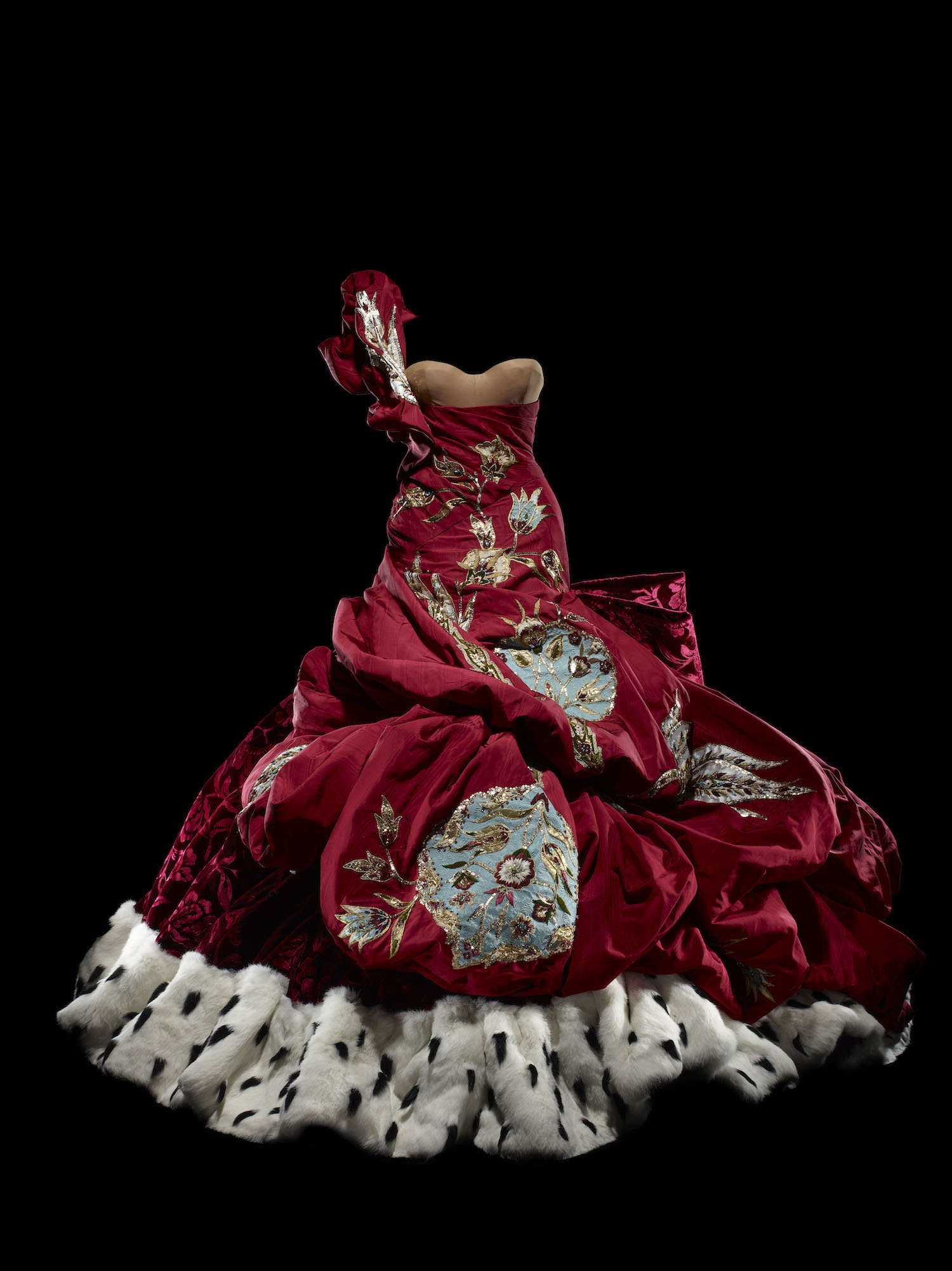
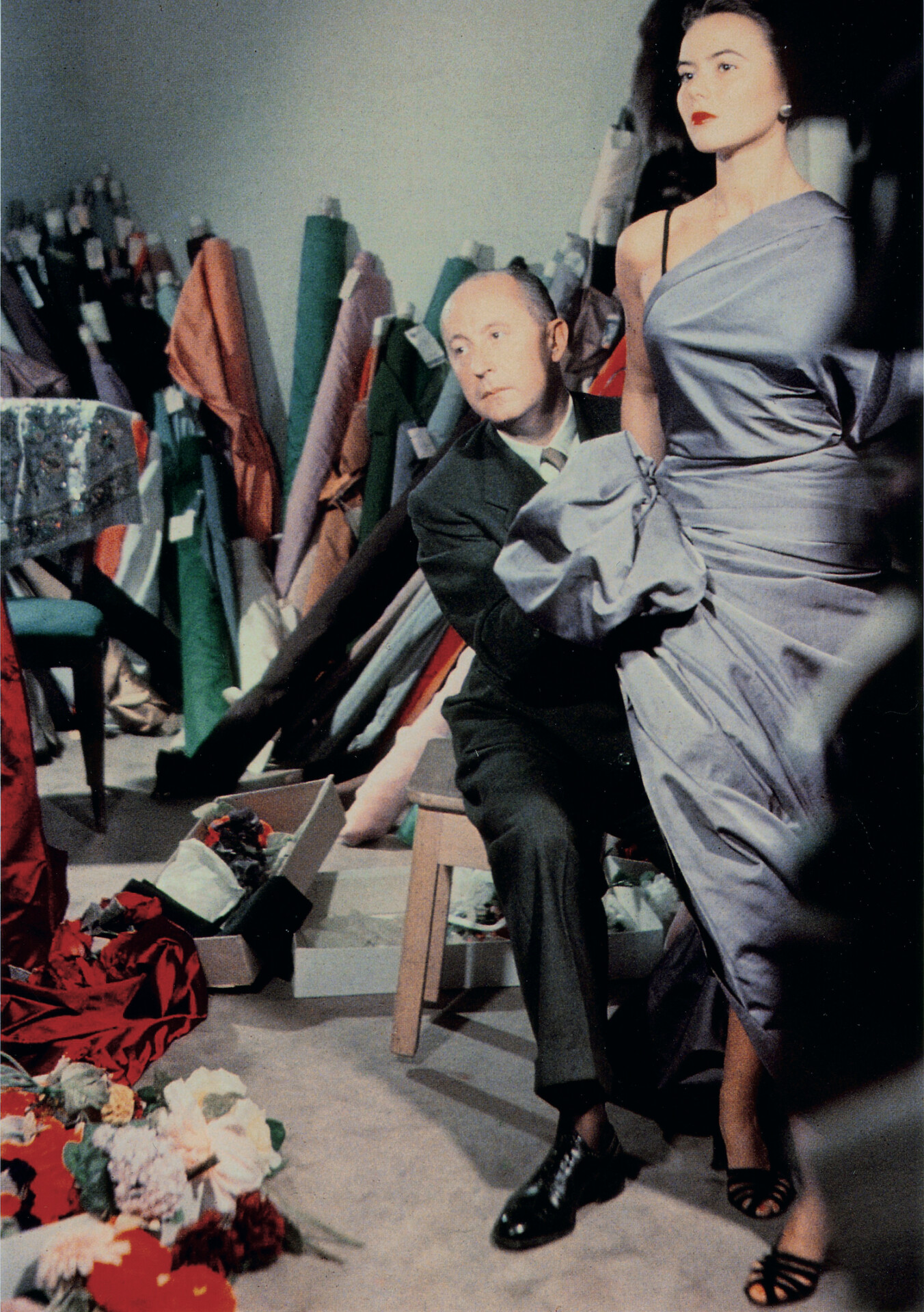
Left: Christian Dior by John Galliano, Haute Couture, AW04 Photo © Laziz Hamani. Right: Christian Dior with model Sylvie, circa 1948. Courtesy of Christian Dior
Lasting just a decade, the impact of Dior’s own short tenure was mammoth. While in design the New Look, an interest in travel and his preoccupation with the garden, (informed by his childhood at Granville, Normandy) have all continued to manifest in the aesthetics of the house – from silhouette to set design – its his position on branding and accessibility which is perhaps the most impressive and far reaching feature of the designer’s legacy, practiced industry-wide and across culture today.
“We touch on the real head to toe approach [in the exhibition],” Burks comments. “Something that started with Christian Dior, where he thought ‘no outfit is complete without a perfume’ – he also was determined to do stockings and gloves and hats and really dress women from head to toe, which meant that even people who couldn’t afford a couture gown, could splash out on a pair of gloves and have that little bit of Dior in their wardrobe.” Indeed, Dior saw perfume as integral to haute couture from as early as 1947 – Miss Dior materialised within several months of his first collection – and its in this vein that the head to toe approach persists in 2019, with the addition of celebrity endorsements, diffusion lines and social media.
“Each of the designers have harped back to the biography of Christian Dior,” concludes Burks, “which is partly why I think the house has maintained its relevance, to look back to the power of the New Look and the amazing designs Christian Dior released on the world, reinterpreting the successes of the house for the contemporary audience.” One of the most literal interpretations of this can be seen early on in Designer of Dreams: Dior’s iconic Bar Suit, gifted to the museum in 1960, stands a metre from a mirroring ensemble by Maria Grazia Chiuri, an arresting display of fashion heritage.
Christian Dior: Designer of Dreams is at the V&A runs through to 14 July 2019.