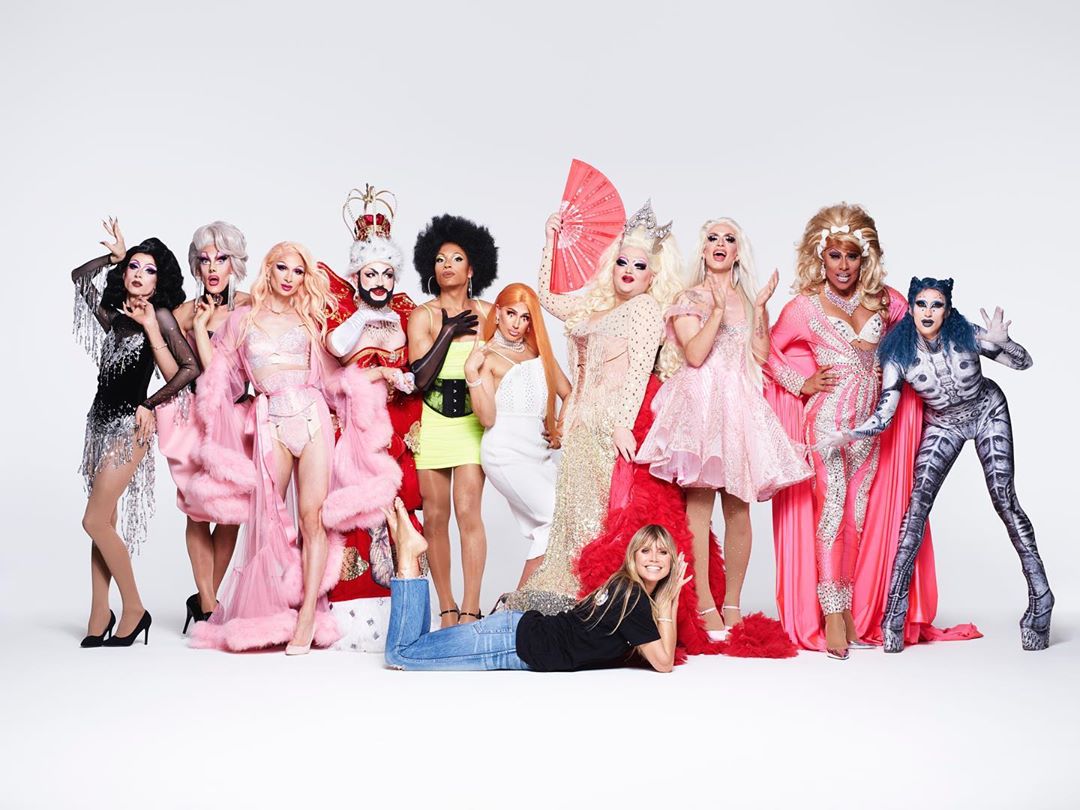
via @heidiklum
RuPaul’s Drag Race is a global phenomenon, so much so that for many people unfamiliar with their local drag scenes, it is how they conceptualise the entire art form. From Ru’s Klein, Epstein & Parker-clad workroom entrances, to the challenges, runway categories, panel critique and climactic lip sync showdowns—which end in one competitor shantaying while the other sashays away—it has become a brand. And like all the best brands, it has spawned knock-offs just different enough to skirt copyright laws, yet close enough that you know exactly where they got the idea from. Enter Heidi Klum’s German-language reality competition, Queen of Drags, which aired for the first time last week.
While the German supermodel is not known for her participation or authority on the drag scene, she does love making reality television. Most American audiences know her from 16 seasons of Project Runway and a short stint on America’s Got Talent, but she has also hosted Germany’s Next Topmodel for 14 seasons and is teaming up again with fashion consultant Tim Gunn for another design reality show,Den Sprung schaffen, later this year.
So, here is everything you need to know about her latest endeavour, Queen of Drags:
Heidi Klum is aware the queer community is not happy about her moderating the show
The German press has been outspoken about the fact that a very privileged cis white woman is not who everyone wanted to represent the German drag community. Klum addresses this in the first episode, asking the queens, or “drags” as they call themselves on the show, what they think about it and making sure it is not appropriation if she wears dramatic eye makeup. The contestants naturally come to her defence, but they also know that she will be judging them at the end of the episode.
To Klum’s credit, there is no Germany equivalent of RuPaul , and the supermodel’s international reputation probably had a lot to do with securing a high budget for the show—a 100,000 euro cash prize (more than the American girls get when you calculate into USD)—and a green light from one of the country’s biggest TV channels, ProSieben. It’s also worth mentioning that Klum does not pretend to have extensive knowledge in the field and does not adopt any cringeworthy phrases from the community, or ask the drags to call her Mutti.
You probably know the other judges
Like the American version, there is only one drag queen as a core member of the panel: Conchita Wurst, the Viennese drag queen that caught the world’s eye in 2014 when she won Eurovision. To Heidi’s other side, sits Bill Kaulitz, the androgynous frontman of the rock band Tokio Hotel. While he was a teen heartthrob back in 2001, sporting rings of black eyeliner and a mane of emo hair, Kaulitz has refined his look at the age of 30, but he is still a well-known celebrity in Germany.
There is a fourth slot for rotating guest judges. One of the country’s most famous drag queens, Olivia Jones, filled it for the first episode, but it was bittersweet. It was obvious that Jones had the practical drag knowledge and a housemother quality that is missing from the show. Still, Latoya Jackson and Amanda Lepore will be stopping by.
The format is Topmodel meets America’s Got Talent
While Ru’s girls are famously sequestered in hotel rooms, prohibited from interacting with fellow contestants off-camera, Heidi knows from her Topmodel experience that renting a villa and having the competitors live together can provide some on-air drama.
Instead of challenges as in Drag Race, each week the performers have a theme to put on drag act— the German queens have a lot more freedom to choose what to present. While RuPaul’s Drag Race relies heavily on references from Paris is Burning and ballroom culture, Queen of Drags is more Cabaret, with the judges sitting at table, instead of on a panel and a full audience occupying other tables in the theatre. In lieu of a runway, there is a Eurovision-style stage with computer-generated visuals in the background and the option for backup dancers.
The queens are showgirls
Because of this format, most of the drags on the series fall into the showgirl category, bringing polished glamour. Although there is one bearded queen, this format is not pushing any limits of drag—its cis men giving you female illusion.
You also won’t be hearing much tongue-popping, “oh nein sie solte das nicht” (a rough translation of “oh no she better don’t”) or the double entendres the American show is famous for. Furthermore, contestants are not judged on their Creativity, Uniqueness, Nerve, and Talent. RuPaul’s Drag Race had the benefit of premiering on a niche channel and gaining a cult following, which allows it to be a bit more provocative, whereas we don’t really want to see Heidi Klum asking gay men whether they think male models are wearing boxers, briefs or going commando underneath their cargo shorts.
The breakout star is Catherrine Leclery
Not only does she have serious performance chops, the 48-year-old Brazilian-born queen is giving us serious grande dame energy. A good 20 years older than most of her competitors, Leclery gives great side eye and cutting comments, but she also lets the audience in on the struggle of keeping up with the younger queens—a theme that inspired her I will Survive Nummer.
The verdict?
If you hold it up to the standard of RuPaul’s Drag Race, you will probably be disappointed, but if you want an introduction to some of Germany’s queens, who will probably never be on the American, British or Australian versions of the RuPaul franchise, it’s perfectly acceptable reality TV.