
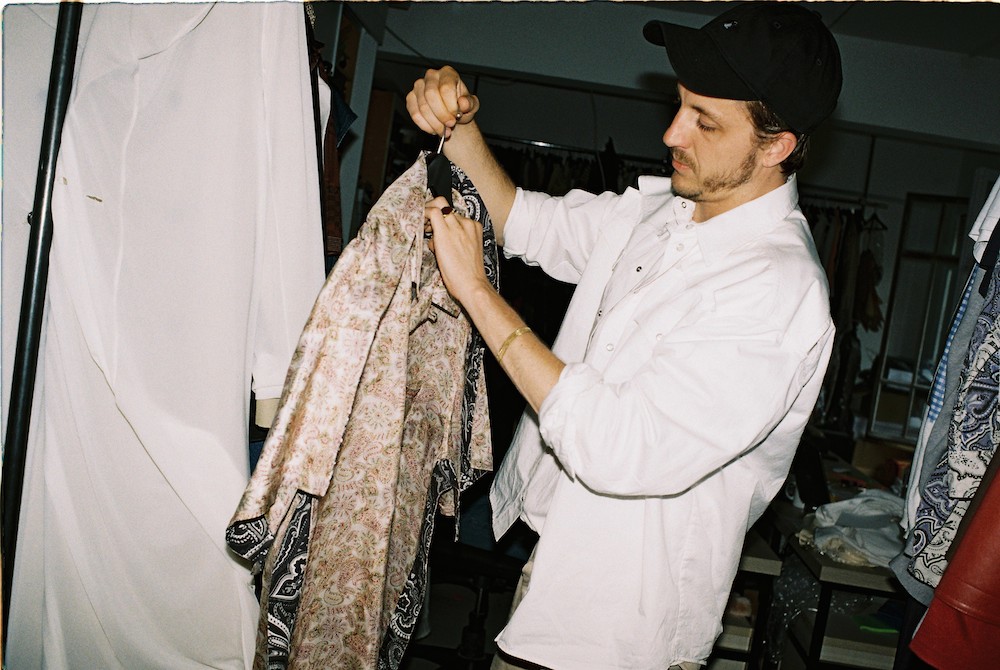
Glenn Martens, the 35-year-old Belgian creative director of Y/Project, has quickly become one of fashion’s most followed figures. When he was young, however, he was more interested in the past. Growing up in Bruges, he drew historical figures, paying attention to the details of their clothes. After briefly studying interior architecture, he submitted a portfolio to the esteemed fashion programme at the Royal Academy of Fine Arts Antwerp. Despite the academy’s selective admissions process (last year, only 20 percent of applicants were admitted), Martens earned a place with the 2004 first-year students, and went on to graduate top of his class from the rigorous fashion programme in 2008. While finishing his studies, someone from Jean-Paul Gaultier saw his graduate collection (“Everything was in white or black, extremely elegant, so it was all about very sophisticated, elongated silhouettes,” explains Martens from his Paris atelier during July’s Couture Week), offering him his first fashion job as a junior designer at the Paris maîson. In 2009, Martens became first assistant to Y/Project co-founder and designer Yohan Serfaty. Following this, in 2012, he made the leap and started making womenswear under his eponymous label, having earned enough money to do so by ghost designing his mentor and close friend Bruno Pieters’ 2011 collaboration with Swedish high street label Weekday, as well as consulting for Pieters’ transparently-sourced and sustainable clothing label, Honest By. When it first started, Martens’ label was bare bones – the designer used to cook his staff lunch – but prestigious stockists Opening Ceremony picked up the emerging brand early on.

On 18 April 2013, Serfaty died of cancer aged 47. at year, Y/Project CEO Gilles Elalouf asked Martens to take Serfaty’s place at the label. Under Martens’ reign, Y/Project went from an edgy, dark label full of leather and inspired by Rick Owens, to an experimental, avant-garde fashion brand featured in numerous magazine editorials and worn by celebrities such as Rihanna, Kim Kardashian, Gigi Hadid and Hailey Baldwin. In 2016, he was a finalist for the LVMH Prize, and last year, he won the prestigious ANDAM Grand Prix – earning him a coveted 280,000 Euro reward and a one-year mentorship with Yves Saint Laurent chief executive and president, Francesca Bellettini. “Most of the time when you have the questions, somebody has an answer for it, but what is amazing [about this is] that somebody with such knowledge, and such impact, and such wisdom, that she’s there to confirm if you’re doing good or not,” says Martens.
It was as a skateboarding teenager in the Nineties that Martens first encountered Diesel. The Italian luxury denim label ran magazines ads that were provocative, daring and controversial, yet inclusive and open-minded. The Diesel advertisements often came with the slogan “For Successful Living,” and showed subjects who just hadn’t been given visibility in mainstream advertising, such as gay sailors kissing in a passionate embrace; a wealthy black family celebrating Christmas, the grandfather proudly showing off the Diesel t-shirt he had just received for a gift; and cheeky instructions on how to smoke 145 cigarettes a day.
“It wasn’t just about fashion,” says Martens. “It was about a statement, and that definitely was the first time I remember seeing a gay couple kissing, and I thought my god, this is crazy. Diesel really changed people. It opened people’s minds, especially kids who had no internet in those days. We weren’t travelling that much, so everything came through magazines.”

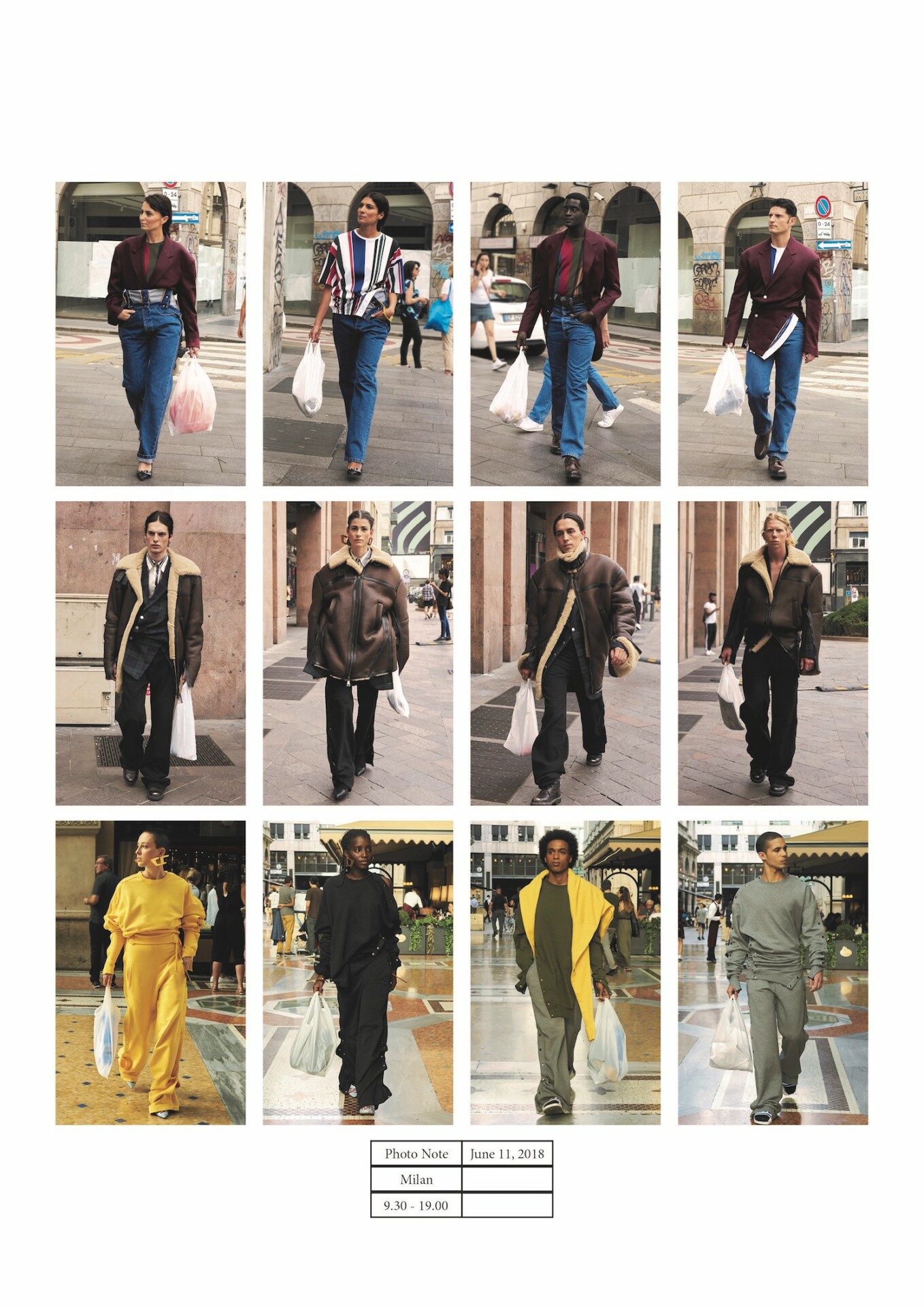
Diesel Red Tag Project by Glenn Martens, 2018. Photography: Hans Eijkelboom
The Y/Project designer affectionately tore out the ads from magazines and began borrowing Diesel t-shirts from his older brother. At age 18, Martens saved enough money to splurge on his first pair of Diesel jeans from a store in Bruges. “They had a brown wax, and after a certain point the wax was going away and the denim came through,” he says, insisting that even at the time, he still cared more about hanging out at the skatepark than designer clothes.
Four decades after Diesel’s co-founder, Renzo Rosso, started the denim label in 1978, the label contacted Martens. Diesel was celebrating its 40th anniversary while readying its new Red Tag Project, a platform featuring a series of capsule collections by various designers wanting to capture the zeitgeist of the present, as the brand once did during the height of its Nineties fame. This March, the enterprise launched at Paris Fashion Week with a cowboy-themed collaboration with Hood by Air’s Shayne Oliver.
Before this debut, Diesel’s chief communications officer, Antonella Viero, emailed Martens, informing him that Rosso would like to visit his studio. “He stayed here for half an hour, it was great,” says Martens, who received another email a month later telling him that Rosso wanted him to go to Italy. “I had no idea what was happening, so I said, ‘Of course if he is going to fly me to Italy, I will fly to Italy.’” Martens toured through all of Rosso’s factories, which including those run by Diesel’s parent company, OTB (‘Only The Brave’). The business, also chaired by Rosso and based in Breganze, Italy, owns other labels including Maison Margiela, Marni, and Viktor & Rolf. “At some point I finally had lunch, and then Renzo joined me, and then he said he wanted to work with me and do collections with me,” recalls Martens, who considered the offer for a week before accepting.
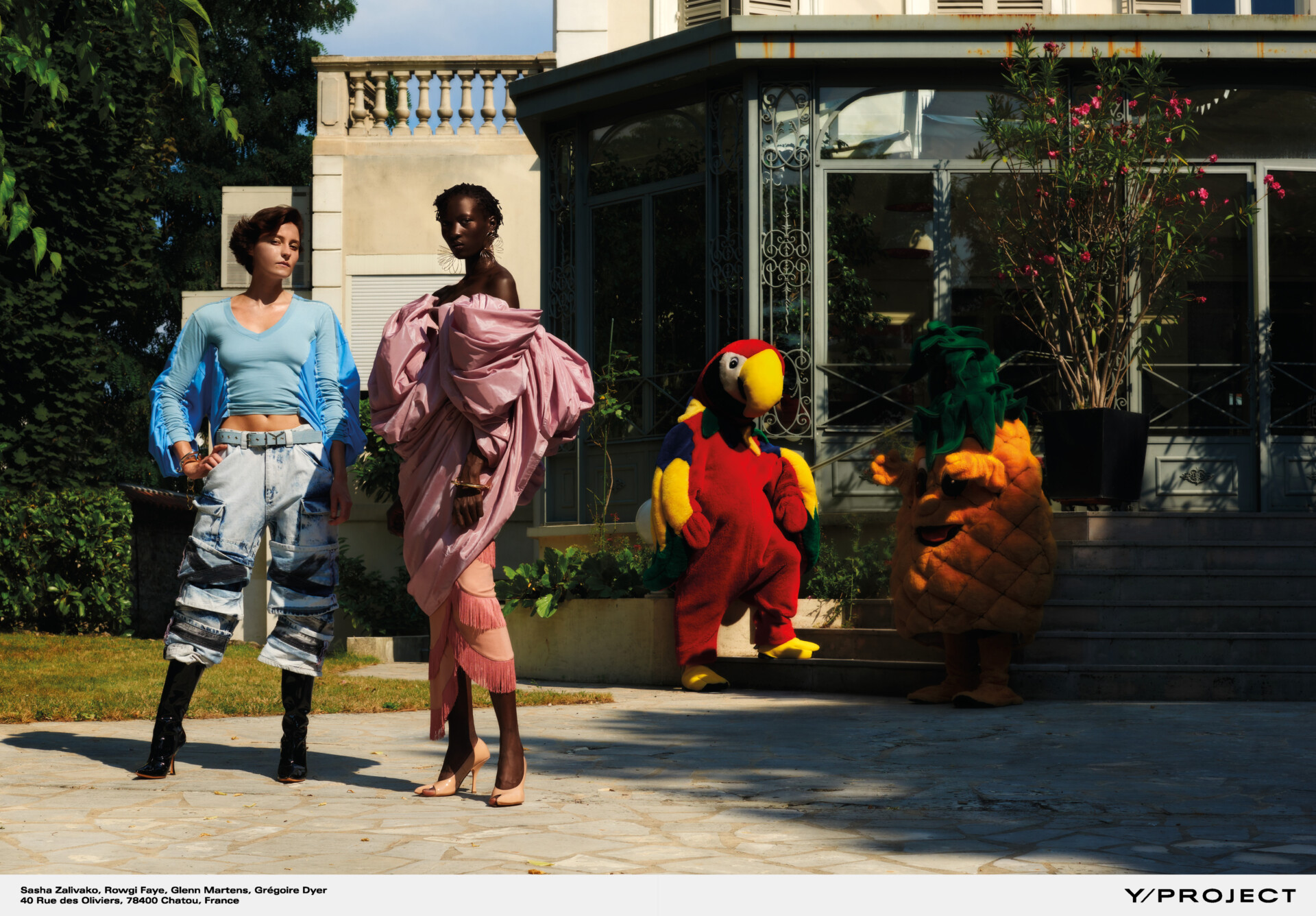
After Martens said yes, the designer insisted that he was going to do the project on his terms. “I wanted to make it very clear that if they did a collaboration with Glenn Martens Y/Project, I’m not going to make a Diesel collection,” Martens says adamantly. “I’m going to make a Glenn Martens Y/Project collection with the Diesel fundamentals, but it should be like a proper marriage, not me designing as an artistic director for Diesel, because if I was to design for Diesel as a creative director, it would be a very different collection. The point was more a celebration of two different worlds, [to] show that Diesel can also be conceptual, and I wanted to be clear that all these things were set.”
Martens looked through the Diesel archives and chose to use the slogan “Go With the Flaw” as his starting point, a catchline he first used in a September 2017 campaign celebrating imperfection as a form of beauty. He subsequently presented the idea to Rosso in their third meeting. “I came with a little tiny drawing, it was like a pair of pants, with a waistband like in a triangle form, and he was like, ‘What is it?’ and I said, ‘One of your slogans is Go With the Flaw, I think it should be the capsule [theme], I think we should just make a full collection full of flaws,’” the designer explains.
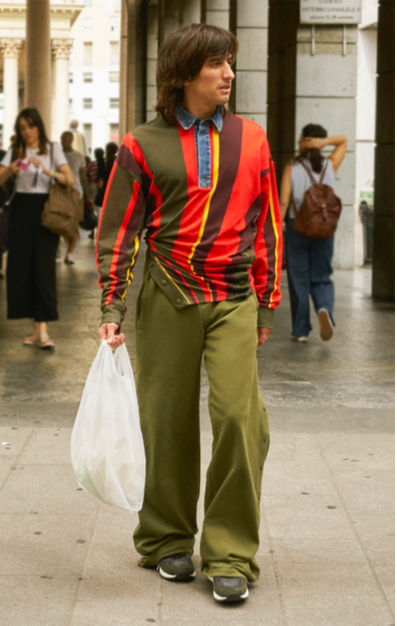
Martens’ edition of Diesel’s Red Tag Project, was launched during Men’s Fashion Week in Milan this June. To shoot the collection’s lookbook, he tapped Dutch artist Hans Eijkelboom, a photographer known for taking candid photographs of random people on the street wearing similar outfits (Rugby shirts, American-flag shirts, and all-denim outfits have served as themes in Martens’ collections) and arranging their photographs together on a grid. The artist, who had never photographed a fashion shoot before, ordered his images of Martens’s collection in groups of models wearing the same items styled in different ways. At the presentation of Martens’ capsule collaboration – which Eijkelboom also captured – models stood on separate platforms in six groups of four, each tier wearing the same clothes while recorded announcements from Paris’ Metro system played over the speakers.
For his iteration of the Red Tag Project, Martens designed long, tailored blazers with sloped shoulders that can be worn tucked in, open, or buttoned up in an asymmetrical manner; an oversized take on the brown leather shearling aviator jacket that can be zipped up in different ways, and a denim jacket with buttons on the side and front so that it could be variously configured. The designer also gave Diesel’s signature jeans a high, triangular waist that can be buttoned up to the top, flapped open, or worn at an angle. “The collection, how I wanted to build it up, is that it fits everybody, and the idea was that,” he says. “It depends if you button it there or close it there, a big or a small person fits into it, and it gets very democratic.”
“It’s very good for [Renzo] and it’s very honest, because he’s asking people like me, which are a generation of Diesel,” he continues. “We grew up in Diesel. Diesel, when I was in the Nineties, was the hottest thing ever. With a little help from the designers of today, [it] could, through its Red Tag Project, return to being the hottest thing ever.”
This article was taken from our current issue, SLEEK 59. Get your copy hier!