 3D Scanner. Courtesy of Google Cultural Institute.
Seen from the outside, the Google Cultural Institute in Paris has a majestic stature. Housed in a 19th-century hôtel particulier, the institute develops some of most advanced technology on earth. Yet inside the international staff seems to be jovial and relaxed. By making the world’s cultural treasures available for online viewing, Google is revolutionising the way humanity experiments with art.
It’s tempting to point out that this company already controls much of our personal information; or that we must live art through the senses; or that technology might change art for the worse. But those urges disappear immediately after entering the Lab, which has offered a visiting session dedicated to the German partners and culture.
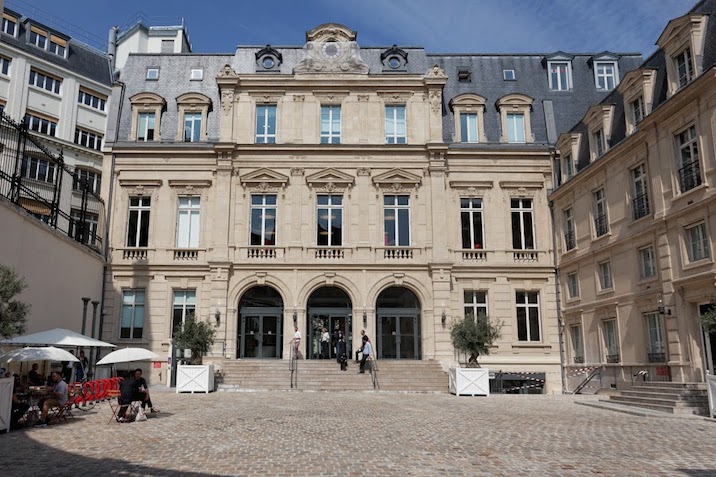 Paris Office. Courtesy of Google Cultural Institute.
What was at first an experimentation of an Indian employee became a stable and perennial project. For instance, The Art Project, which is the oldest, has the aim of making art collections from all over the world accessible online. Another significant goal of the Lab is to constitute genuine historical archives and build picture networks as a witness of history. On the Google Cultural Institute website you can scroll through original documents of the German Federal Archive or get a panoramic view of the panels of the East Side Gallery, whose graffiti online might remain unaffected by the passing of time, or worse, property developers.
To accomplish such colossal documentation the team had to build solid partnerships with museums and curators, and even the minute details of the artworks amassed can be appreciated thanks to the Lab’s Ultra High Definition cameras.
 Courtesy of Google Cultural Institute.
Their Museum View grants access to hundreds of virtual exhibitions, the same way as you’d roam the streets using Google Street View. On top of that, last year, the Lab opened its doors and facilities for artists-in-residence, an initiative that allows for a deeper reflection around arts and technology. We spoke to Laurent Gaveau, head of the Lab, about the concept behind this Google experiment, and how “digital natives” interact with art.
Sleek: why did Google feel the need to create the Cultural Institute?
Laurent GaveauIn the beginning, it was really an experiment lead by a member of Google who was passionate about art. When discovering Europe while studying, he thought that it was necessary to find solutions in order to share more easily the art collections he saw. So you can say that the project was very personal. He realised his initiative with 17 first partner-museums. Because of its success (quality, audience, interest) Google decided to make something permanent of it and founded the Cultural Institute.
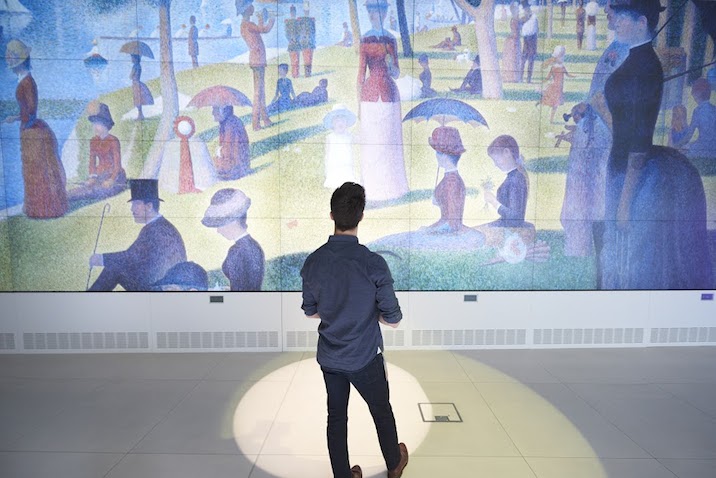 Big Wall Experiment. Courtesy of Google Cultural Institute.
You now have many partners but are museums and institutions still sceptical of this project? Yes, it is a project that must be presented and explained to museums. Many were sceptical, especially five years ago- at the beginning. Probably because they thought it was a coup, a way to promote Google but with no depth. Today, some museums are still sceptical but less and less so. I think the people we work with appreciate the work we do and know that the project is trustworthy.
 Work Space. Courtesy of Google Cultural Institute.
What is your dream concerning the use of your technology?
My dream is that gradually museums use it to tell stories online — whatever the platform. I would love them to use the possibilities that the internet has to make content available. It is what museums do best: curate. Often, what the audience lacks today is context, and tools to understand cultural wealth available to us. I think that the more museums tell stories, the more the public is prepared to receive culture.
So the goal is to make art more accessible?
Always!
How does the “digital natives” generation (people born after 1989) engage with contemporary arts in relation to what we called “digital arts”?
I do not have the answer to that but what I see after a year and a half of work is that they use a great deal of technology in their artistic practices but they incorporate it in a way that is totally natural. I think that with this generation, we will come to a contemporary art that will be technological, at least partly, but not in the way “digital arts” were a subclass of contemporary arts. I would love us to think more about this question and see how artists seize technology.
Text by Fleur de Féral
Mehr: A New World: How Japanese Photography Reshaped Conceptual Art
Mehr: Ann Veronica Janssens Forges the Possibility of Infinite