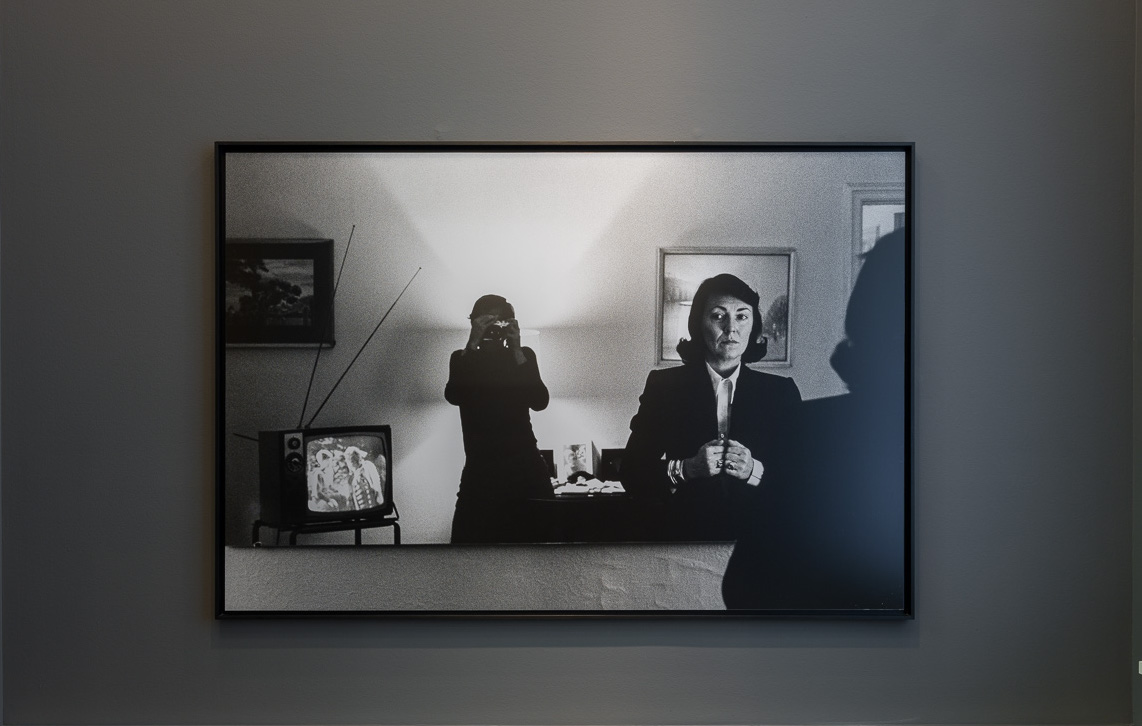
Installation view from Photo Collection of Helmut and June Newton at June´s Room, at the Helmut Newton Foundation, photo: Gerhard Kassner
Since the breaking of the #MeToo scandal, the arena of nude photography has gone under intense scrutiny, with countless panel discussions and articles posing questions such as “Can the female nude survive the #MeToo era?” It’s a question that keeps on cropping up at the Helmut Newton Foundation in Berlin — the late German photographer’s cooly confrontational nudes take on an even more provocative sheen in light of the movement and the increased necessity to question the established conventions of the past. Yet, at the Foundation’s latest tripartite show, Helmut Newton SUMO / Three Boys from Pasadena / Photo Collection, which opened earlier this month, there is something more to be gleaned from the work other than the proliferation of naked women —the emphasis on influence, friendship and connection.
Exploring a trio of aspects from Newton’s career, the exhibition orbits around a showcase of images from his monumental photo book, SUMO — published by Taschen and dubbed “the biggest and most expensive book production in the twentieth century,” originally in 1999. Elsewhere, in a chain of three rooms, works by Newton’s former assistants Mark Arbeit, George Holz and Just Loomis are displayed, highlighting the influence of Newton on their work and vice versa, in the fields of nude photography and celebrity portraiture particularly. But it is the last — and most intimate — selection in the exhibition that is perhaps the most interesting of all: a mesmerising private collection belonging to Newton and his widow, collaborator and fellow photographer, June Newton (AKA Alice Springs).

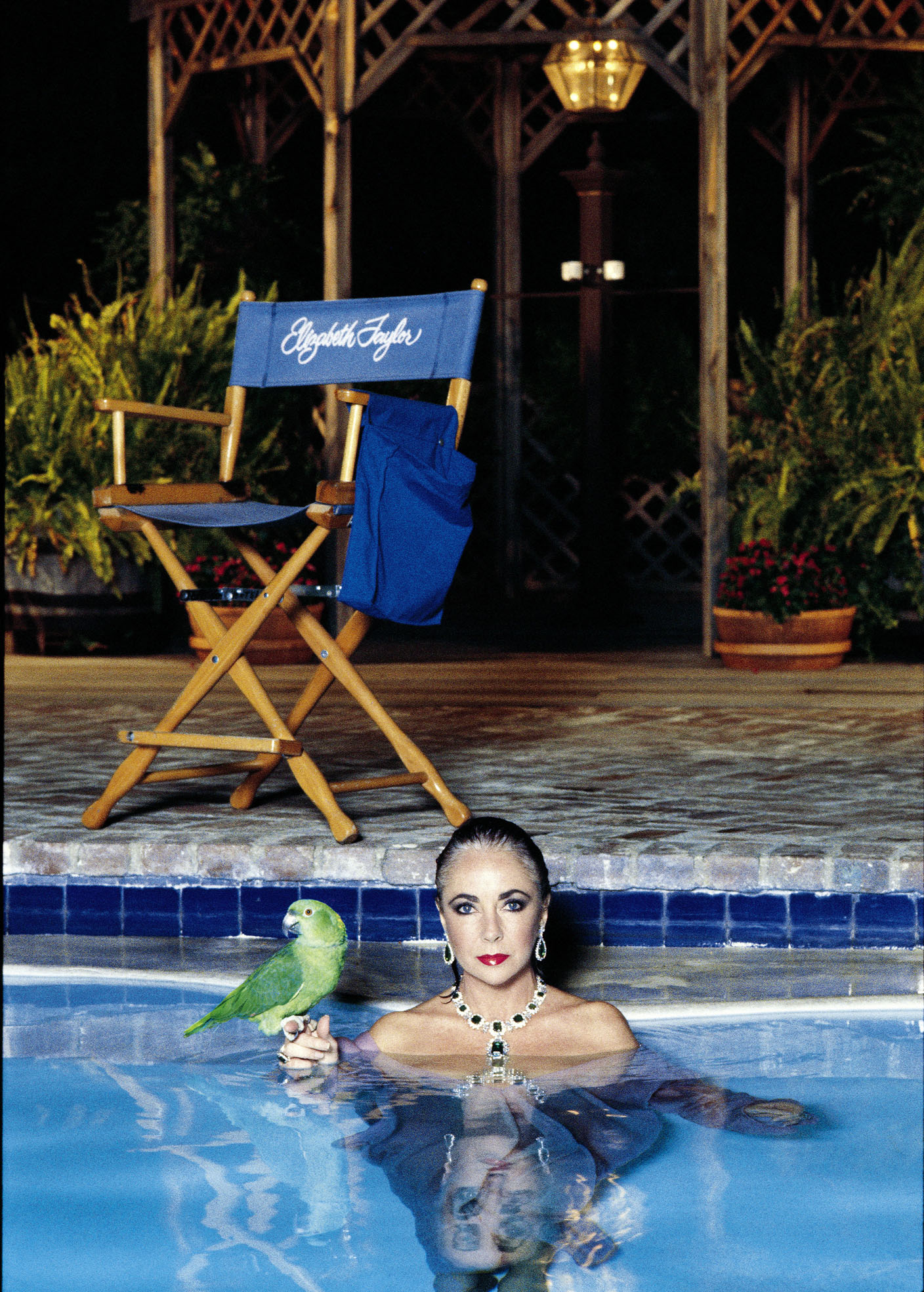
Helmut Newton, American-Vogue, Monte-Carlo, 1995. Right: Elizabeth Taylor, Vanity Fair_Los Angeles 1989. Copyright Helmut Newton Estate.
“This collection is a bit like a self-portrait of its collectors,” the Foundation’s curator Matthias Harder tells SLEEK about the couple’s exquisite array of photographs. Originally housed in the corridors of the couple’s home in Monte Carlo, the collection was given to the foundation by June Newton and this is the first time it is seen publicly. Containing an enchanting span of black and white photographs, ranging from stoic portraits by August Sander to spirited studies of prostitutes by Brassaï and tense documentations by Mary Ellen Mark, as well as examples of Diane Arbus’ singular portraiture (namely a brilliantly quirky photo of a nudist woman wearing nothing but horn-rimmed sunglasses), the collection is an outstanding who’s who of 20th century photography.
But not just is it a magnificent showcase of world-famous photographers — it also offers a revealing account of the Newtons’ personal taste — from their exacting eye for beguiling nudes (which incidentally often appear in a welcome contrast to Newton’s stark and severe interpretations), to dramatic fashion photography (such as the angular abstraction of a blazer lapel) and a mismatch of nature and architectural shots. The collection also illuminates the difference in husband and wife’s taste. For example, a shadowy Robert Mapplethorpe of a be-masked man in a basement-like setting was acquired by June when the controversial American photographer visited her in Paris. According to Harder, Newton himself wasn’t much of a fan.
For Harder, the inclusion of the private collection alongside the other two displays, brings the exhibition “full circle.” As he explains, “Together these collections tell us about friendship — Three Boys from Pasadena shows how these photographers went from apprenticeship to friendship. Meanwhile, ‘June’s Room’ (as it is officially titled by the Foundation and which hosts the private collection) is always dedicated to the friends of the Newtons. Before this, another assistant exhibited here, another friend. It is of an intimate size, but seems to represent the collection overall.”
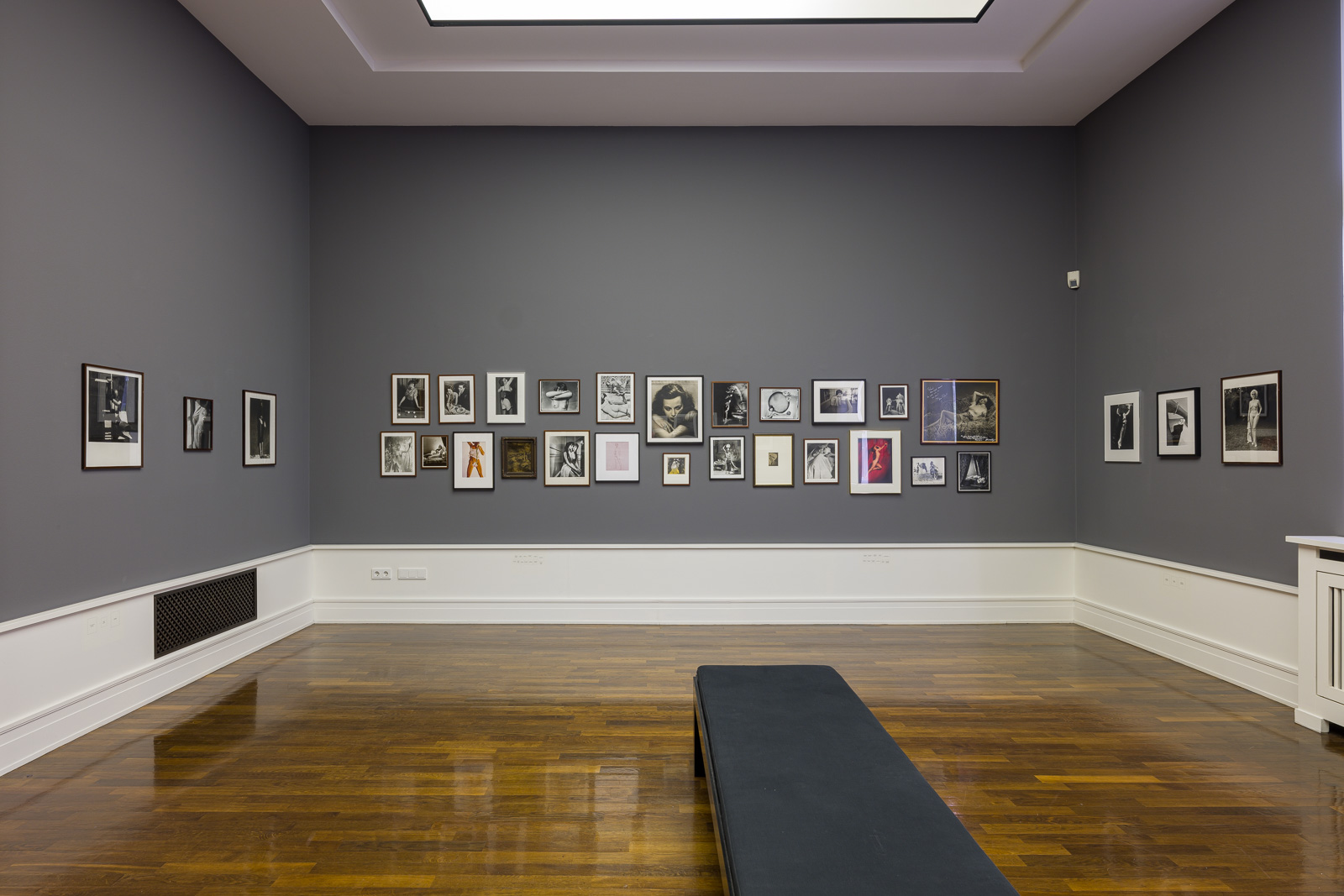
Installation view from Photo Collection of Helmut and June Newton at June´s Room, at the Helmut Newton Foundation, photo: Gerhard Kassner
It is a compelling standpoint in which to evaluate an exhibition that will inevitably come under scrutiny for a very particular representation of female bodies. Throughout there are echoes of one another’s work — Newton’s interest in dolls is evident in a 1930s’ Hans Bellmer photograph of one of his famous uncanny forms, which later reverberates in Mark Arbeit’s surrealist, cropped female nudes. Or, how the pose of Arbus’ nudist — she is as un-self aware as though she is dressed — finds a counterpart in Newton’s most famous visual signature, the duality between nakedness and being clothed. Friendship is further underscored in the numerous photographs that bear dedications to Newton and June — including a “Happy Birthday” inscription scrawled by Mary Ellen Mark.
Most of all, these ideas are realised in the relationship between June and Helmut themselves — it should be noted that June Newton edited the tenth anniversary edition of SUMO, published in 2009, as well as a number of his other books. The intense working and romantic connection between the two is memorably realised in a famous Newton photograph, Self-Portrait with Wife and Models (1980). Dressed in a raincoat, Newton is visible in the mirror with the model in the foreground. On the same plane as Newton and the mirror, is June “sitting like an art director or an editor-in-chief,” says Harder. “June was always around…”
Helmut Newton SUMO / Three Boys from Pasadena / Photo Collection runs through to 10 November at Helmut Newton Foundation