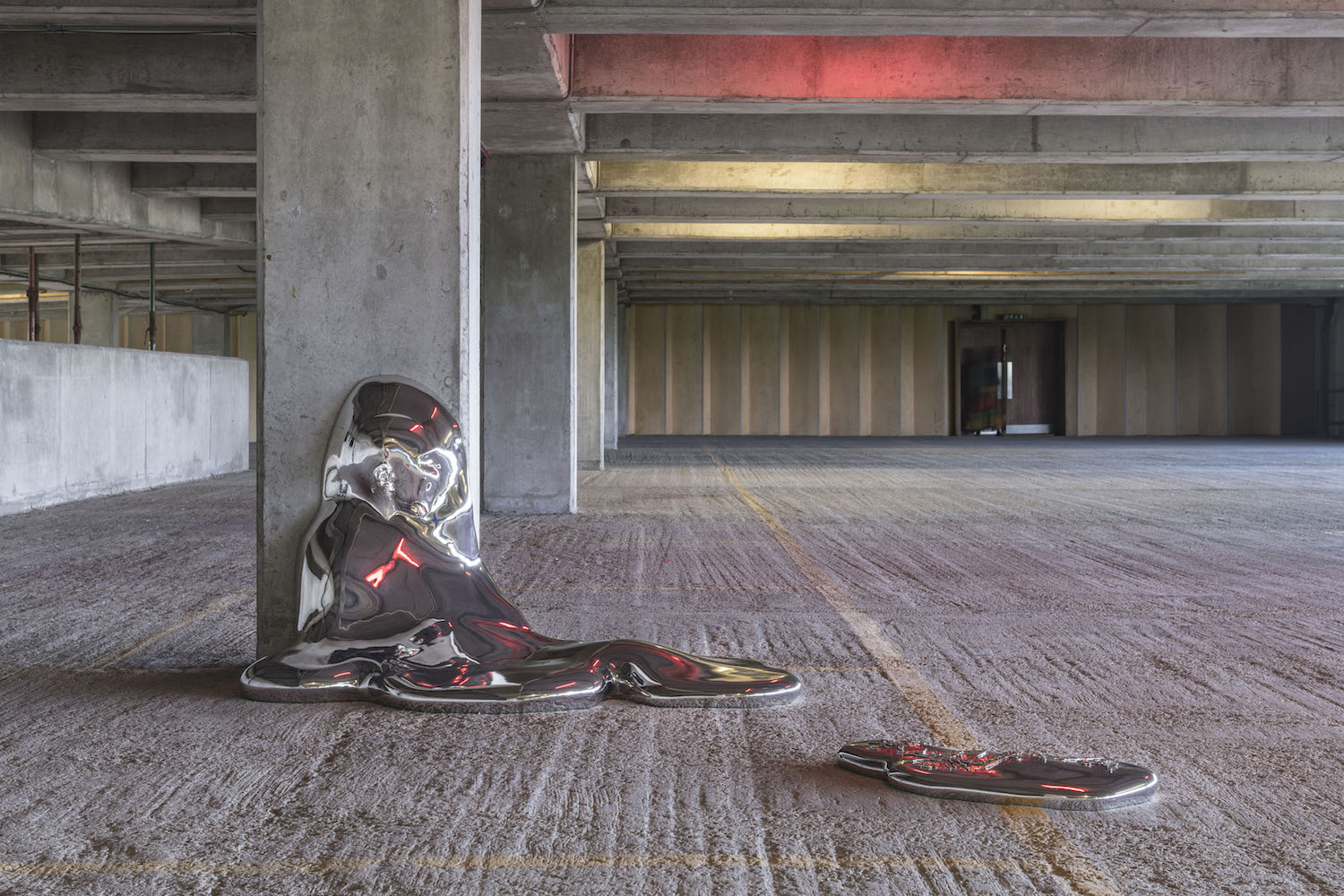
Jenna Sutela, Neither A Thing, Nor An Organism, 2018, Courtesy of the artist, Photo: Damian Griffiths.
The work of Berlin-based Finnish artist Jenna Sutela could best be described as a quivering blob of molten chrome, cellular matter and cyborgian detritus, its random convulsions threatening to burst at any moment. Epitomising this is her 2018 sculpture, Neither A Thing Nor An Organism. Apparently named after a passage on metallurgy from Giles Deleuze and Félix Guattari’s French philosophical magnum opus, A Thousand Plateaus (1980), the 36-year-old describes the reclining lump of ectoplasmic metal as “polymimetic alloy pond brain, two chrome amorphous blobs with a head and a gut emerging from them”. Her forms recall the T-1000 of James Cameron’s 1991 sci-fi classic, Terminator 2: Judgement Day, a shape-shifting android assassin which adopts the form of things it touches by replicating their molecular structure. In ‘Biophilosophy for the 21st Century’, American contemporary philosopher Eugene Thacker argues that “there have only ever been three approaches to thinking about life: soul, meat and pattern”, a view Sutela’s work seems to share. Combining lively matter with ghostly machines, her films, sculptures and installations examine the increasingly porous boundaries between all three.
This proximity between head and gut, a recurring motif in the artist’s projects, also recalls the writings of Georges Bataille, the Gallic post-war philosopher of l’informe (formlessness), whose surrealist cult, the Acéphale (from Greek, akephalos, headless) was symbolised by a decapitated man with his guts on display. Another example is Sutela’s video Nam-Gut (the microbial breakdown of language) (2017), which alludes to the origins of life on Earth (and therefore culture) in mulch and germs. The piece uses the fermentation of a kombucha ‘scoby’ (a symbiotic colony of bacteria and yeast) as a random number generator. In turn, this process creates Sutela’s nam-shub, a poetic text inspired by an ancient Sumerian incantation (which prominently featured in Neal Stephenson’s 1992 cyberpunk novel Snow Crash, a possible source of inspiration). The result is a sputtering of alien vocals accompanying diaphanous letters floating around a bacterial soup. Like Bataille, who argued that humanity’s essence is defined by its big toe, not its brain, Sutela’s generative poetry suggests that consciousness is formed deep in the humus.
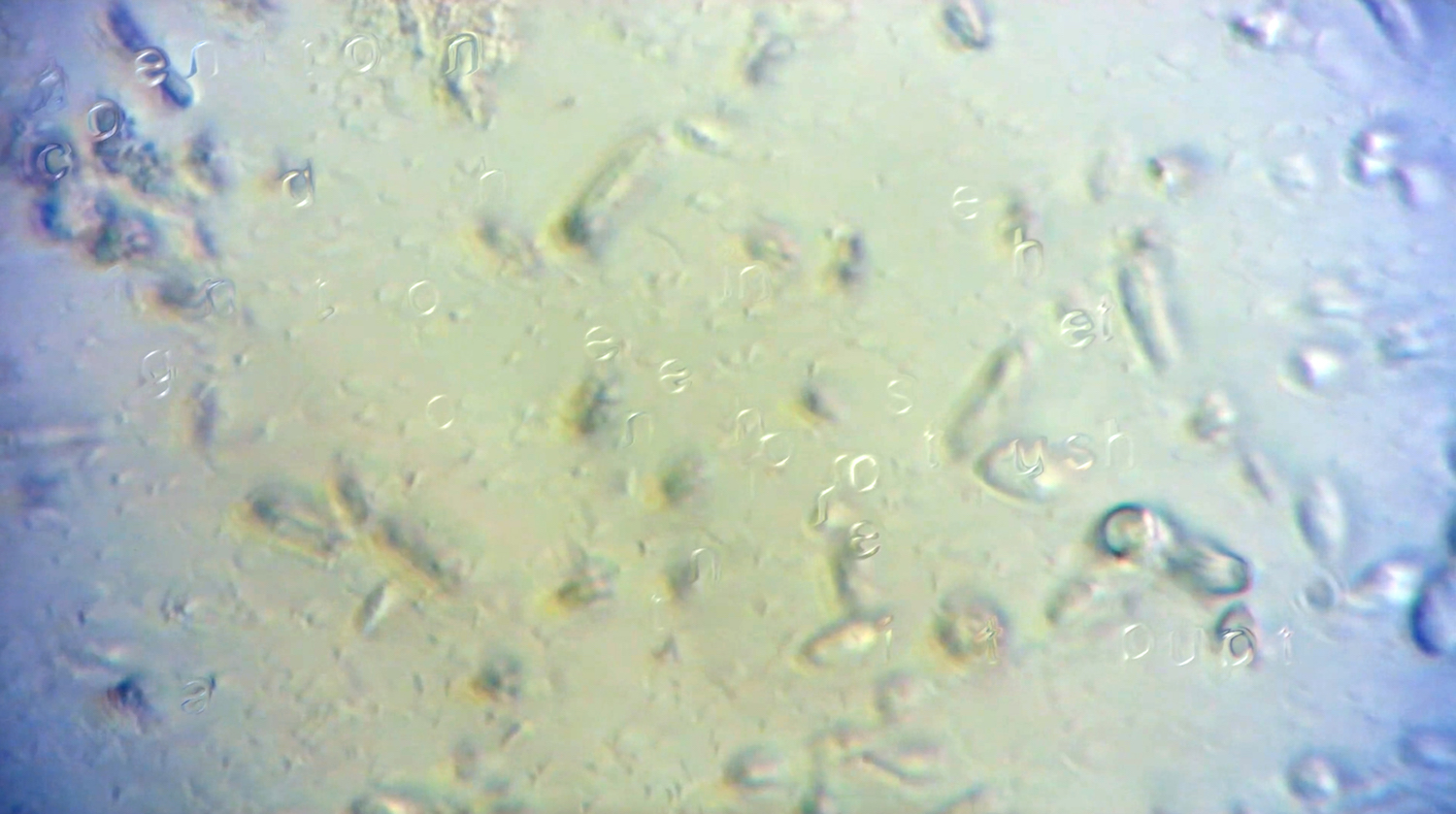
Nam-Gut (the microbial breakdown of language), video still, 2017. Courtesy the artist.
This mix of the spiritual and the biological is typical of Sutela’s work. An ongoing exhibition opening in April at Tank Shanghai, More More More (摸摸摸), uses living moss and edible algae to ‘write’ on the gallery’s walls using a ‘Martian’ language invented in the 19th century. Originally, this supposedly alien script was ‘channelled’ by the French medium Hélène Smith, but here it is generated by a machine learning algorithm. In a related video, nimiia cétiï, installed at Somerset House in 2018, Sutela interprets Smith’s Martian tongue using her own voice, as well as the movements of Bacilus subtilis, a bacteria that scientists believe has the potential to survive on Mars. The artist speaks of “making art that surpasses the human realm, and thinking about the bacterial realm as an audience”. Indeed, her subjects and interlocutors are more often single-celled than mammalian, and have so far included slime moulds, algae blooms and water bears. Inspired by science fiction and often working with laboratory researchers (she is currently working with microbiologists at the Massachusetts Institute of Technology), her artworks feature a diverse cast of microfauna that emerged aeons before us, and will continue to inhabit the planet long after human beings are gone.
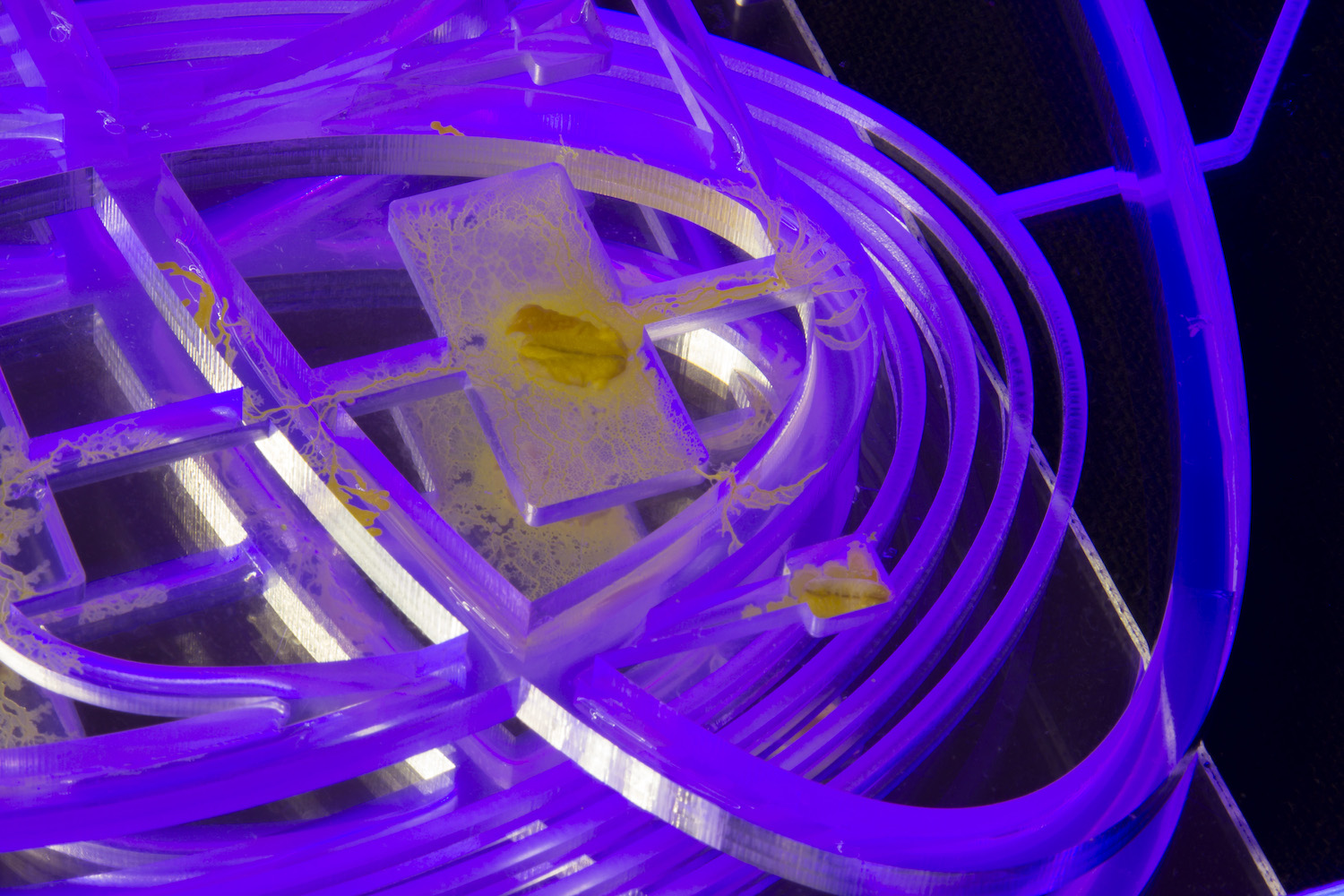
From Hierarchy to Holarchy, 2015, Photo: Mikko Gaestel.
As the boundaries between ‘things and organisms’ blur—particularly in the age of synthetic biology, with programmable cells and advanced forms of artificial intelligence—it increasingly seems as though we exist ‘outside’ of ourselves, peering in. Recent novels and films preoccupied with the ‘xeno’—the foreigner, the stranger, the outsider—have begun to address this. These include: the alien visitors of Jonathan Glazer’s Under the Skin (2013) starring Scarlett Johansson; Denis Villeneuve’s Arrival (2016)—based on Ted Chiang’s sci-fi novella ‘Story of Your Life’ (1998)—and Jeff VanderMeer’s 2014 Southern Reach trilogy of novels, the first of which, Annihilation, was adapted as a film directed by Alex Garland in 2018. These disturbing narratives tend to displace the centrality of their human protagonists, undermining our belief in rational order and natural selection—stories from our hard-earned Enlightenment that have long consoled us.
Sutela, too, is interested in channelling the language of the idea of the Other in her work. Until 10 May, she will be participating in Genders: Shaping and Breaking the Binary, a group exhibition at Science Gallery London. Following this, she will be showing at the Liverpool Biennial (11 July to 25 October), this year dedicated to the body and its relationship with the world. Moreover, her art arguably enacts a critical function, questioning the fragile foundations of human rationality, observing that we have neither a monopoly over intelligence nor consciousness. Her practice is poetic and often playful, foregrounding ethical questions of how to live, not only with other human beings but with other ecosystems. Referencing what the American art historian Caroline A Jones calls ‘symbiontics’—the need for a more interconnected understanding of being—Sutela says she is interested in “developing a culture that’s based on interspecies symbiosis rather than the ‘survival of the fittest’ narrative”.
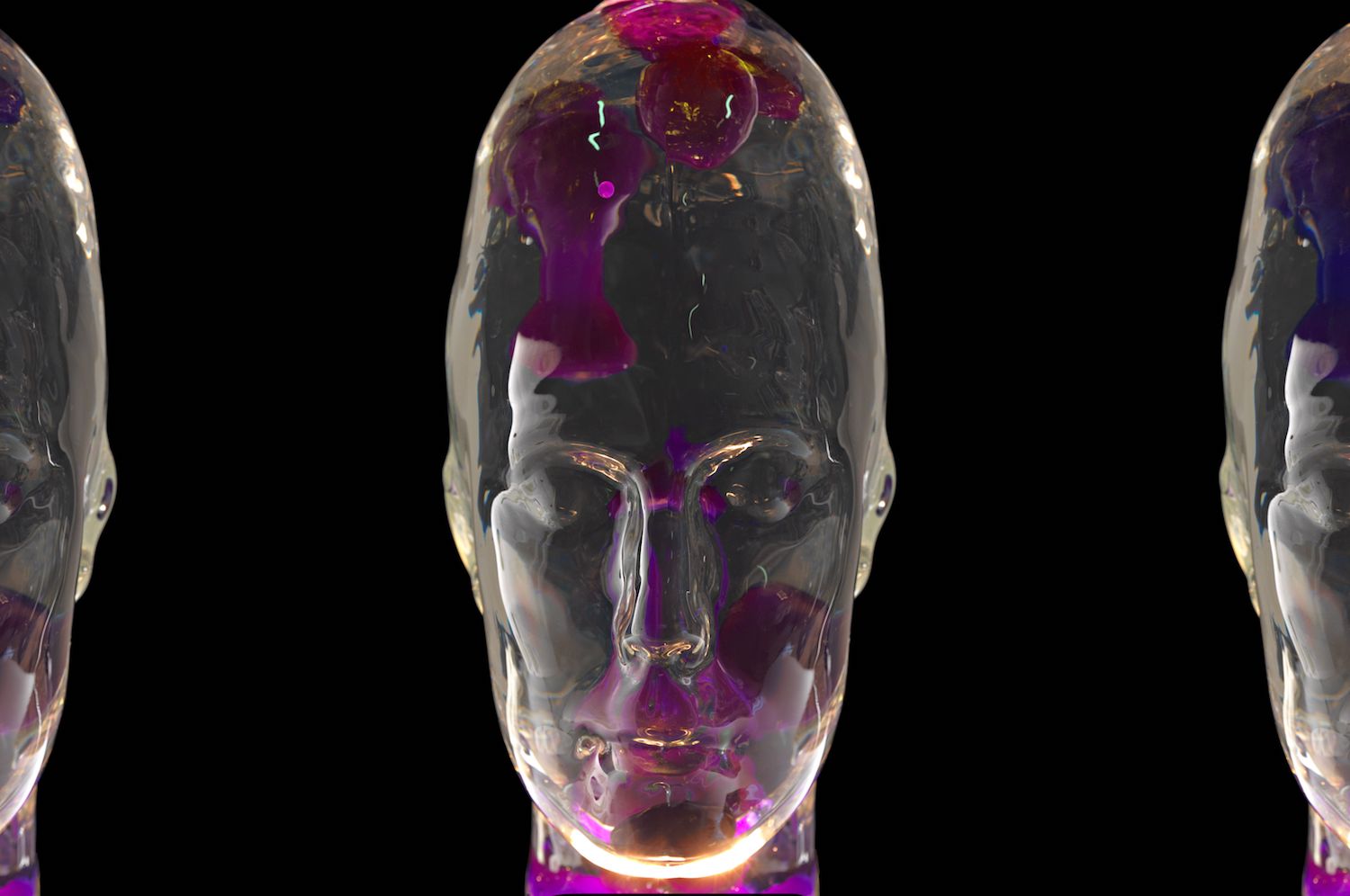
I Magma, 2009, Courtesy the artist.
"With a little less hubris, Sutela seems to suggest, there is much that we could learn from slime."
In a series of work beginning with From Hierarchy to Holarchy in 2015, Sutela staged exhibitions and performances using the ‘many-headed’ slime mould Physarum polycephalum as her agent and guide. Physarum is a yellow slime that has long beguiled biological researchers with its ability to make complex decisions and solve spatial problems. As Sutela says, “I am fascinated by Physarum polycephalum because of its amorphous body and collective mind—it has been called a natural computer.” Resolutely single-celled and brainless, it is nonetheless able to self-organise through the decentralised interactions of its many nuclei. While it lacks neural matter, its slimy trace acts as an externalised memory, a figurative kind of ‘autobiography’.
In From Hierarchy to Holarchy, Sutela placed Physarum inside a plexiglass labyrinth in the shape of an organisational diagram which the mould navigated in order to find food. Sutela’s interest in the organism has led her to researchers from Turku to Tokyo, spored across exhibition spaces in London and Berlin, and, at times, performed ‘through’ her in ‘many-headed readings’ prior to which she ingested a little Physarum. “I imagine that its hive-like behaviour is programming my own,” she says. For Sutela, Physarum offers a stark contrast to the problems of organisation, both technical and sociological, which have plagued human history. With a little less hubris, Sutela seems to suggest, there is much that we could learn from slime.
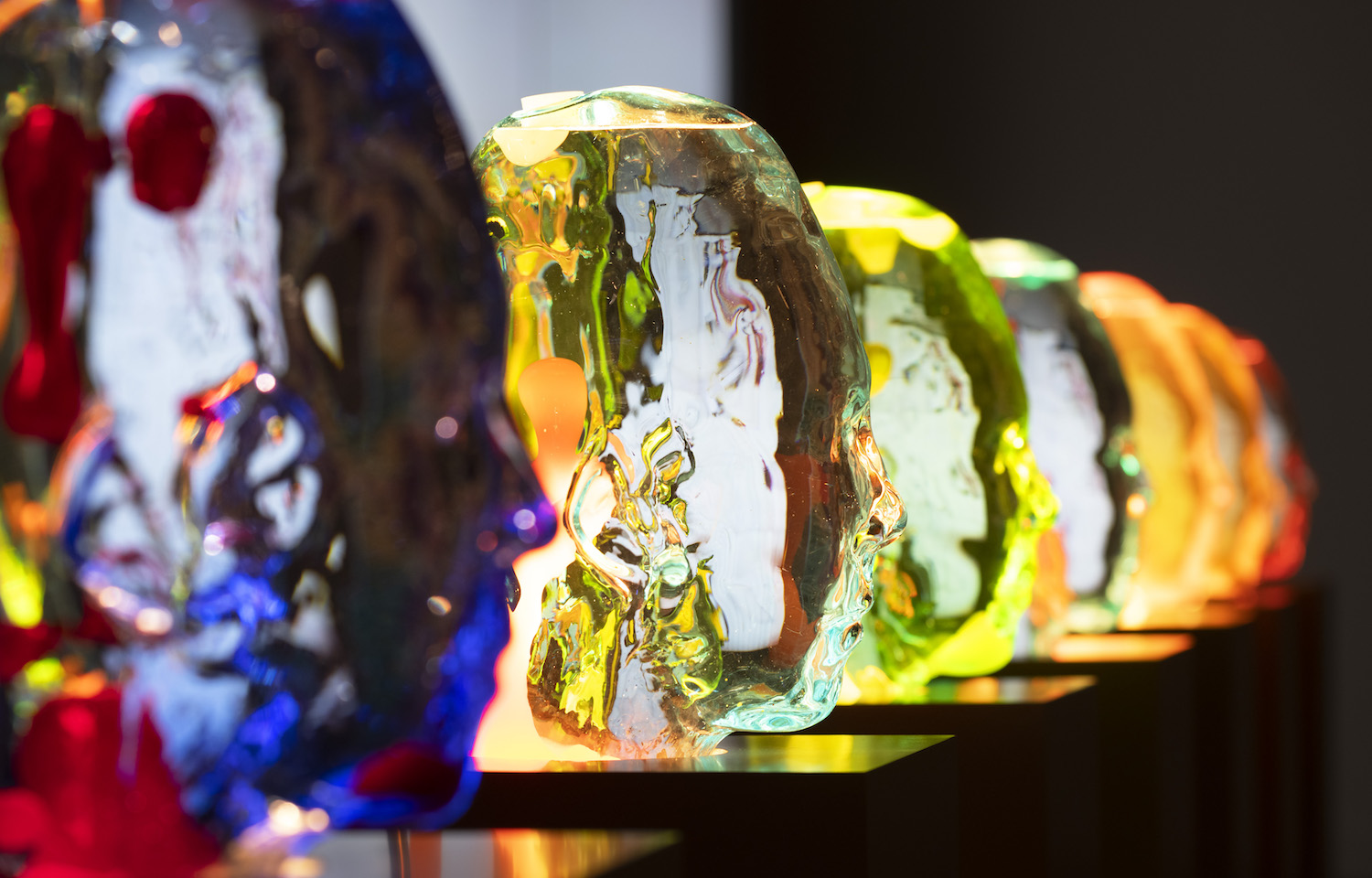
Unter I Magma (2019), a multimedia project co-commissioned by Stockholm’s Moderna Museet and London’s Serpentine Galleries, Sutela created a series of glass lava lamps in the form of her own head (her ongoing exhibition, No No Nse Nse at Kunsthall Trondheim, presents photograms based on this series). Glowing globules of molten wax drift through them, creating totemic energies. The lava’s movement is used to generate fragments of premonitions in a corresponding mobile app of the same name. Reminiscent of the popular personalised horoscope app Co-Star, Sutela describes the I Magma app, created in collaboration with the American poet and programmer Allison Parrish and the Turkish artist Memo Akten, as a “machine oracle” which generates daily divinations using AI trained on literature from the Internet Sacred Texts Archive. While the app by itself can feel a little ephemeral, the cryptic daily premonitions it delivers are surprisingly affecting, casting their own ambient spells on the day. Examples include: “You are not a one”; “Our veins have been the different channels”; “It is written from the mooned net”; and “Early reign, the lunar goddess”.
From Mud Muses, A Rant About Technology. Courtesy of Moderna Museet Stockholm.
‘Lava’ was famously first used as a random number generator in Silicon Valley in the Nineties, and later developed by the San Franciscan online security firm Cloudflare in 2017, who designed the Wall of Entropy, an assembly of 100 lava lamps whose unique molten forms are employed to model unbreakable internet encryption codes. While Cloudflare used its lamps as a source of mathematical unpredictability, Sutela says she is “look- ing for signs of pattern and meaning in the randomness”. It is poignant to note, in an era of ubiquitous computation, that true randomness,a ‘language beyond language’, so to speak, here embodied in the movement of one liquid inside another, remains one of nature’s most potent resources.
Chaos theory emerged via the image of pollen grains dancing on a droplet of water. That molecular ‘noise’—the random movement of particles in liquids or gases—was first observed by the botanist Robert Brown in 1827. Deemed unfathomable until later developments in thermodynamics, it seems a useful way to consider Sutela’s work, too. As a system of order and disorder, her art is comparable to Brown’s chaotic idea of noise. By channelling patterns of fluid single-cell forms and the spiritual presence of artificial intelligence, she opens up the possibility of an encounter with other beings who have been ‘in the room’ all along: our cohabitants, symbiotes and other ghosts in the machine. In conversation, she says that the urgent concerns of climate change and her new baby have bolstered a desire to address her work to non-human forms of community: “I’m feeling very human animal right now … I want to represent a certain era and a certain species in the best possible manner.”
This article originally appeared in SLEEK 65, jetzt erhältlich.
No No Nse Nse is running online at Kunsthall Trondheim through to 29 August.
Genders runs through online at London Science Gallery to 28 June.