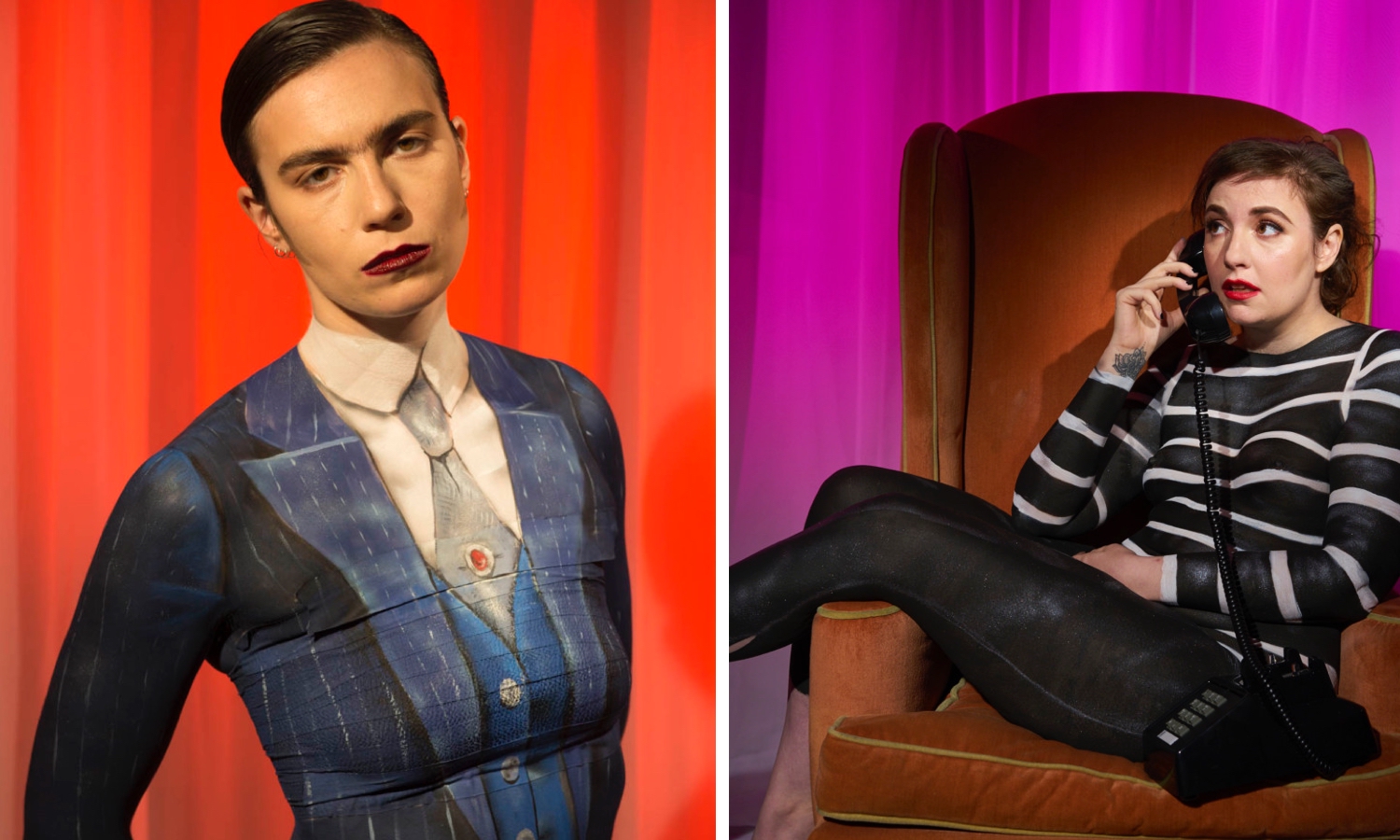
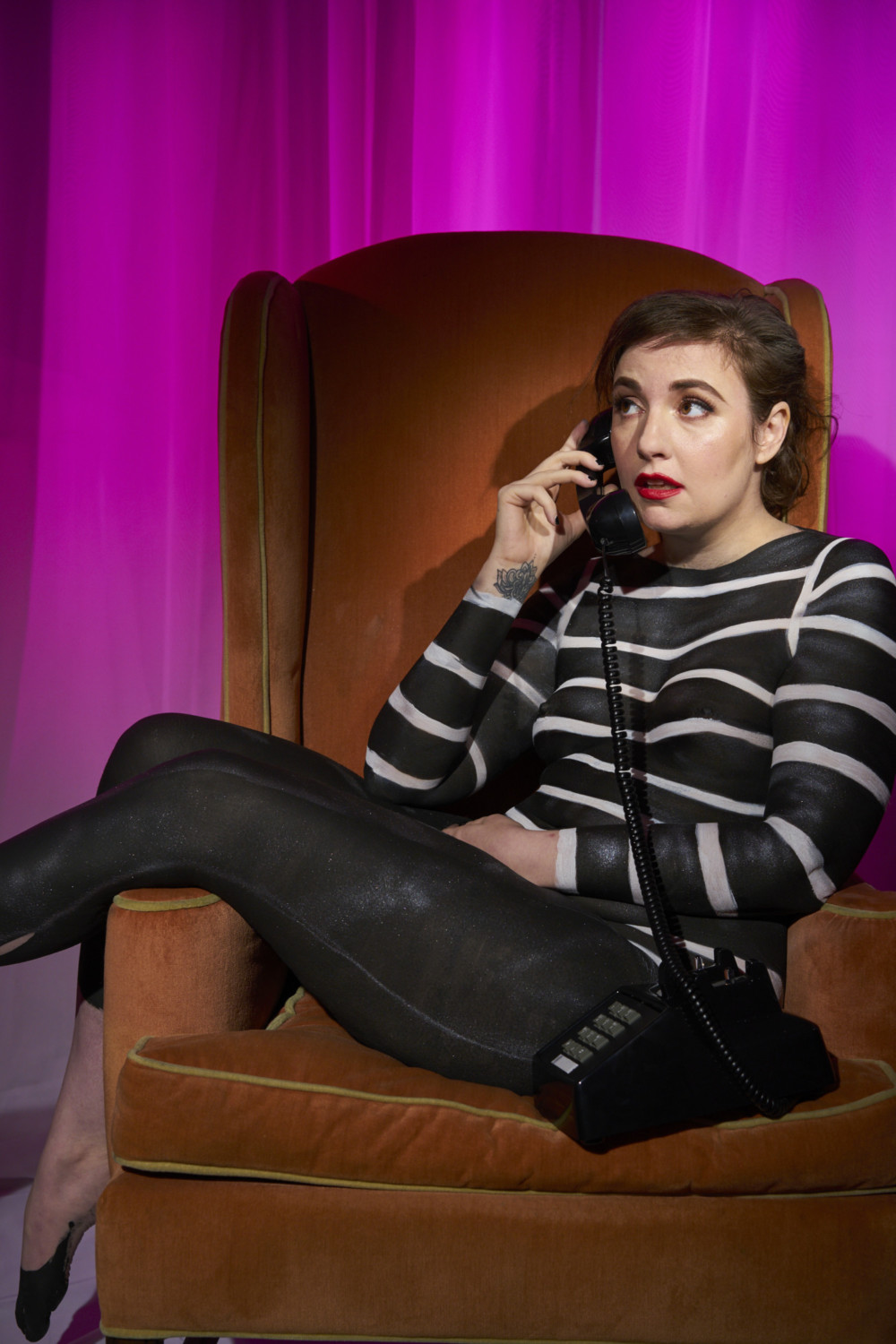
LAURIE SIMMONS, from the series Some New (Lena/Pink/Alternate View), 2018. Courtesy the artist and Salon 94
“I’m transitioning too,” says Laurie Simmons, both tongue-in-cheek and very sincere. She’s referring to her youngest child, Cyrus Grace Dunham, who transitioned this year. Cyrus’ new memoir, A Year Without a Name (2019), details their personal experience of gender dysmorphia, but in a family like the Simmons’, it was everyone’s business.
Few families today are so publicly visible while also being so creative and tight-knit. First, there’s Simmons herself, an artist and filmmaker; then there’s her husband, the painter, Carroll Dunham; her eldest child, the writer and actor Lena Dunham, and Cyrus, who apart from being an author is also an actor and trans activist. They are the type of bohemian family you might associate with the Manhattan avant-garde of the early 20th century, and therefore an obvious choice of subject for Lena’s lovingly parodic, auto-fictional breakout film, Tiny Furniture (2010). In the film, Lena plays Aura, a recent college graduate returned home to the downtown loft of her exasperated artist mother, Siri, portrayed by Simmons, whose practice consists of taking staged photos of dollhouse furniture.
The real-life Simmons is known for similar artistic subject matter, but her work is far more varied and yielding. Though some of her work have suffered a relative lack of visibility, her recent retrospective offered a welcome corrective. Laurie Simmons: Big Camera/ Little Camera, which opened in 2018 at The Modern Art Museum of Fort Worth, Texas, and travelled this year to The Museum of Contemporary Art, Chicago, offered viewers a chance to roam freely through the intimate worlds Simmons has been creating since the Seventies. These worlds are inhabited by dolls and dummies, candy-coloured domestic interiors, animistic objects, friends in disguise.

LAURIE SIMMONS, from the series Some New (Grace/Orange/Alternate View), 2018. Courtesy the artist and Salon 94
Her newest and most personally reflective series, however, is Some New (2018–), first shown at New York’s Salon 94 Bowery last year. Featuring models largely stripped of clothing and painted partially or entirely in body paint, the series has been a means, in part, for her to explore her relationship with Cyrus and Lena, as well as several new people who have come into her life of late.
One source of inspiration for this body of work arose from Simmons’ discovery of online videos of women who’d had their lower halves carefully painted to make it appear as if they were wearing jeans. In these films, a crew followed behind, documenting the public’s reactions. Given that Simmons has long trafficked in illusion, she was beguiled by these films, and subsequently tracked down the make-up artist responsible for these painterly masterpieces, convincing her to work with her. Simmons explains, “I loved the idea that, for a few moments, it was like I was making paintings, in a really strange but conceptual way. And then of course there’s the idea that my subjects are naked and the only thing between them and the world is what we’ve chosen together to paint on them.” The idea of the ‘Emperor’s new clothes’ was also very much on her mind in light of the political predicament of Donald Trump, specifically the notion that the presidential disguise is a complete illusion. Lena and Cyrus appear in Some New (the former as Audrey Hepburn, the latter as Rudolph Valentino), as do some of their friends, including some belonging to Cyrus’ circle of queer and trans activists. She allowed each person to collaborate on their presentation, their degree of exposure, their painted ‘outfit’, encouraging each to participate fully in their representation. “It’s as real as I get, it’s the closest I’ve ever gotten to portraiture,” Simmons says of this work. “I never think of myself as someone who’s able to take a portrait, I need the artifice. The uncanny needs to exist in real life. The uncanny needs to be uncanny.”
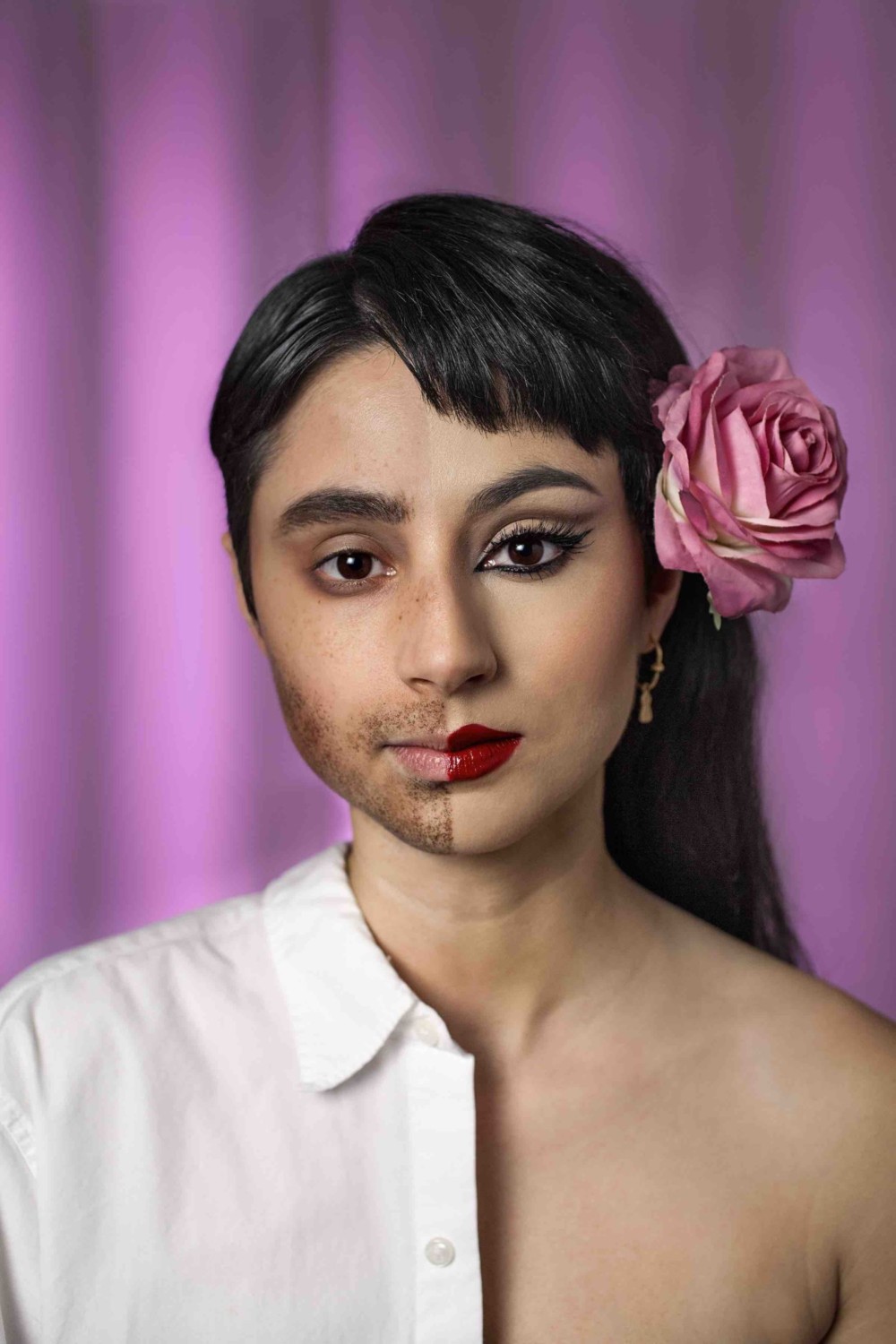
LAURIE SIMMONS, Some New: Half Moon/Half Woman, 2019. Courtesy the artist and Salon 94
Uncanniness takes on a more expansive set of meanings in Some New. Some of the irreverent tricks remain (body paint, for instance), but the subject is more sober, its implications more political. What could be more uncanny than the feeling of being trapped in the wrong body, assigned an incorrect gender? What could possibly produce a more acute experience of unease? With these recent portraits, especially those of trans subjects and subjects rendered as both male and female (Some New: Half Man/Half Woman [Lavender], 2019), Simmons has returned to the tension of captivity and freedom – to be trapped in a body might be as oppressive (or more so) as being trapped in a house. As the trans artist, Zackary Drucker, recently suggested in reference to the works of trans photographer April Dawn Alison, “A photograph is a type of body.” Simmons’ newest images might just offer that body the possibility of escape.
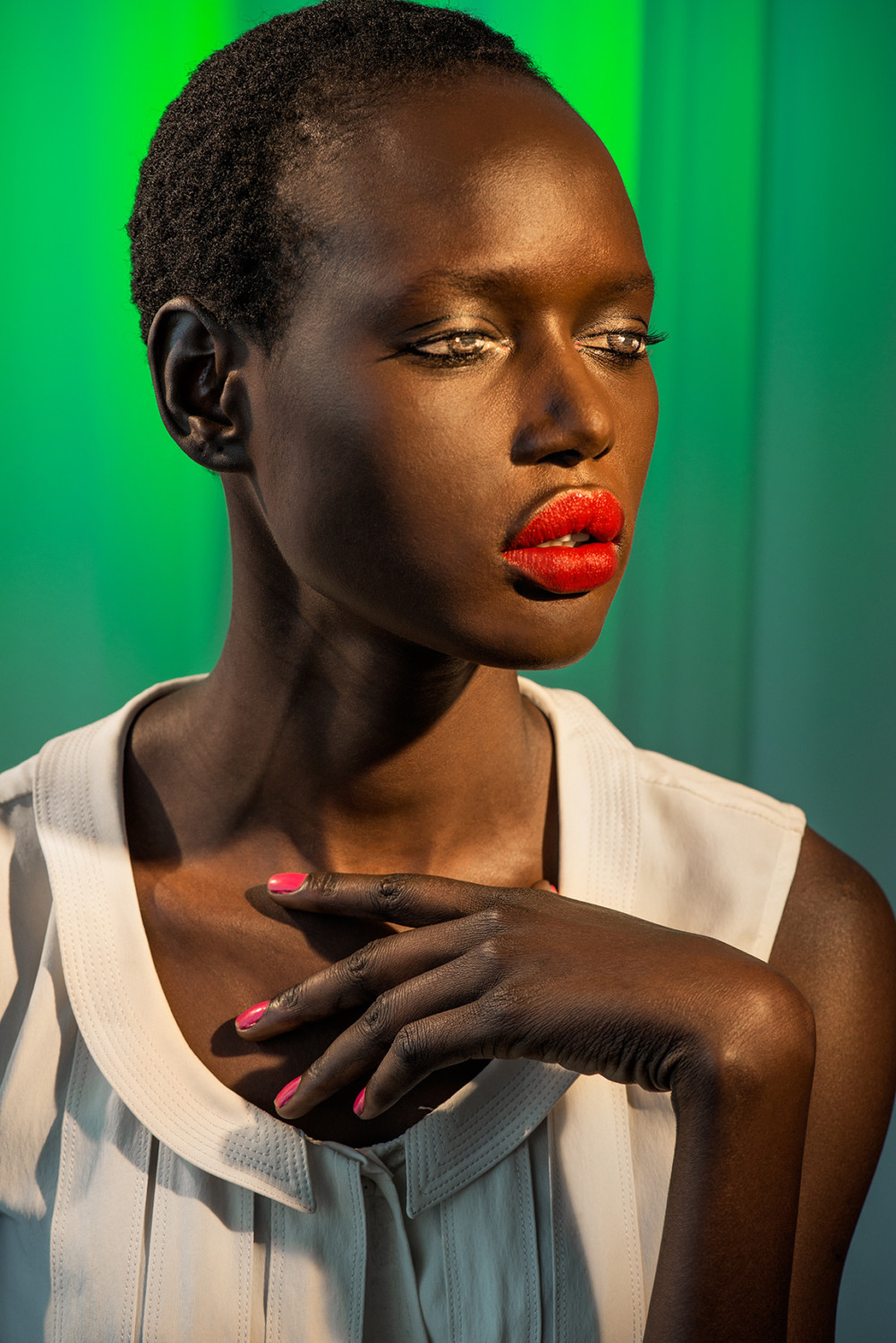
LAURIE SIMMONS, How We See: Ajak (Green), 2015. Courtesy the artist and Salon 94
A fascination with expressing the many ways of being began long ago. When Simmons graduated from Philadelphia’s Tyler School of Art and Architecture in 1971, she fell naturally into the medium of photography – both for the ease and transportability of it, but also as a conscious way of rebuking the hegemonic cult of male-dominated Conceptualism. She and Cindy Sherman met and became friends in 1979 at New York’s Artists Space gallery when Simmons had an exhibition there. At the time, their artistic affinity converged around their engagement with so-called ‘setup photography’, whereby constructed tableaux and/or elaborate costumes were crafted expressly for the frame. Though photography has remained Simmons’ principal medium, she’s found ways to animate and diversify it through art films such as the puppet musical, The Music of Regret (2006), as well as My Art (2016), a feature-length film about a middle-aged female artist, also played by Simmons, struggling with her lack of recognition.
Engaging with constructed environments and manufactured identities over the course of five decades has made the artist an icon of feminist art alongside Sherman, Martha Rosler and Lynn Hershman Leeson, among others. Yet she insists that her entry into the subject matter that kindled her career was not entirely planned. Early audiences saw the work as a “feminist critique of a woman trapped in the kitchen, trapped in her own home: a domestic captive”, she says. “But I was really thinking about my very whitewashed post-World War II Jewish upbringing, where everything looked perfect.” Gradually, however, the inanimate objects began to move, sprout legs (as in Walking & Lying Objects, [1987–1991]), assume Dadaesque absurdity and emancipate themselves. “I anthropomorphised everything,” Simmons adds, “I imagined my dolls coming to life, I imagined my pets could talk, I imagined objects getting up and walking away.”
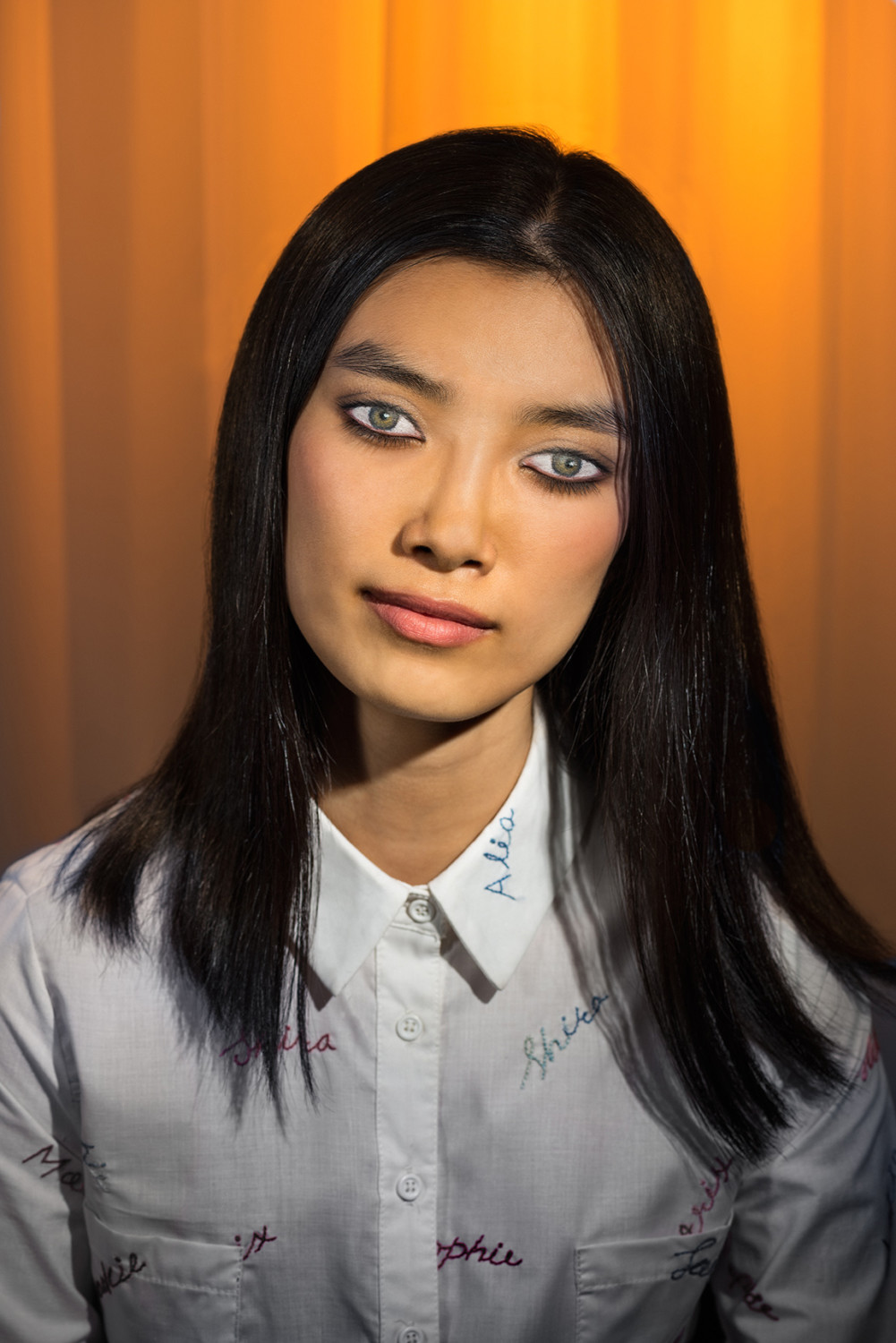
LAURIE SIMMONS, How We See: Sisi (Gold), 2015. Courtesy the artist and Salon 94
The tension between captivity and freedom, be it structural or physical, has continued to influence her work, even as she’s moved increasingly into photographing live subjects. The critical precursor – the transitional object – may have been sex dolls, which the artist first encountered on a trip to Japan in 2009. These life-size female replicas are designed to offer companionship and sexual surrogacy to their lonely, predominantly male, owners: uncannily human-like silicone mannequins replete with engagement rings and vaginas. Enthralled, Simmons ordered one, then a second, and shot them for a series called The Love Doll (2009–2011) in a range of positions and outfits at her Connecticut home. In these pictures, Simmons gave her dolls the trappings of a rich and fancy life in the countryside, but their placid, vacant, almost-human expressions suggest a total spiritual lacuna. It was a relatively slight conceptual leap to arrive at her 2014 Kigurumi series, in which a human model donned an oversized Japanese anime-style mask and posed in a variety of settings. The intuitive next step was to strip off the mask – but not entirely. In her series How We See (2015), the closed eyelids of her human models are painted meticulously to appear open. Whether to suggest a dream state or a void, the closed/open lids make for an eerie sleight of hand.
The artifice and constructedness of these scenes today find themselves reified on social media. In a sense, Simmons’ artistic conceits foreshadowed the Age of the Internet, or at the very least, the Age of the Influencer – this present period in which people carefully produce the illusion of experience and perfection exclusively for their social media followings. Simmons thrills to the labyrinthine offerings of online culture: “I was waiting for the Internet without knowing it,” she exclaims. “I can get really lost, go down the rabbit hole,” adding that, “People laugh when they hear how many hours I’ve spent watching Japanese make-up tutorials. I know the Internet does bad things, but it’s made my life a lot better.” It was the collision of ‘rabbit hole’ discoveries with the more intimate changes in her family life that spurred the most recent series of images. Cyrus’ decision to transition became a kind of inspiration and imperative – this is a family, it’s clear, in which creative influence is reciprocal.
This article originally appeared in SLEEK 64, jetzt erhältlich.