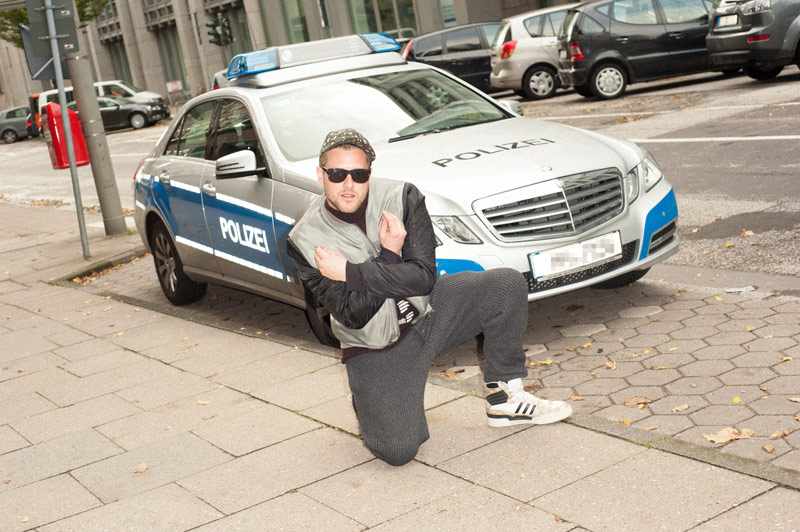
 YEAH BWOY – Uwe rocks a youthful hip-hop look in front of a car belonging to Hamburg’s finest (note: do not try this at home). Bomber jacket: H&M, Jogging pants: Dries van Noten, Leopard-prnt cap: H&M, Sneakers: ADIDAS Vintage
Surely no one would go so far, but one has to admit that those designs do add some flavour to the otherwise quite restricted palette of male dressing. Barbara Vinken, who recently published her book “Angezogen” (“Dressed”) to wide acclaim, even says that there is no such thing as male fashion anymore. She argues that the suit, the only socially acceptable dress for men of a certain standing, hasn’t really changed since 1830. Therefore fashion, when understood as the coming and going of trends, can only be found in those looks that do away with the suit.
If the suit is the uniform for any man of whom society requires some accountability, the next look has become the uniform for every 20- to 35-year-old who feels kind of edgy but fears the tight grip of life – and possibly the cut from daddy’s wallet – more than anything. Having fulfilled his shopping dut-ies, Uwe is now dressed in a beanie, a biker jacket and some checkered shirt over a printed T-shirt. To say the least, Uwe is totally uncomfortable with himself: “I feel like an asshole,” he says of this phase in the experiment. He instantly gets in a bad mood and only half-jokingly ponders whether someone will physically assault him.
But one cannot really blame some designer locked away in his far-from-reality atelier for this. Yes, it is true that the craftsmen of high fashion and the high street alike have a thing with youth culture and the various looks it developed, but the Peter Pans of this world have all too happily embraced those styles themselves. In a state of YOLO, no one needs a designer to look his possible worst. So while this outfit is the most normal, it is also the most impossible for any self-respecting man to wear.
When Georg Simmel published his “Philosophy of Fashion” in 1905, the sumptuary laws, once established to keep the lower classes from wearing the nobleman’s frocks, were long since history. But as far as Simmel was concerned, those rules were still somehow intact, as he understood fashion as a means of adapting to one’s peers and seeking distinction from the lower classes. Trends would then sort of trickle down from high to low. Where better to test that theory than at Hamburg’s Neuer Wall, one of the city’s posher shopping streets. It is just after lunchtime and Uwe now wears what the experts call “luxury streetwear”: a Louis Vuitton pullover and some Dries van Noten sweatpants styled with a camouflage hat and a shiny blouson jacket. In short: the affluent types are not amused. Funnily enough, the ladies even seem to be hiding behind their scarves, which are by the very same brand that knits Uwe’s sweater. Don’t they recognise their kin? Apparently not – and why should they? The cues designer fashion takes from the street – in contrast to Simmel’s trickling down theory – and which do find their way onto the catwalks, are seldom emulated by those with power.
Worked up by the effects his gangsta-with-a-payday-loan had on Hamburg’s well-off, Uwe decides to spend his afternoon parading around in this get-up some more. The frivolity-phenomenon we witnessed with the man-boy look now seems to be at play as well, as we can see him posing in front of patrol cars and in general behaving rather childishly. He’s still our man, still our Uwe and there’s obviously lots of irony involved, but one can’t help but wonder about the infantilising effects of that style. Hip-hop fashion does make men look like teddy bears after all. “I don’t wanna look like a young ’un, so why not go back even further?”, the logic seems to go. No wonder its advocates develop a fondness for long steely weapons too.
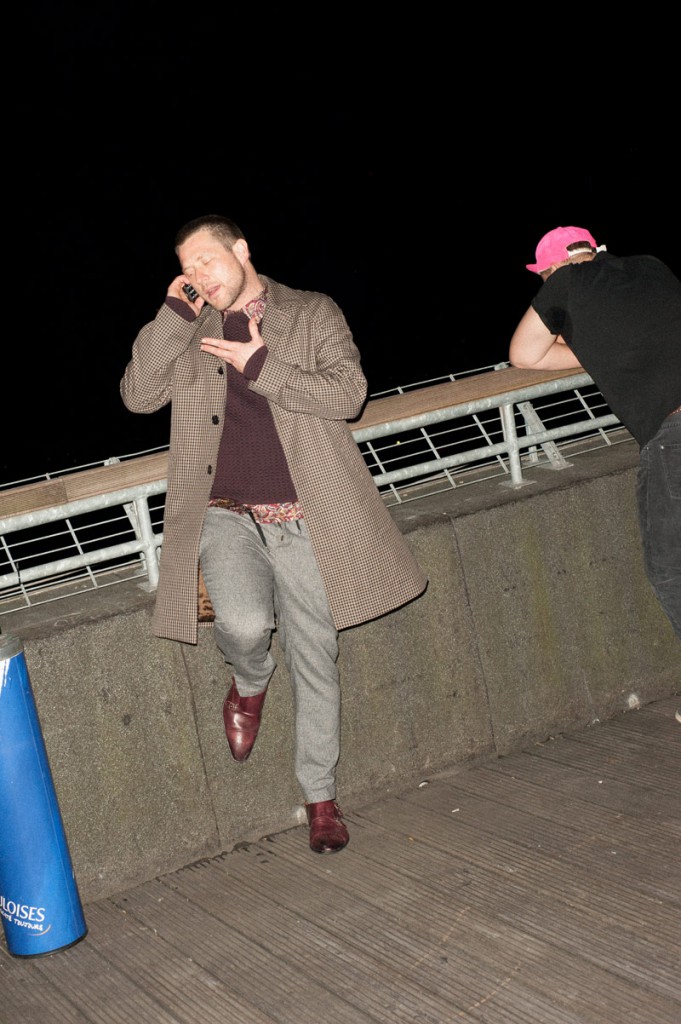 MANLY – This tweedy outfit lends gravitas to Uwe as he takes an important business call outside Hamburg’s trendy Kraniche nitespot. Silk shirt: Dries van Noten, Sweater: Calvin Klein, Pants: Diesel Black Gold, Coat: Prada, Shoes: vintage
Later, at night, it’s “back again” (and a bit beyond) for our control sample. After a whole day of youth-ful, boyish, and even toddler-style fashion, Uwe changes into a contemporary look that takes him a bit closer than he would normal-ly go to the Mis-ters, Sirs and Herren of this world. It comes as no surprise then, that upon arriving at the trendy “techno shed” Kraniche, Uwe is a little anxious that his friends will laugh at him for what we want to call “The Gent” look. He assumes that a Prada coat, paisley shirt, flannel pants and monks might seem “off” in this location, but – alas – no one takes any notice. It is just Uwe who apparently feels the need to add a slightly more cocky air to the confident manners he regained so quickly. Why is that?
Much like Simmel, Thorstein Veblen argues that we dress to impress. The sociologist, who in 1899 wrote his “Theory of the Leisure Class”, called it a little differently (“conspicuous consumption” to be precise) but nonetheless, fashion for him was a way of showing others what social class, or stratum, one belonged to. The higher up the food-chain, the more show-off, or wasteful, one’s clobber. It sure does work here: as the look is unexpectedly appropriate – and as such not the object of ridicule – it manages to bring out Uwe’s inner “big daddy”.
So the question remains: who would want to wear clothes that make us climb down life’s ladder not just a few but almost all steps? Yes, these looks might be very fashionable – in the sense that they are not a uniform – but for any grown man they are inappropriate at most, if not ridiculous. The comfort of toddler-style pants quickly vanishes when laughed at by your bank manager. Dressing-down, nowadays the most common fashion advice, only works to some degree. If one takes it too far, those jolly looks will even make him behave like a coy schoolboy or like one of those ne’er do wells from the suburbs, just like they did with Uwe. Something no man could truly want for himself – even if we as a society have become very forgiving.
The desire to dress up on the other hand, often brings out a male stereotype which is no longer in chime with our postmodern concepts of gender roles and the equality of sexes. It also feels very stuffy. This clearly cannot be the goal either. What’s a man to do then?
That question, which is asked in front of wardrobes and changing rooms the world over, can only be answered from case to case, from man to man. But it should never be answered with blind faith in everything that contemporary fashion has to offer.
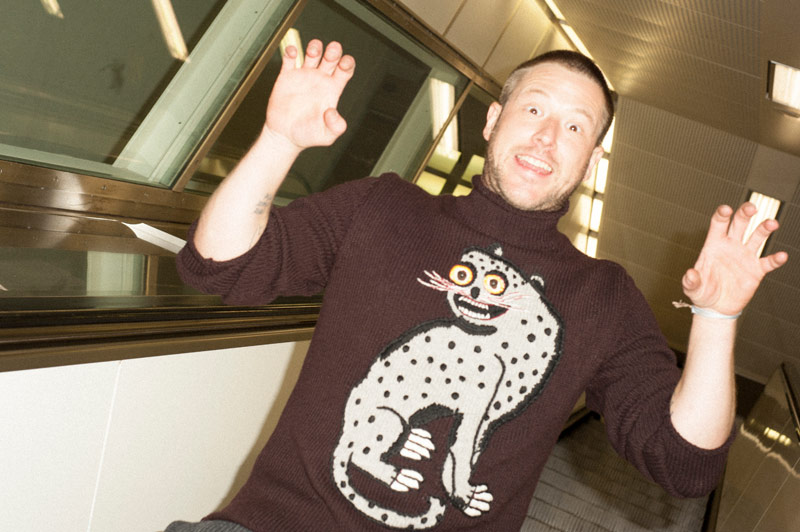 FIERCE – Uwe sports a fashionable luxury sweater by Louis Vuitton, while channeling the spirit of a big cat. Raaaarrgh! Sweater: Louis Vuitton