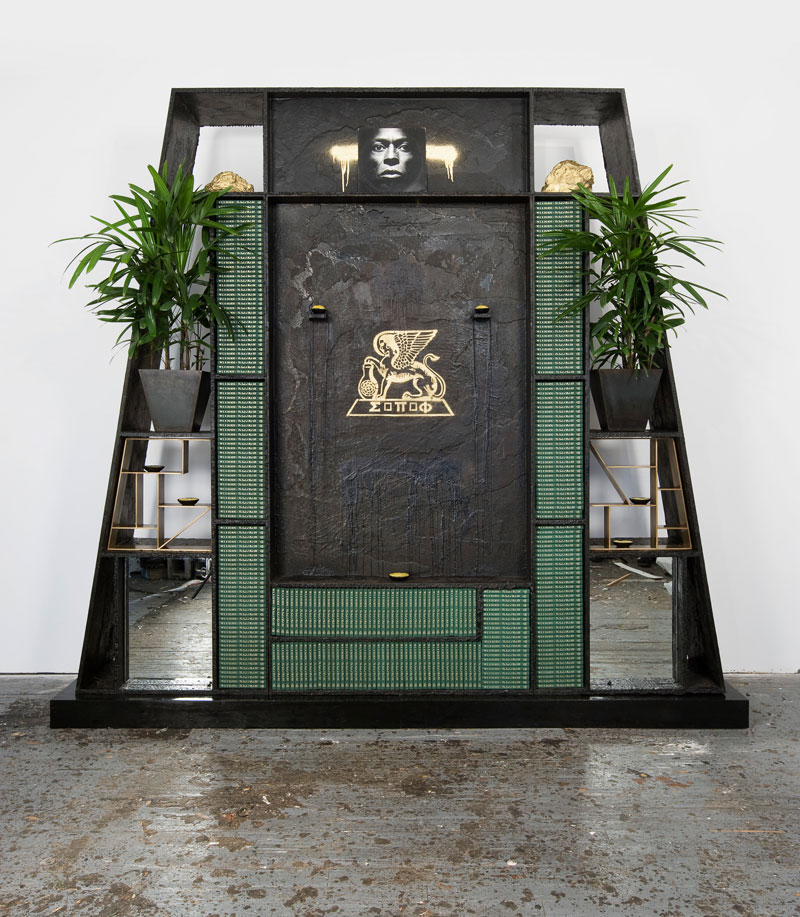
Schlank: Tell to me about your relationship with materials: what do you find interesting about the ideas around drips and spatter and spill?
RJ: There’s inherently a sloppiness to it that I relate to. Unpredictability. I think it speaks to my interest in improvisation. I’m a big fan of jazz and avant garde jazz. I’m a big fan of hip hop and a lot of the root of hip hop is this improvisation of language, this quickness. This idea that language just comes to you and is born in this rhythmic pattern.
In my work, there’s quite a bit of digging, scratching and a lot of what I always considered removal of material, more than application of material. More often we would consider the work of a painter and we’re thinking about almost exclusively the idea of addition. He takes the paint and he adds to the surface and through that addition an image or whatever is born. My process is – I don’t want to say more complex than that – but certainly more layered. There’s a tremendous amount of application, materials being melted, being created to apply to a surface but then after that initial application there’s a whole process of removal. Whether that’s scratching from the surface, digging from the surface, taking away from the surface. That takes me back to my days initially learning about photography, which is a subtractive process. We call it taking pictures. That for me is a really important aspect of how I consider making things.
Schlank: You’ve used a lot of domestic materials, such as bathroom tiling or parquet flooring. What do you find interesting about contrasting those structures in contrast to all those textured things you use like shea butter or wax?
RJ: I’ve always been interested in domestic space. I think part of the ownership that people are able to acquire from my work is a familiarity with the materials. This kind of “I know what that is” but also “I don’t know what that is”. I think even with the shelves. We understand what a shelf is, or what an altar is, or however you want to describe them. I’ve often described them as something to put something on – like a vehicle to place things. We all need a place to put our things, whether it’s our emotional baggage or when you come home and you take your keys out of your pocket and you have a side table and a bowl that you place them in. It’s the comfort of knowing where your things are. For me a lot of this work has been an opportunity to place my ideas, my concepts, essentially a lot of this work is my sidetable. The place where I need to locate my ideas, my concepts, the things that I struggle with and the ideas that I’m trying to negotiate. My work has in a lot of ways become that place.
Schlank: What do you find interesting about the defunct sound elements in your work – radios we’re not hearing, records that aren’t being played…
RJ: I feel like there’s an opportunity to employ the work differently than you’re witnessing it. That for me is really significant. I made my mother a work and I talked to her a few months later and she was using it! In her space it was very utilitarian. It was a value tool and it was something that was living way outside of just enjoying the aesthetic object. It was an album she was listening to, a book of poems she was reading and a material she was applying to her body. That multiplicity of process and of use value is to me one of the most fascinating things. Obviously in an institution and in a gallery you’re not going to be able to employ it that way necessarily, but just the idea of considering how it would be employed is value enough.
Often with the records, what I really was interested in was pictures. It goes back to my interest in photography. I became less interested for a period in making pictures because there were so many great ones I could find – like the Al Green cover that I used. Giving those pictures another opportunity to give us something again in a different way.
Schlank: Your wall-based works also seem to play with something quite spiritual and shamanistic and wider ideas about the fetishisation of art.
RJ: They were originally born that way. When I first started making the shelf works I was thinking about historical figures that I’m interested in and I wanted to make things that maybe they would use. It was for people that we just don’t have access to any more, fictional characters or in some cases real characters. It was intended to have a spiritual quality. I wasn’t raised in a religious home, so I’m really interested in this idea of finding a neo-spirituality.
Schlank: That comes across in your film “The New Black Yoga”. A sense of an new spiritual language and form of worship.
RJ: I was talking to my sister the other day and she’s a really strict atheist. So is my father. They always ask me “do you believe in God”? And I always say yes. Why not? What do I have to lose? I’m not afraid of the spiritual. It seems like a beautiful opportunity. Coming from no religion, I feel no burden to reject anything. I’ve always been able to delve and born my own spiritual language that is to me very valuable. I find it to be one of the more sincere aspects of the work I do.
Schlank: There’s something utopian about that language.
RJ: Absolutely. A lot of my work searches to do is define a safe space. There’s a tremendous amount of optimism in my work. It’s not a blind optimism its a very conscious optimism and its about escapism. I always say I could name every one of my shows “I Don’t Live Here” where it’s just about a journey. It’s about searching.
From Sleek 34 “The Trip”
Rashid Johnson “Shelter”
28th September – 25th November
South London Gallery