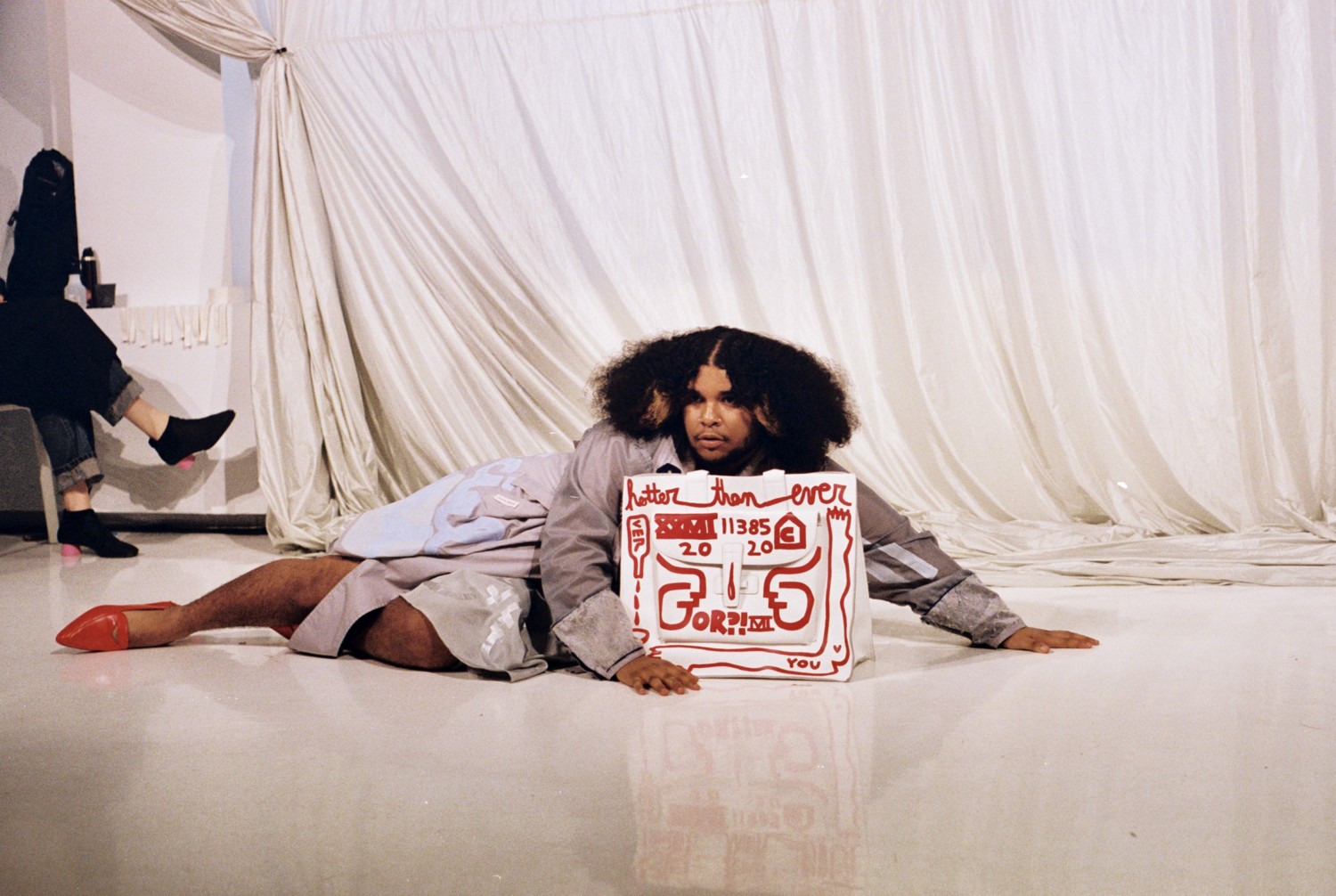
Photo: Satchel Lee. Courtesy of Official Rebrand
Like many of the best ideas, the concept for fashion label Official Rebrand was born from time spent in the cubicles of Berlin. There, US-born designer MI Legget shed their ideas about gender identity and any preconceptions they may had about what makes for an original design—and now they are taking on definitions of masculinity in a new collection. While we are getting better at identifying which elements are toxic, there isn’t a blueprint for what masculinity should be. SLEEK spoke to Legget about their take on the matter and their new video that compares learning manliness to aerobics.
Your video deals with modern masculinity. What do you think is changing currently about the definition of “being a man”?
I hope it is expanding. We, as individuals and a society, are always evolving and therefore, need to be open to change and growth. WHAT IS A MAN is meant to challenge the notion that masculinity is fixed, inherent and mandatory. Satchel Lee and I cast trans and non-binary people as well as open-minded cis-men that we felt demonstrated inspirational, expansive, creative, non-exclusive gender identities.
Josie Bettman directed the movement, developing a circuit of exercises, which the models then interpreted. The simple patterns and repetition combined with the models’ improvisation signified the constant practice, relearning, and collaboration it will take to reach a place where toxic gender norms don’t define our lives. Tara Shafa’s video of overlad clips of the spontaneous yet repetitive choreography set to LC’s track “1/12 2020 super vision” captured the energy of the presentation beautifully.
My partner, Sessa Tate, made an amazing soundtrack for the show that mashed up songs from a wide range of genres—Loretta Lynn to Fischerspooner—showcasing the simultaneously idolised and demonised position that masculinity holds in our culture. The track demonstrated the social whiplash we are subject to, with endless, often incongruent, expectations placed on us based on assigned gender. In some communities, these gender norms are starting to be challenged more, but it is like the sustainability question: we need to have a total overhaul of how society operates for true gender-liberation.
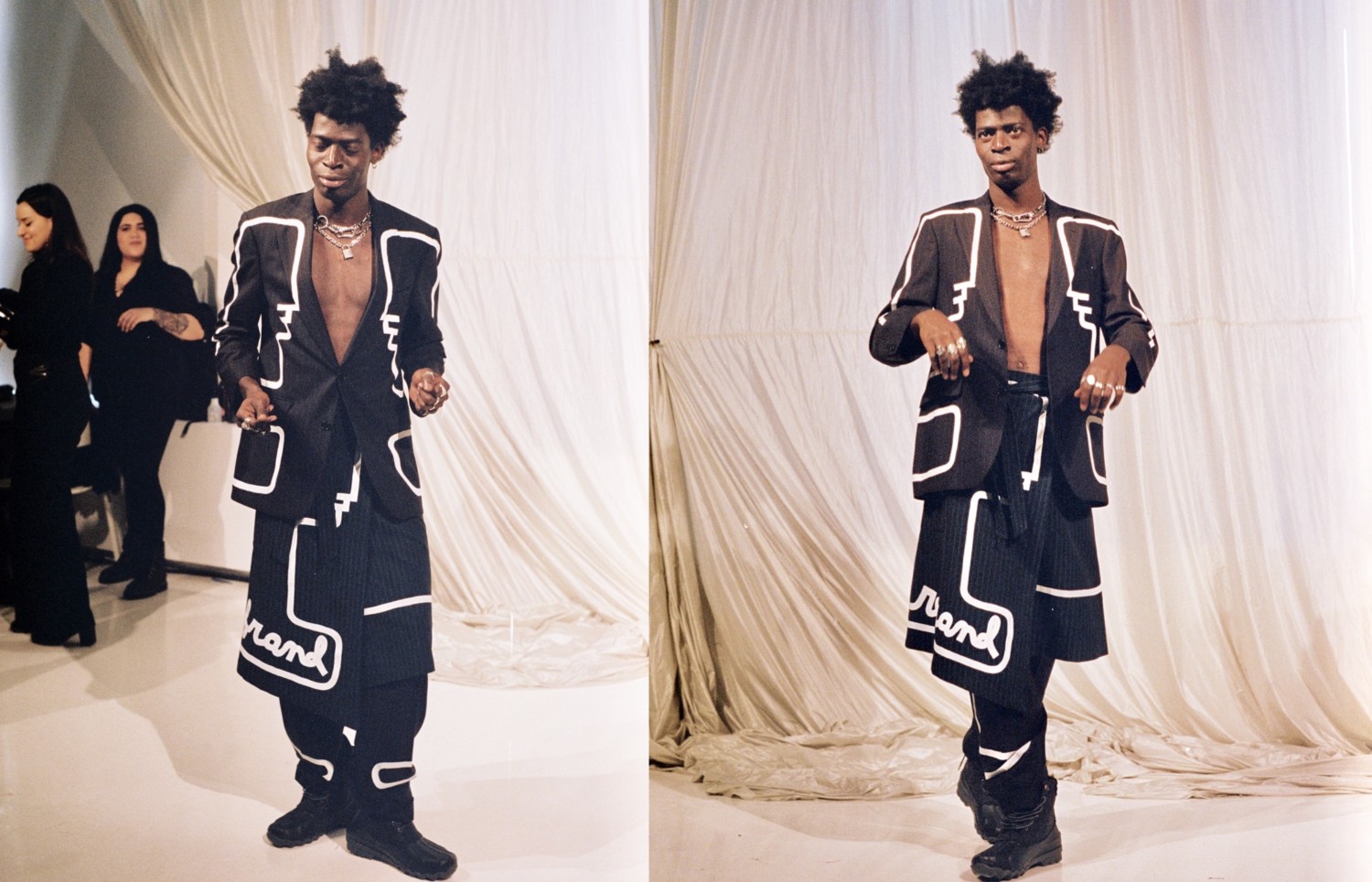
Photo: Satchel Lee. Courtesy of Official Rebrand
Your time in Berlin played a large role in the creation of your brand/ How did the culture here affect you and do you find it difficult to relate your experiences back to New York?
Berlin’s queer art and party scene was hugely formative for me. When I lived there in 2015 and 2016, for the first time ever, I felt at home in my sexuality and like I belonged in a community and culture. It was very inspiring. This self-realisation, sexual realisation, and feelings of freedom and community, reverberated through my work as I studied experimental design at Kunsthochschule Weißensee, and laid the groundwork for the aesthetic I’m still exploring today.
Transitioning back to the States was a shock. Political consciousness and action have always been vital to me, yet I admit I checked out of American politics while in Berlin and was not in the loop most of the 2016 election. Immersed in a very hard-partying community, I personally lost sight of the importance of universal political solidarity in favour of unapologetically queer, anti-normative self-expression in a rather insular community, which, while individually liberating, cannot secure the collective changes we need for global queer liberation.
"We need to have a total overhaul of how society operates for true gender-liberation."
I moved back to the US a few weeks before Trump got elected. Suddenly all the reasons I felt ashamed to be an American were impossible to ignore, as I had been able to while running around the Berlin underground. It was really overwhelming, but being overwhelmed is not an excuse for non-action, especially for those of us protected by white privilege. Since returning to the States and founding Official Rebrand, I have been trying to merge political action with queer anti-normative self-expression.
How would you describe your design process of rebranding and when did you start to get into it?
Rebranding is about fluidity and transformation, expanding and extending the lives of objects. It’s about challenging the stagnancy and sanctity of consumer objects. I paint, draw, take apart and reconstruct deadstock from other brands, second-hand donations and select vintage items. Designing from resources that already exist turns fashion industry’s problematic supply chain on its head, while removing gendered expectations in the process.
As a kid I made clothes out of household waste like newspapers and old curtains, but I started “rebranding” in 2016 while working for Fábio M Silva in Berlin. We painted a bunch of T-shirts for a pop-up in a toilet stall and I was hooked after that. I had never found clothes I fully identified with before then. The act of transforming generic garments into something unique and personal strengthened me, as I was transforming myself, discovering my own gender fluidity and coming out as non-binary.
See the video below:
VIDEO – TARA SHAFA @3cupsbasmatirice
STYLING – RYAN WILBAT & ARIEL RAWLS @awlforyoureyestosee @celine_bagg
SET DESIGN – RYAN WILBAT @celine_bagg
HEAD PIECES – LEILA JINNAH @leilajinnah
MUSIC – LC @instagrannaccount
CHOREOGRAPHY – JOSIE BETTMAN @scum_network
CASTING – MI LEGGETT & SATCHEL LEE @satchellee
HAIR @mannymakeshair
MODELS – ERIC ELLISON, JOSIE BETTMAN, CORY WALKER, SESSA TATE, MAR CHAN, SAM PILAND, CHARLES ALLCROFT, FABE ROBINSON, KRIS DEGIROLAMO, CYRUS VEYESSI, YANNIK STEVENS, JOSTYN FERREIRA
@sessa_cookie_mueller @faberobinson @scum_network @ej.ellison @corywalkers @charlesallblue @titesqueez @cyrusveyssi @yannikatthedisco @samuelabrahampilandchicchon @martrimony @jostynn__