
Courtesy of Molly Goddard and Tim Walker (2018). Originally published in SLEEK 58.
Although Lady Gaga’s and Bradley Cooper’s intimate duet might have caused more than a few blushes at last week’s Oscars, a bold wave of pink dresses also brought a rosy flush to the evening: Sarah Paulson in jewel-toned Brandon Maxwell; Gemma Chan in tiers of pink sherbet Valentino; Angela Bassett in cerise; Helen Mirren in coral Schiaparelli.
To turn up then, as so many actresses did, in all manner of pink shades, from blush to bubblegum, seems like much more than a coincidence, but a communal reclaiming of pink — a long-established cultural signifier of femininity — as powerful. The proliferation of pink was especially striking considering the donning of black occasion wear at last year’s ceremony in the wake of #MeToo. Returning to the red carpet in pink as a common badge of honour suggested a sort of rebirth, phoenixes rising from the ashes of misogynistic injustice in the only way they knew how — in pink.
But the Oscars were only the tip of the iceberg in a period pickled pink. As fashion week finally comes to a close, we can stand back and reflect on the plethora of pinks that popped up from New York through to Paris, from flouncing ball gowns to teeny-tiny accessories, and consider the wider meanings behind its current popularity, and how it’s lot more than visual shorthand for girliness.

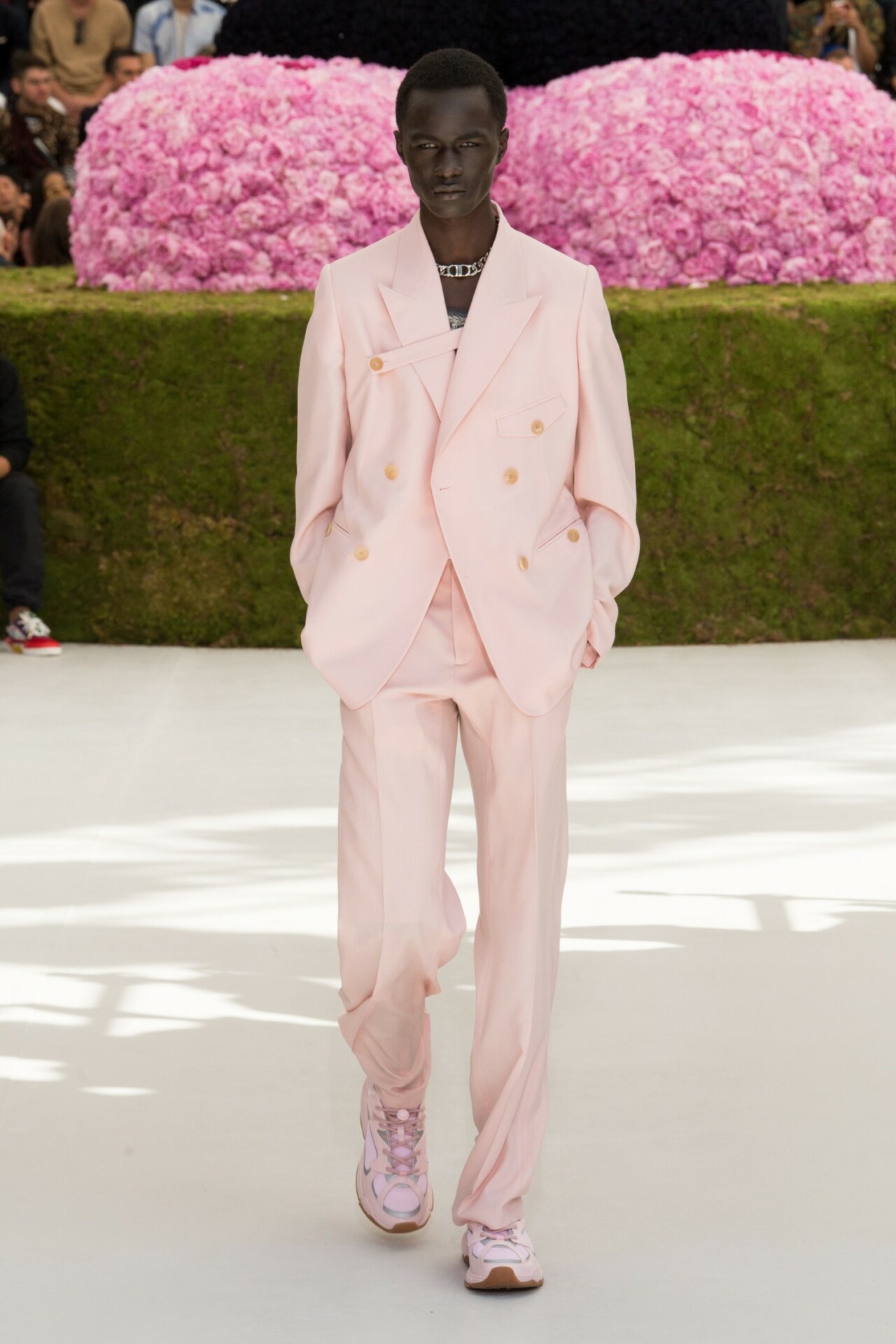
Left: Molly Goddard AW19. Right: Kim Jones for Dior Homme SS19.
It’s noteworthy that one of the leading names in contemporary fashion, London’s Molly Goddard opened and closed her autumn/winter show with pink dresses. The first look — a sensible strawberry number complete with a wide and pointy Puritanical collar — couldn’t have been more of a contrast to the beguiling cloud of shocking pink tulle that saw out her AW collection. Seemingly pink has long been a cause of fascination for Goddard with pale marshmallowy hues in particular running from collection to collection.
The combination of pink and volume has far-reaching connotations in Goddard’s dresses, assuming significant weight when worn by the likes of Rihanna. The vast frilliness and sweet pinkness takes on new power. No longer twee and saccharine, pink is joyful, assertive, courageous.
These properties of pink were what many designers channelled in their autumn/winter shows. Before finishing in a flurry of Ice Capades-style mini dresses, Karl Lagerfeld’s final show for Chanel included a number of pink looks in a series of colour blocking intervals. Among the houndstooth and the icicle tassels, these outfits stood out as modern and memorable — a wide-leg trouser and zip-top combo with belt bag and cape acquired attitude cast as it was in eye-watering fuchsia pink.
Simon Porte Jacquemus for his eponymous brand followed suit with accents of blinding pink. A swooshing trench coat, billowing trousers and statement hoop-earring look in hot pink called to mind the sort of DGAF fierceness embodied by Kim Cattrall as Samantha Jones. Somehow Jacquemus’ interpretation bolstered the sophistication of pink — pink as grown-up, sexy and desirable. Although a dark and serious mood overtook at Balenciaga, a spectrum of pinks added lightness and spirit. In particular, a gigantic, pillow-y anorak in shiny ballet slipper pink stood out as radically contemporary.
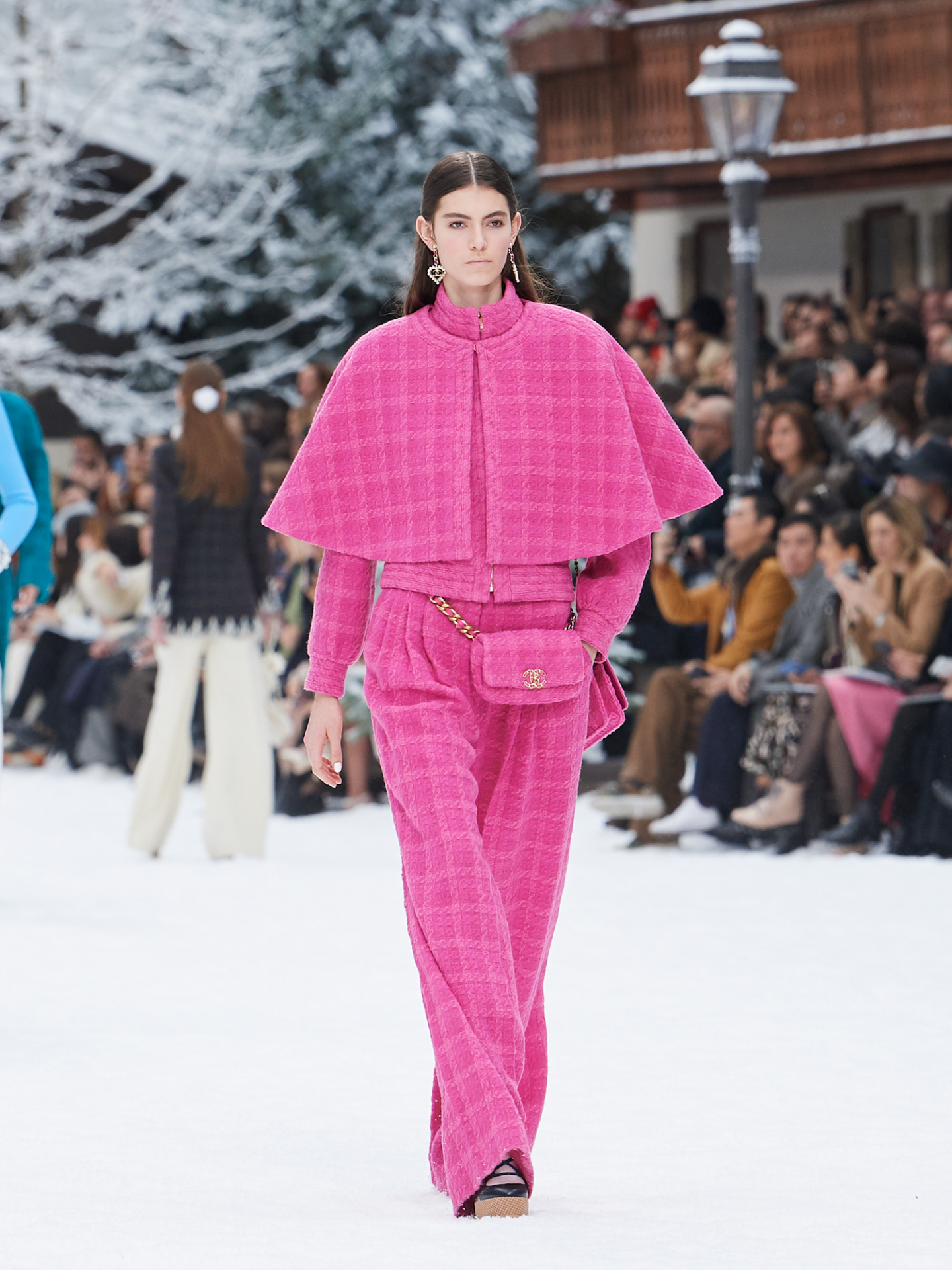
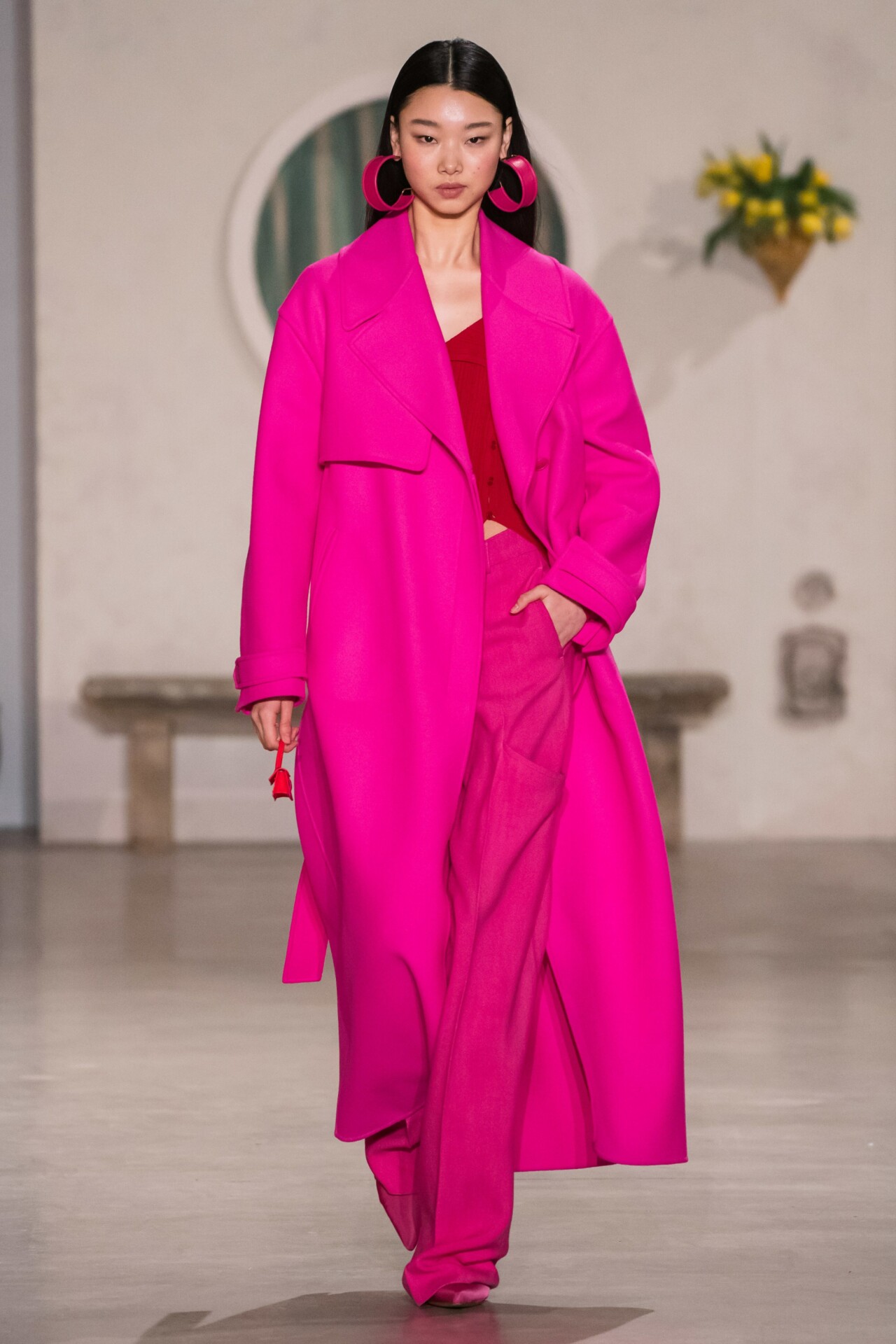
Left: Chanel AW19. Right: Jacquemus AW19.
Arguably, the recent range of pinks across fashion weeks and at the Oscars solidifies a cultural shift in our understanding of the colour. Since ‘millennial pink’ — described by The Guardian as “a grapefruit shade of apricotty salmon” — became more than a colour but a way of life for the Instagram generation back in 2017, pink has experienced something of a facelift in the cultural imagination. Where once pink was relegated solely to the sphere of little girls’ plastic toys and frilly princess dresses, in recent years pink has revamped its outdated connotations. One such example of pink’s newly acquired cool credentials was Kim Jones’ icy pale pink suits — an Instagram favourite — at his debut SS19 Dior menswear show last autumn. Worn with matching sneakers, it suggested a new dawn for the age of pink.
But long before Kim Jones interpreted pink as cooly masculine, the colour has had divergent gendered connotations. The relationship between pink and femininity is a relatively new phenomenon. An article for the Smithsonian.com und cited by Jezebel (based on research by the historian Jo B. Paoletti, author of Pink and Blue: Telling the Girls From the Boys in America) references a 1918 article from the trade publication Earnshaw’s Infants’ Department that stated: “The generally accepted rule is pink for the boys, and blue for the girls. The reason is that pink, being a more decided and stronger colour, is more suitable for the boy, while blue, which is more delicate and dainty, is prettier for the girl.” According to the Smithsonian piece, the binary — pink for the girls, blue for the boys — was only established in the 1940s based on American consumer preferences and gained further traction in the ‘80s with the development of prenatal testing (where parents could find out the sex of the baby prior to birth). The binary has recently been documented by the South Korean artist JeongMee Yoon in The Pink and Blue Project.
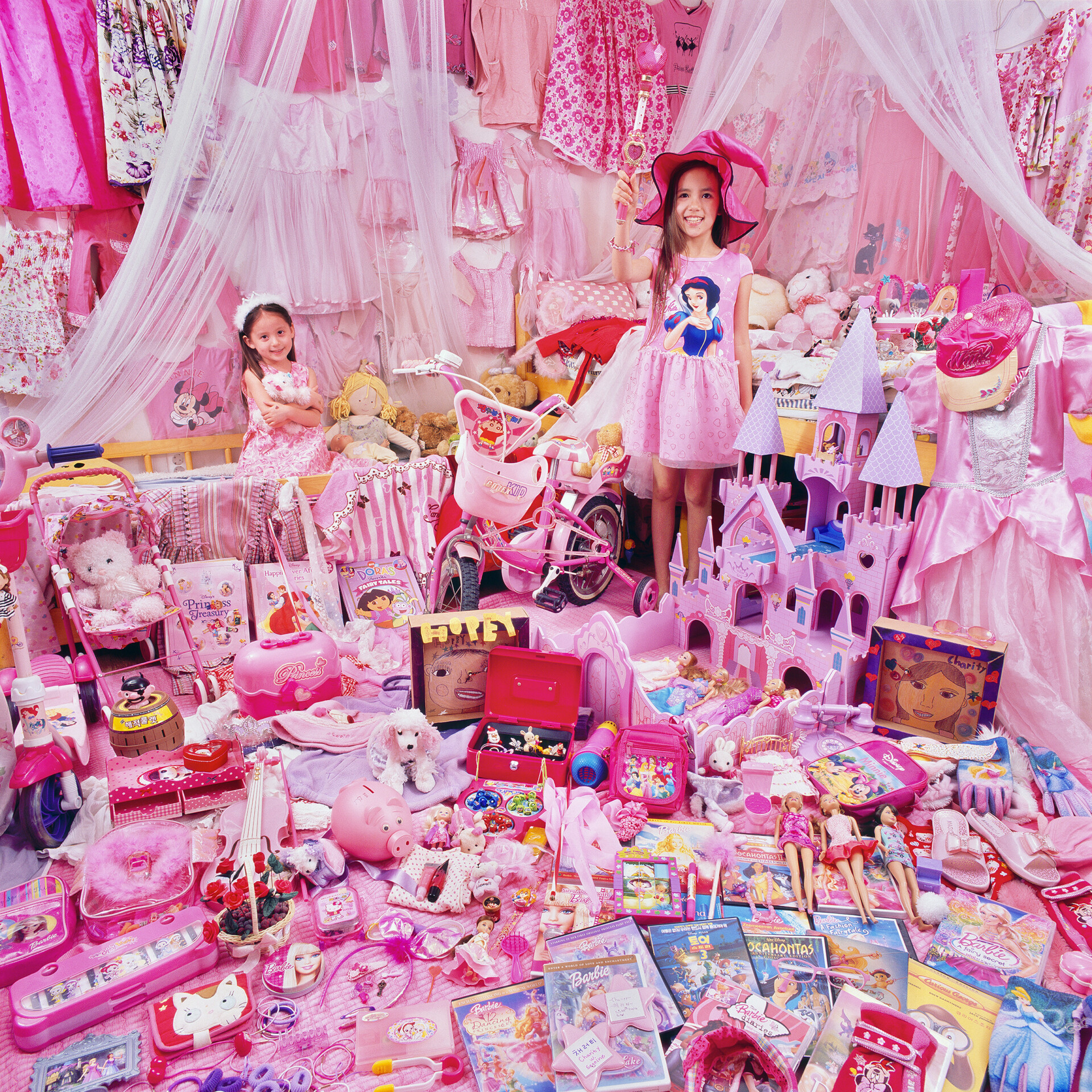
The Pink Project, Charity & Hopey and Their Pink Things, Gyeonggi-do, South Korea, Courtesy of Hatje Cantz. © JeongMee Yoon
Considering the authority of the pink-blue gender binary in contemporary society, it’s hard to believe that this is a relatively recent concept. The historically changing nature of pink, however, allows for a greater freedom in terms of its interpretation. If pink has proved anything overtime it’s that it’s fluid not fixed (as much as the Mattel Barbie manufacturers might protest). There’s a reason why pink has popped up frequently in punk culture, for example — consider The Clash’s baby pink 1978 single cover for “White Man in Hammersmith Palais”, or the jagged bright pink banner across the Sex Pistols’ Never mind the Bollocks— and that’s because of its hard-won potential for subversion and rebellion. There’s also a reason why the colour was even the subject of an exhibition at the Fashion Institute in New York last year, because as its curator, Dr. Valerie Steele states: “Pink is the most divisive of colours.”
But not only is pink provocative it is also seeped in a history of resistance and revolution. One need only take a look at the recent Women’s Marches and the popularity of irreverent pink Pussyhats to recognise the radical potential of pink. Furthermore, the pink triangle has been a symbol for various LGBT+ groups, dating back to Nazi Germany, when it was worn as a ‘badge of shame’ by homosexual men in concentration camps. Since then, it has gone on to be subversive symbol for the gay, lesbian and queer communities, with an upright version of the original pink triangle used by the AIDS advocacy group, ACT UP.
And so, in 2019, when we see actresses of all ages and races opting for the colour at the biggest event of the year, and designer’s bringing pink in a myriad of tones and shades to their runways (to be worn by both men and women), we know it’s not just because it’s pretty. It’s because pink has always been a matter of protest and had a point to make.