 Harun Farocki, Inextinguishable Fire, 1969. Film still
Since his death mid last year, there has been a recent flurry of public and critical attention around the work of German filmmaker Harun Farocki. In Berlin alone, in the last few weeks, we have seen showings of the artist’s work at Haus der Kulturen der Welt and Akademie der Künste, both of which follow on from Farocki’s enormous solo-show-cum-retrospective at the Hamburger Banhof (which closed in January after running almost an entire year). Last weekend, a panel of friends and colleagues of the artist met at HKW to publicly discuss his posthumous reception and analyse his importance.
If there is a central maxim to Farocki’s films and installations it is that to see and to be seen is always (necessarily) a political gesture. In trying to introduce his work, I continually return to Farocki’s 1992 film “Videograms of a Revolution.” The film is constructed from found footage of Romanian dictator Nicolae Ceausescu’s now infamous last public address in Bucharest, during which revolutionaries stormed the presidential palace. In the televised broadcast of the speech, the image cuts out, claiming technical difficulties and leaving a static pink screen in its wake. Against this official version of events, Farocki sets a number of other sources of footage, all viewing the same scene. In one source, an amateur handycam in an adjacent apartment moves from literally filming the televised broadcast to pointing out the window at the unrest taking hold in the surrounding streets. A week after this speech in Bucharest, Ceausecu’s execution would be televised.
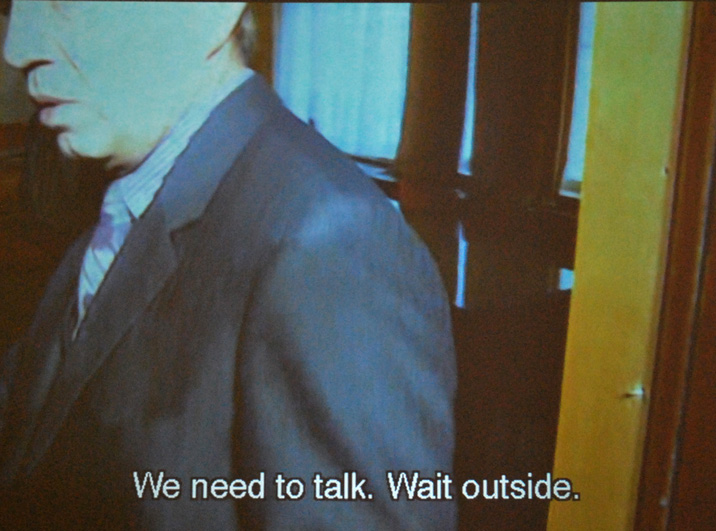 Harun Farocki, Videograms of a Revolution, 1992. Film still
‘Videograms of a Revolution’, like much of Farocki’s output, is very much a product of its historical context. On the one hand, Farocki tracks the development of new technology (in this case the spread of personal video cameras) while on the other, he analyses its application in upholding or unsettling political power. Farocki’s intervention into the Romanian government’s ‘official’ telling of Ceausescu’s last days is elegant and detached. Through a simple juxtaposition of two vantage points on the one event, Farocki points up the inherent bias in both views and proves the ease with which the moving image can be weaponised to support a particular version of truth. In making his arguments, Farocki often uses such simple techniques of juxtaposition and comparison (what he called ‘soft montage’) to establish a way of seeing ‘through’ his material to its implicit agenda. The interest in “Videograms of a Revolution” does not lie in the official broadcast nor the home footage but in their comparison – not in technology, nor politics but in their synthesis.
In an essay titled “Reality Would have to Begin”, Farocki analyses the way in which an image’s meaning and content is not implicit to the image itself, but is projected onto it by its viewer. “The photographic image,” he explains “is built out of dots and decomposes into dots. The human eye synthesises these dots into an image.” It is this process of synthesis which is of most interest to Farocki in his films. Someone viewing an image decides what they want to see in it. They see what they are looking for, what they have been asked to look for and what is most in accordance with their world view. Unpacking the implications of this seemingly simple observation has been the driving force for almost all of Farocki’s work and it is an observation that we should keep in mind now too, as we discuss the man’s work and try to reach a consensus about his place in art history.
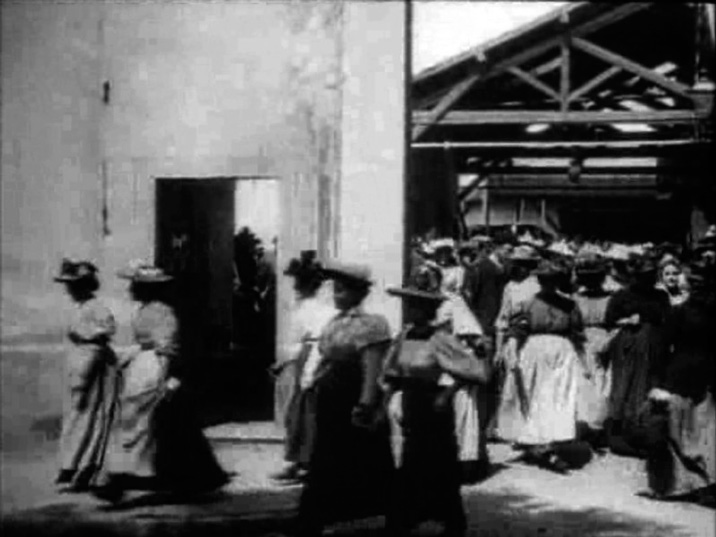 Harun Farocki, Arbeiter verlassen die Fabrik, 1995. Film still
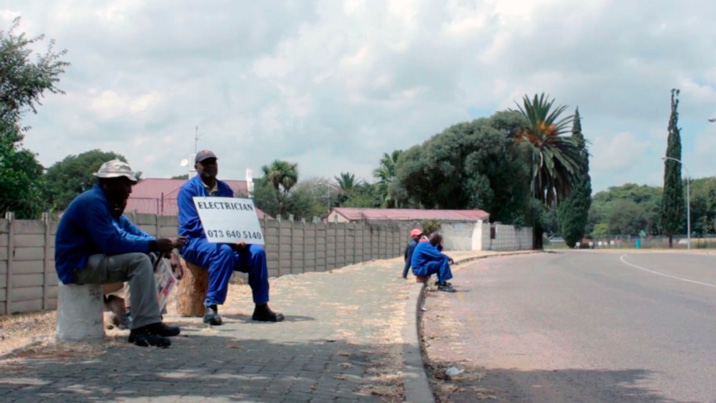 Harun Farocki, Labor in a Single Shot, 2014. Film still
Though Farocki is doubtless an important figure and deserves much recognition, the recent surge in critical attention should still be viewed with a degree of scepticism. It may or may not be relevant to note that the critical push for Farocki’s historical status has mostly come from within the visual arts, as opposed to say cinema or television – both of which are contexts in which Farocki was also active. The cynical fact is that any change in how the art world tells its own history is always met by very real shifts in market value. This is one of the reasons it is always interesting to see wie an artist is canonised – to see which aspects of their life and work are deemed worthy of history and which are passed over or actively suppressed. Any account of history is a means of contextualising a particular version of the present – making it seem inevitable and justified. So now that Farocki is to be a part of history, which version of the present does this history justify? Death, like photography, takes something fluid and fixes it into an image. The danger of Farocki’s canonisation, and our discussion of him now that he cannot speak for himself, is that we simplify the man down into an image of himself. And images, as Farocki is still reminding us, are easily politicised.
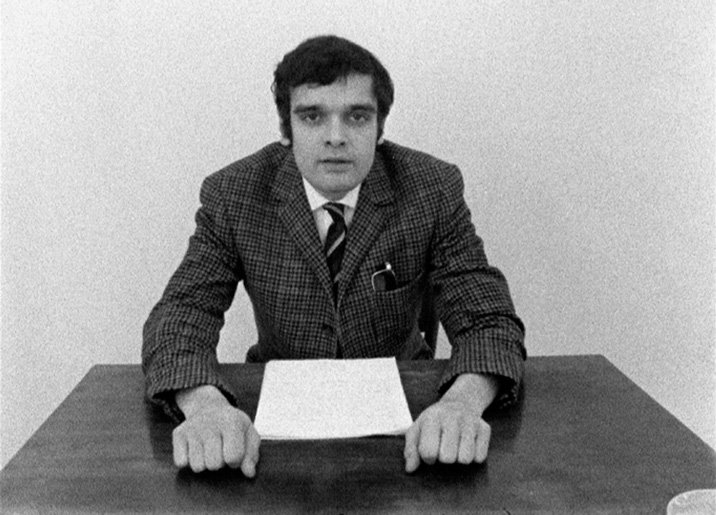 Harun Farocki, Inextinguishable Fire, 1969. Film still
Text by Henry Andersen
“Eine Einstellung zur Arbeit”, a project by Antje Etman and Harun Farocki, is currently showing at HKW
Mehr: Keeping COOL: Interview with Charlotte Cosson and Emmanuelle Luciani