
Photography by Selassie.
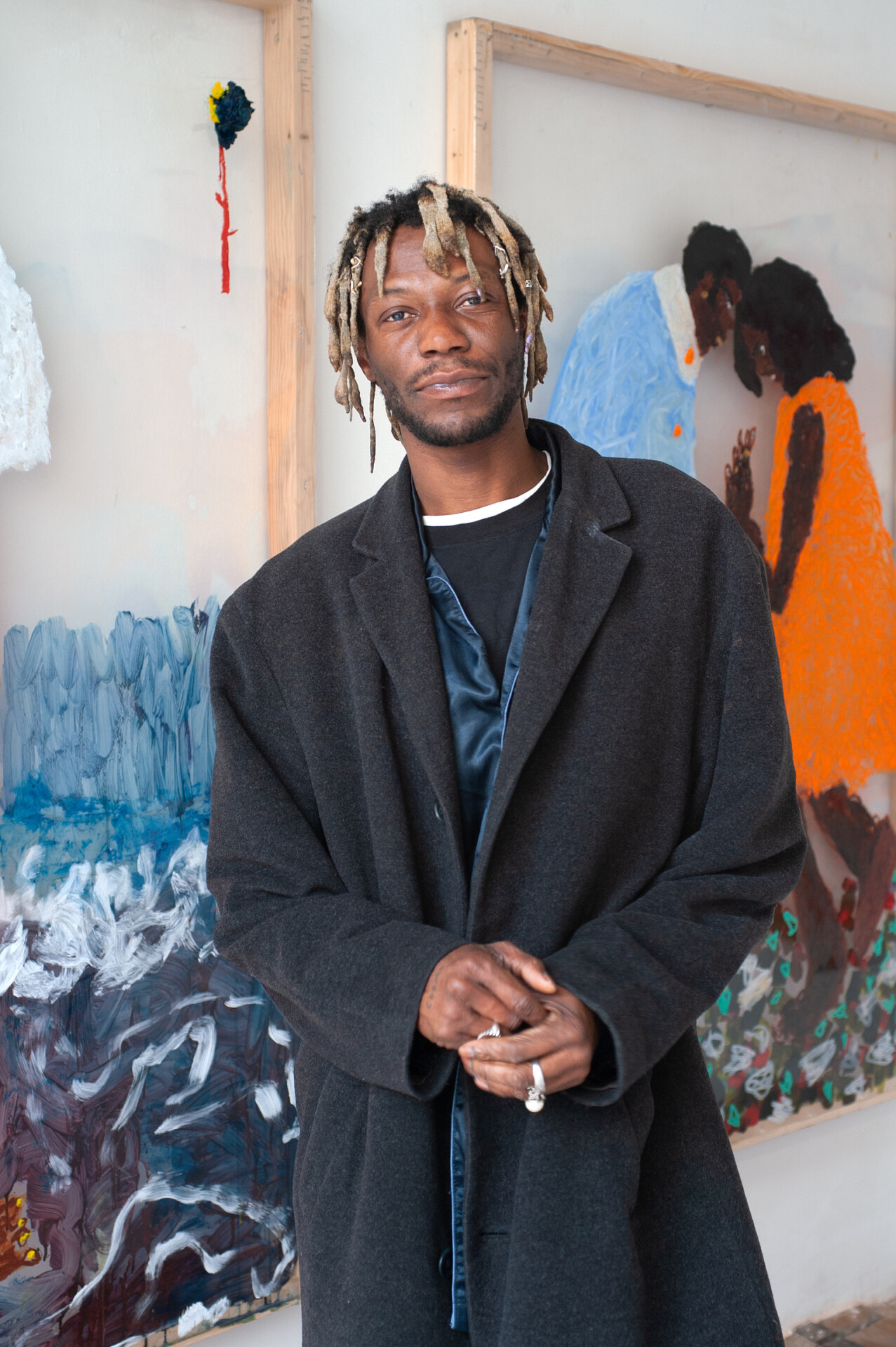
Today, Selassie is pink he says. Usually, he’s purple. But today, he feels pink – for no particular reason. It’s more of a feeling, a state of mind, an emotion. It’s not about his favorite color; in fact, Selassie loves all the colors. The brighter, the merrier. He’s an artist, so that’s obviously the only right answer. When we meet him in the Von Racknitz + Baer gallery in Berlin-Charlottenburg, he’s a bit sick. His voice sounds peevish, but the smile on his face is huge. He’s wearing a fashionable black hat, a grey pullover, and lots of silver chains and rings. On his feet, he has comfortable slippers – a sign that he feels at home here, where his paintings are showcased.
Although he is not quite recovered yet, there’s still a lot for him to do. One week after our interview, he will leave Berlin to move to Ghana, reconnecting with his family and his roots, saying goodbye to friends, networks, and memories. A goodbye to this fast-paced city. The self-taught multidisciplinary artist came here three years ago. Since then, he has shaken up not only the art scene but also founded a music label, performed as a dancer and musician, and collaborated with other successful creatives such as the German DJ and rapper Badchieff. But mostly, Selassie is known for his strong, colorful paintings that capture all kinds of moments in life, his own inner conflicts, and the things he loves.
LEFT Photography by Selassie RIGHT Photography by René Kluge.
When we ask him how his family feels about moving to Ghana, he says: “My girlfriend is excited. My daughter is excited. My father thinks it’s a crazy idea. And my auntie also thinks it’s a crazy idea.” He laughs while strolling through the gallery. There isn’t much he is going to miss. In fact, the feeling of missing something is pretty rare for him, he explains to us. Selassie just moves forward. For him, everything is forever, even if it’s a picture. “I feel like you build families,” the artist says. “If I want to show my paintings, I can do it here, in the gallery. In Ghana, I can just have a peaceful mind and paint. And I’m always going to be here, you know?”
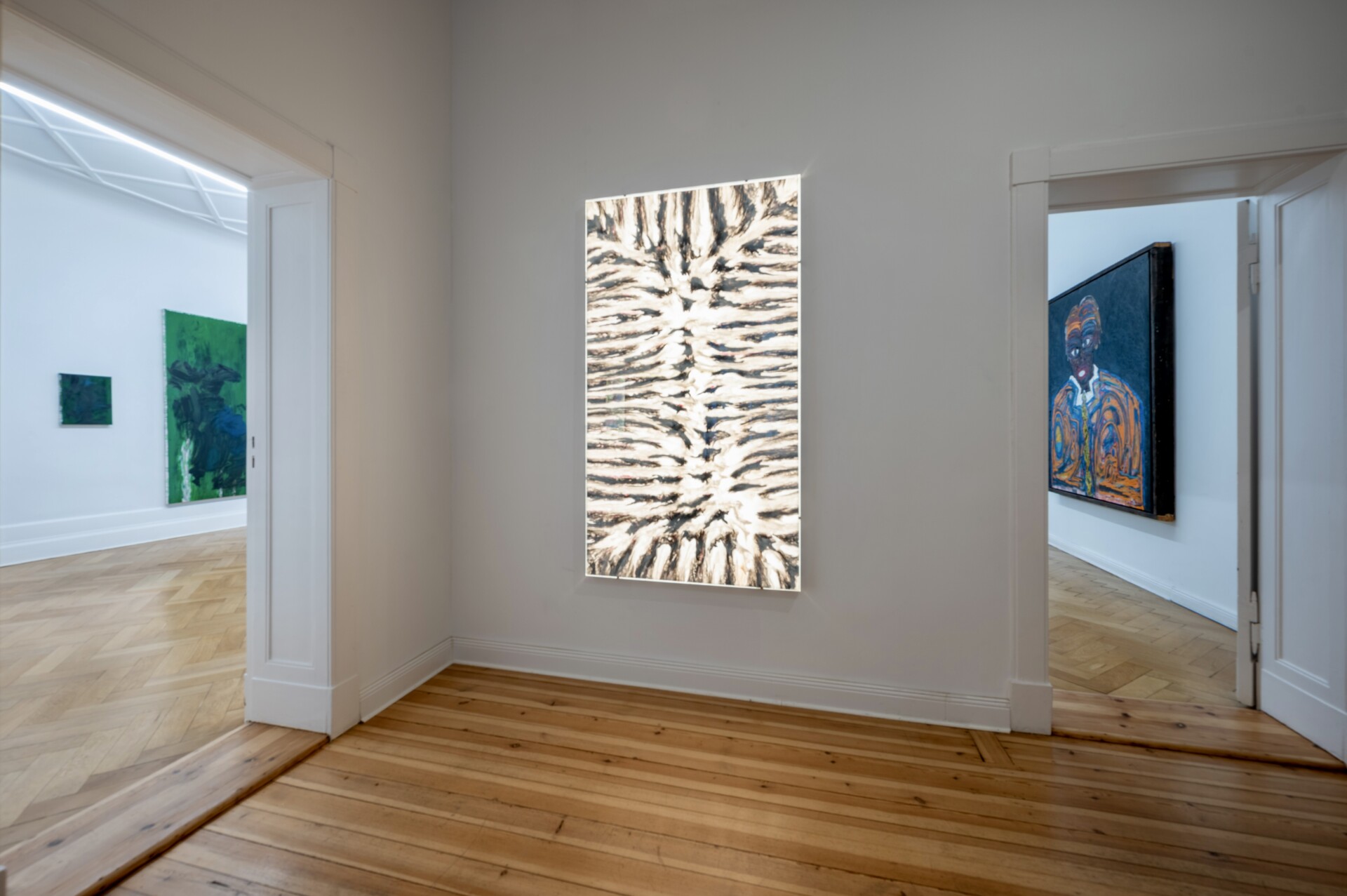
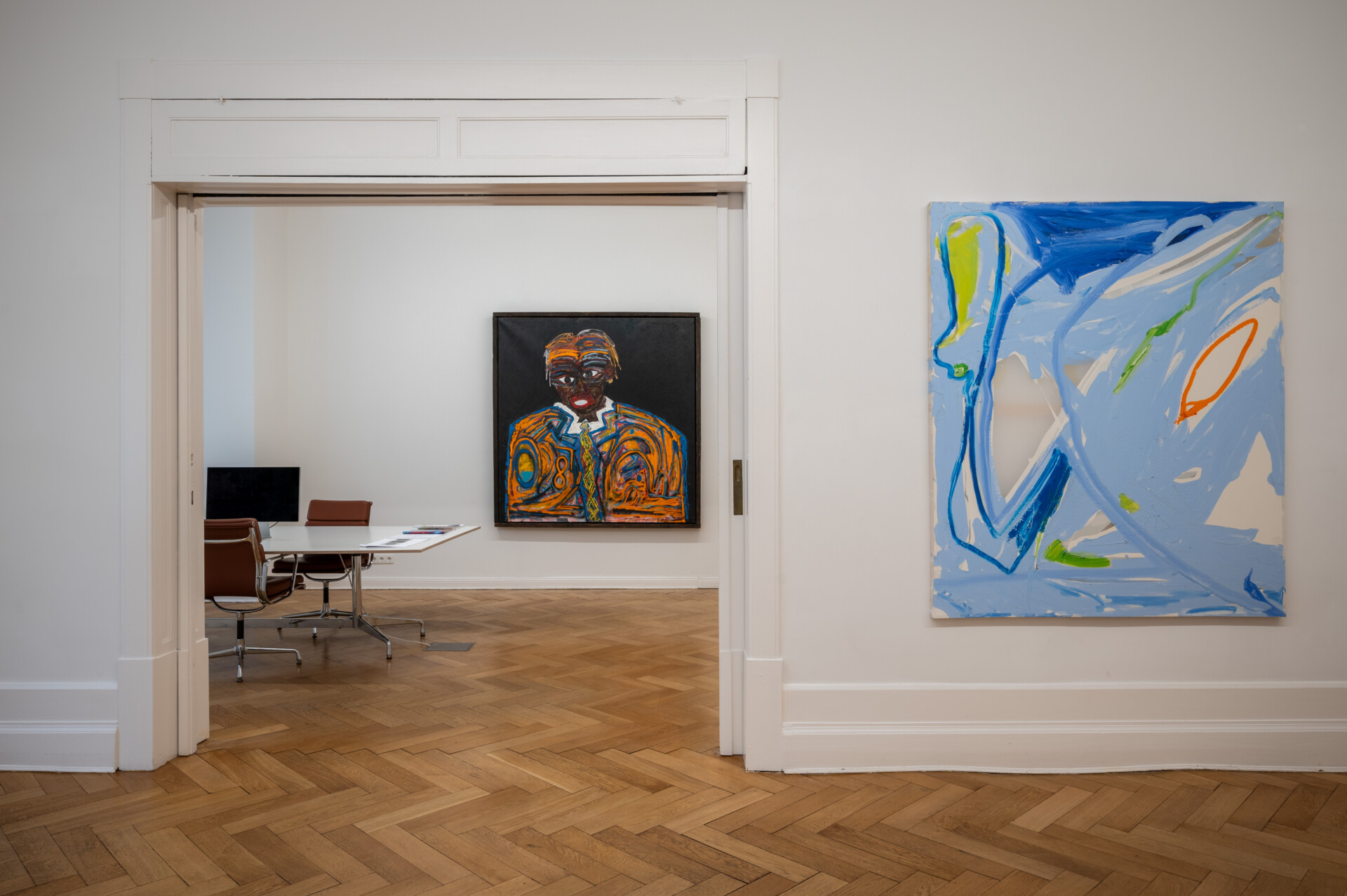
He stops at a crème-colored couch in the center of the gallery’s main room. It peacefully meanders like a snake through a world full of oil, acrylic, resin, plastic, glass, concrete, and light. On the walls, the pieces of other artists, such as Bruna Sperling, Susi Gelb, und Jonathan Niclaus, are showcased. Selassie’s own artistic development comes to life on a big painting in the next room:
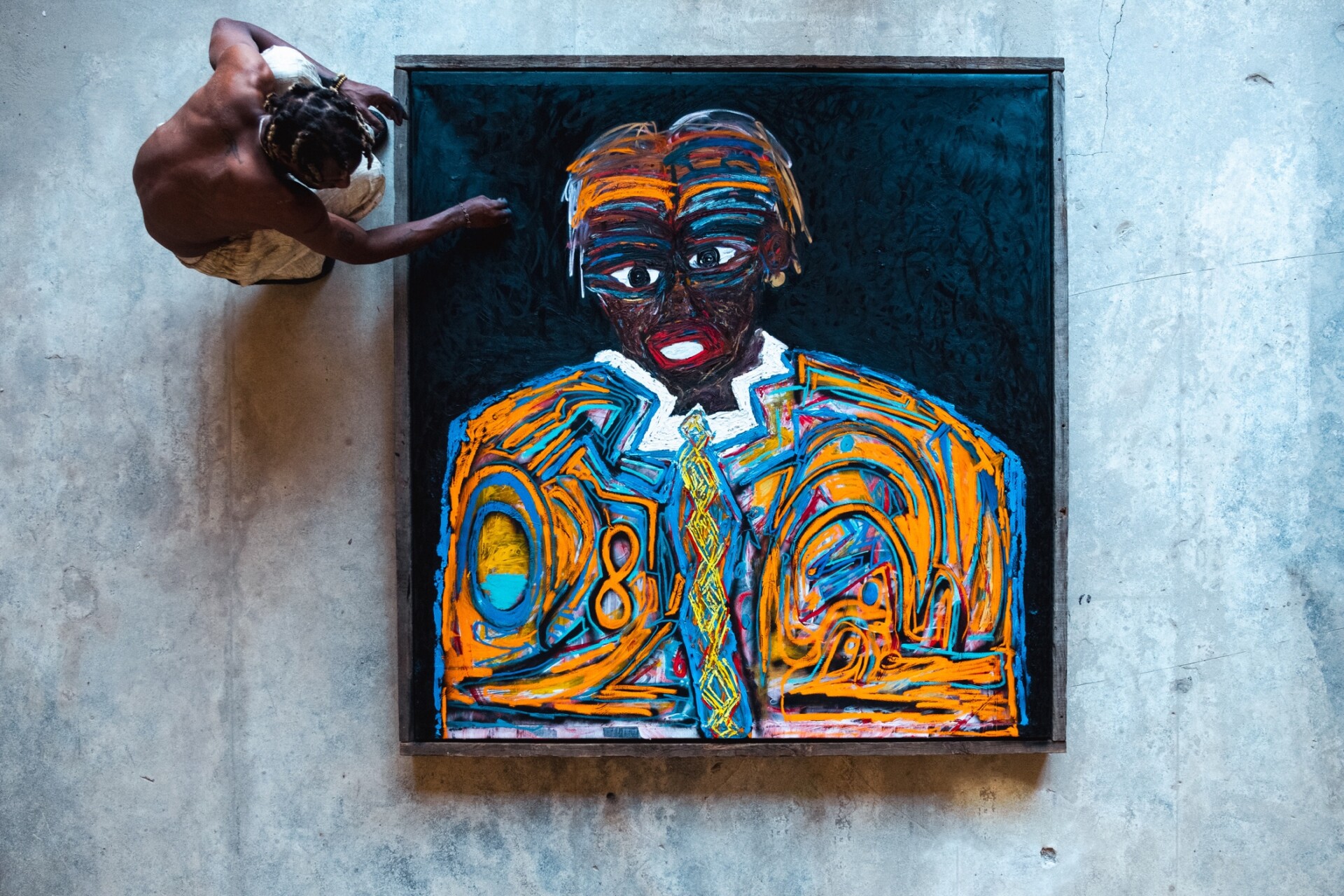
It’s an abstract, expressionist self-portrait with big asymmetrical eyes and blue and orange strokes that he applied with tubes as well as his own hands. He’s wearing what seems to be a blazer, a white shirt, and a yellow serrated tie. “I never wear ties,” Selassie says when we ask about the outfit in the painting. “But my family is strict.” If you look closely enough, and if the light hits the surface the right way, you can find innumerable eights hidden in the black background and one striking one on his chest. The eight is his lucky number, he tells us. For him, it is connected to some of the most important people in his life.
Photography be René Kluge.
Selassie’s self-portrait belongs to a series he painted when he came back from Ghana the last time. All of them show family members and friends, all painted within two to three weeks. “It felt like I was just sleeping in the atelier, waking up maybe at four o’clock in the morning, painting, painting, painting, and then falling asleep at 12, and then waking up again,” he tells us while looking at the self-portrait. “That moment just felt very uncontrolled and very honest.” Through that, the painting reminds Selassie of a time when he allowed himself to feel like an artist for the first time. “I was really thinking about how to portray myself and my family in a way that it could end up in a museum, you know?” he remembers. “I gave everything for it to feel like forever.”
When Selassie looks at the self-portrait in the gallery in Charlottenburg, he sees that it’s both vulnerable and strong. The black frame is heavy, symbolizing the weight he felt on his shoulders at that time. “I wanted everybody who raises this portrait to feel like, ‘Yo, it’s heavy!’” the artist says, laughing. “If someone buys it one day, they should feel like, ‘How the fuck are we going to get it out of here?’” When asked if he would find it difficult to sell the painting, he says casually: “No, I’ll just paint a new one.”
Back then, when Selassie painted the portraits, he was sad coming back to Germany, missing his home and his family. “If you see them for months, and then you get pulled out of it, it reminds you of your childhood,” Selassie remembers. The artist was born in Spain and was raised by his grandparents in Ghana after his mother decided to leave him to start a new life in Germany. When he was 15 years old, he followed her. “Since then, I’ve gone back to Ghana three times, and every time I saw all these beautiful things that reminded me of myself.”
Photography by Jonathan Joosten.
If Selassie is honest, he says he never wanted to live in Berlin. “It has its purposes, but the energy might be too intense for someone like me,” he says. In Ghana, he wants to focus on his art, enjoy the simpler things in life, and try to find his own rhythm again. He wants to travel through Africa, see and learn as much as possible, meet new faces, and try new techniques from all around the continent.
“I bought a lot of pigments from different places over the years, like Morocco,” Selassie continues wandering through the showroom “I think it’s interesting to make your own oil – just to start from ground zero.” The artist rarely paints with brushes. As he says himself, he’s not good at knowing how something works on a technical level. But he is good at experiencing it. And if he allows himself to run free, he’ll achieve the result he intended: “If I have to make oil in tubes, then I’ll find a way to make tubes. If I have to make oil sticks, then I guess you can use pigment and oil and roll them up.” But there are also other projects waiting for him in his home country. Right now, Selassie is working on a newspaper project focusing on other artists in Africa, as well as an exhibition he wants to showcase in his uncle’s church.
Photography by Selassie.
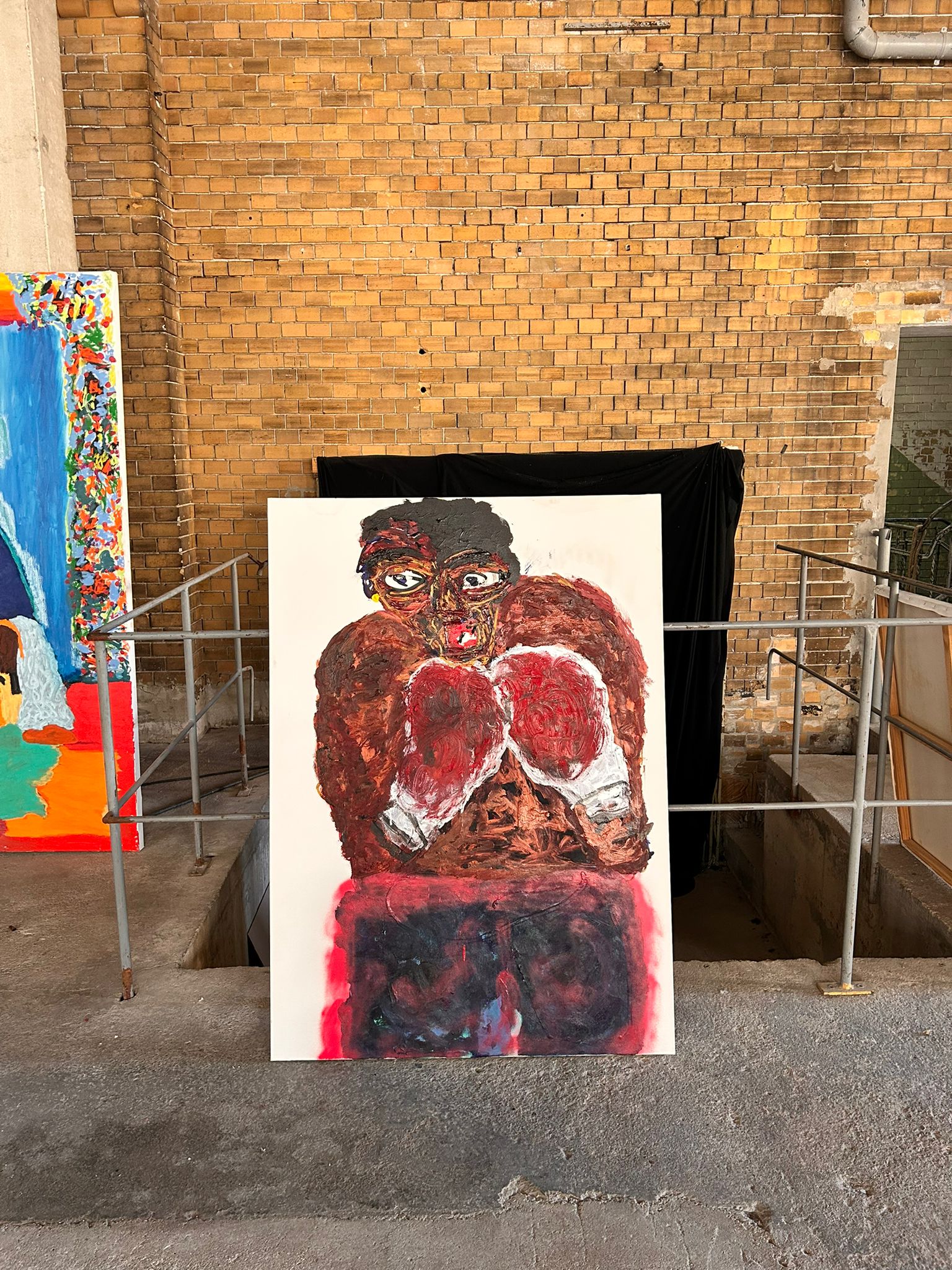
At the end of our visit to the VRB gallery, Selassie sits down on the big couch in the main room, readjusting his hat a bit. With a smooth movement, he digs his cell phone out of his pocket and shows us the photo of a painting he made to summarize his time in Berlin: On the screen is another self-portrait; another character. It’s a shirtless boxer with a distorted face and big red gloves. “I felt like I learned a lot in Germany,” he says. “I learned so much good and so much bad at the same time.” Here in Germany, Selassie experienced racism for the first time. He experienced being looked at differently. “And at some point in my life, I also noticed everybody is fighting here to have a family,” he explains. “Everybody wants to make a lot of money to have a fam. In Ghana, I saw that the people there don’t have everything in life they think they need, but they do have a fam.”
After our interview, Selassie puts on a huge black puffer jacket and grabs his computer. “I’m gonna go now to see my little monster,” he says with a grin, referring to his little daughter waiting at home for him. With him moving to Ghana, Berlin definitely will lose a unique creative mind, but one day he will come back. Even if it’s just for a visit. He takes a last stroll through the gallery and a final look at his painting. Maybe he will miss it just a little bit after all.