
It’s close to midnight in Berlin and I’m getting ready to speak with Eugene Hütz over the phone. The often itinerant Gogol Bordello chief is wrapping up his work for the day in New York City, but really, his mind is elsewhere. To be exact: 5,687 miles away in Ukraine. Born and bred in Kyiv, Hütz has watched the grotesque spectacle of war and mass killings play out on television since the conflict began when Russia invaded his home nation in February. Understandably, his sentences are laced with expletives and a palpable sense of outrage.
“It’s pretty classic Russian behaviour,” says Hütz. “But this time it seems to be particularly fucking brutal. That’s where the shock is.”
“Let fury have the hour, anger can be power, do you know that you can use it?” sang Joe Strummer in ‘Clampdown’ (1979) by The Clash. It’s a stirring conceit on paper, but how useful are mere words in the barbaric light of reality when villages not far from where you grew up are being raped, slaughtered, and tortured? Doing what he can, Hütz has taken on the mantle as a kind of unofficial artistic ambassador for Ukraine, turning his Instagram account into an anti-war repository that takes swipes at Russian propaganda. Technically, Hütz has always been fighting the cause. After all, the ‘Gogol’ in Gogol Bordello is a reference to Nikolai Gogol, the 19th-century writer of Ukrainian heritage who wrote about his homeland in Russian at a time when the Ukrainian language was repressed under the rule of the Russian Tsar. According to Hütz, Gogol’s work was almost like a “smuggling operation.”
“I’ve never been out of touch with my heritage,” explains Hütz. Evidently, misattributions when it comes to Soviet cultural history stick in his craw. “Many pieces of music that are supposedly Russian are usually borrowed from places like Japan or Ukraine or Poland,” he says. “It’s hilarious how clueless some people are. But anybody who knows a bit about European culture will be well aware that this cultural appropriation has taken place for hundreds of years.” A zine contributor who was immersed in the Ukrainian punk scene at the ripe old age of 13, beyond everything else, Hütz is your textbook music nerd. He rhymes off bands – both established and underground – with elan, and is sage-like when recounting classic shows from his childhood. In the West, there’s a tendency to pigeonhole the former Soviet Union as a singular yawning mass, rather than see it from multiple perspectives, particularly when it comes to creative pursuits. Hütz, however, is quick to point out the idiosyncrasies that mark his home country out as unique.
“If you ask Sonic Youth, who played Kyiv in 1989, or someone like Lydia Lunch, they’ll tell you that, out of all the Soviet countries, Kyiv was the only place where there were hip kids who understood what they were trying to do,” says Hütz. When he talks about his past in Ukraine, it’s not in a way that’s didactic or intended as a history lesson. It’s more borne from a place of pride, coupled with a sense of frustration at being overlooked.
“Ukraine is unique because it has a central European mix,” Hütz continues. When you went to the countryside, especially the Karpaty area, you would see that you are living in a magical country where there are various dialects of Ukrainian, Polish, Hungarian, Romanian, Tartar, and Romani. And that’s when people were like, ‘Oh, so I’m like, part of this special mix, not just part not a part of that sanitized, Soviet crap.’”

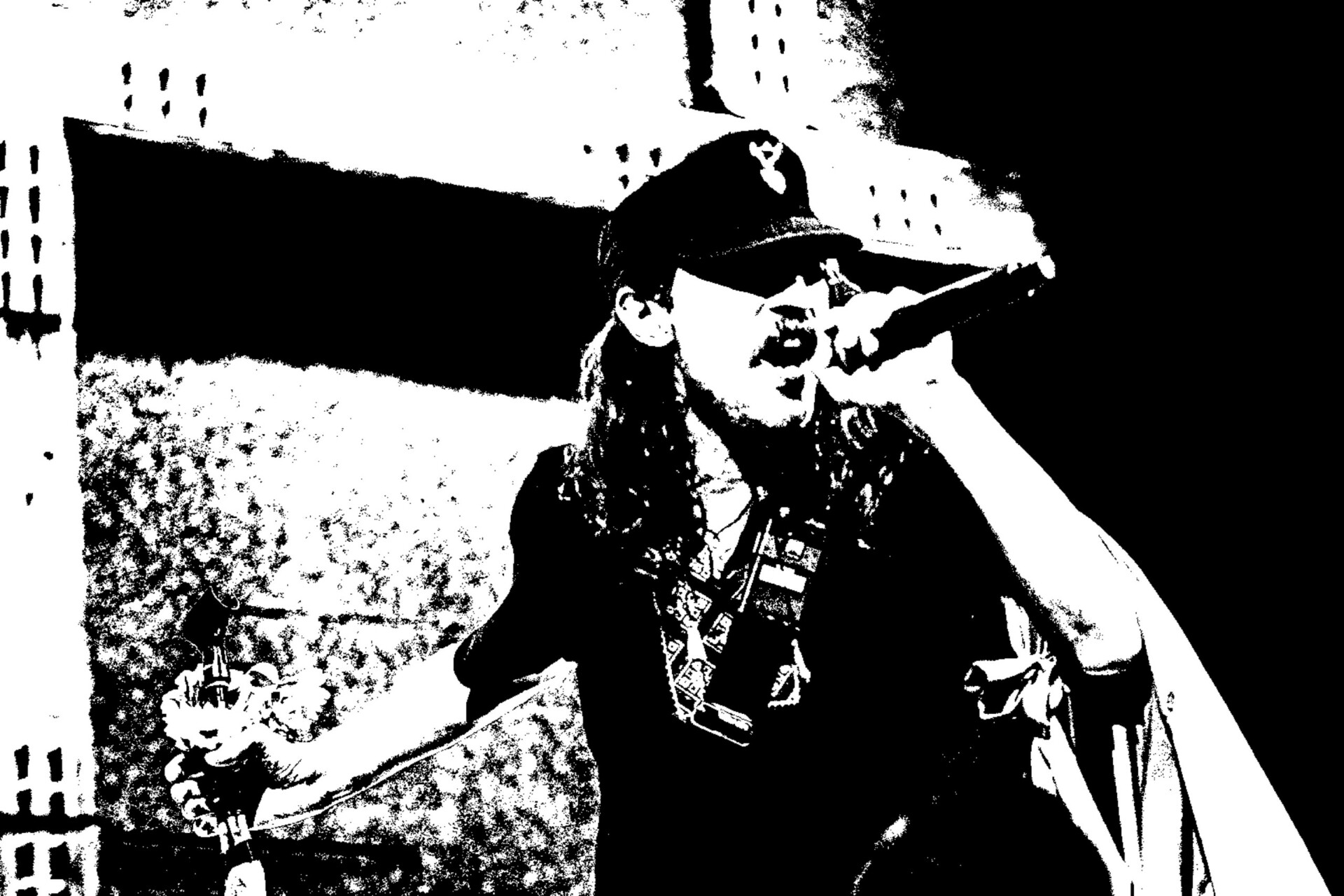
Image Courtesy of the Artist
That eclectic richness also defines Gogol Bordello, which has become one of the great cult (and live) bands of the 21st century. Like a magpie weaving a mashup of trinkets into its nest, their kitchen-sink approach combines instruments such as accordion, fiddle, horn, guitar and bass into an impossibly palatable whole. Initially, some naysayer critics dismissed the group’s brand of ‘gypsy punk’ as a disingenuous schtick that played into stereotypes rather than subverting them. Yet fast forward 30 years, and the group is not only still selling out shows globally, but as far as Hütz is concerned, serving their most important purpose yet.
“This past month makes it look like I’ve been chilling on a hammock for most of my previous life, and I’ve been going crazy for fucking 30 years bustin’ shit out!” he laughs. By this, he’s referring to recent fundraiser shows alongside the likes of Patti Smith, as well as the none-too-subtly titled tribute song, ‘Zelensky: The Man With The Iron Balls’ (2022), written in tandem with Primus’ Les Claypool, The Police’s Stewart Copeland, and John Lennon’s son, Sean. When it comes to the arts in a time of crisis, there’s often a tendency for those involved in it to trivialize what they’re doing as pointless frippery.
Hütz doesn’t agree.
“Our singles and shows absolutely make a difference,” he says. “When you are in the trenches with a fucking rocket launcher; or travelling through rural Ukraine to escape the invaders while holding a loaded gun, it’s natural to feel disconnected. Any reminder that there is activity to support them going on out there in Germany or Australia or Brazil or the States or Japan or wherever else can transform that perception and make it feel like life is possible again.
In the past, Gogol Bordello has been described as a trans-global art syndicate; a fire-spitting travelling roadshow nonplussed about belonging to a particular home, community, style, or even a scene. Rather, it’s a project committed to multiculturalism that can be accessed by everyone and anyone. For someone who spends so much time on the road, being a good world citizen surely trumps any notion of nationalism.
“The Ukrainian situation reminds me of the oneness of the world. It’s omnipresent and it’s inevitable,” says Hütz, leaving room for a pause. “We live in that one quantum field of infinite possibilities, yet some people are consumed by their personal shit. In reality, life on Earth is designed so that what’s happening to the person across the street will happen to you. Maybe not tomorrow, but at one point the tables are gonna get turned around, so it’s a lot wiser to open up to that oneness on your terms. That way, you will be a little bit more prepared when suddenly, it’s you who is at the epicentre of the fucking disaster.”
Before our time chatting comes to a close, I’m intrigued to discover what music Hütz has been listening to during this impossible time. A man known for lighting up parties with his bonkers DJ sets that span everything from Dancehall to esoteric Balkan jazz, his recent predilections are unsurprisingly more pointed. He flags various tunes by The Clash, Patti Smith’s ‘People Have the Power (1988) and Socal Punks Rancid’s call to arms, ‘Solidarity’, a song named after the independent Polish trade union and social movement Solidarność, whose protests led, in 1989, to the country’s first partially-open elections since 1947.
“The problem with pop culture is that it’s catered to those who are half asleep; It’s like people are wandering around the world without any real sense of direction or focussing on what it’s made out of,” laments Hütz. “That’s why Joe Strummer and Patti have become crucial: they make the simple point that we do have the power as long as we’re fearless. Russia holds people in a state of complete ignorance and arrested development by using fear, but that doesn’t work on Ukrainians. We are distinctly different – we will crawl bare hand over fucking tanks.”
“It’s a catastrophic time,” admits Hütz. Before adding, “But we will win.” If anger truly is power, this phone call leaves me no reason to doubt his words.
As featured in SLEEK 73 – PASSION. Available in print and digital hier.