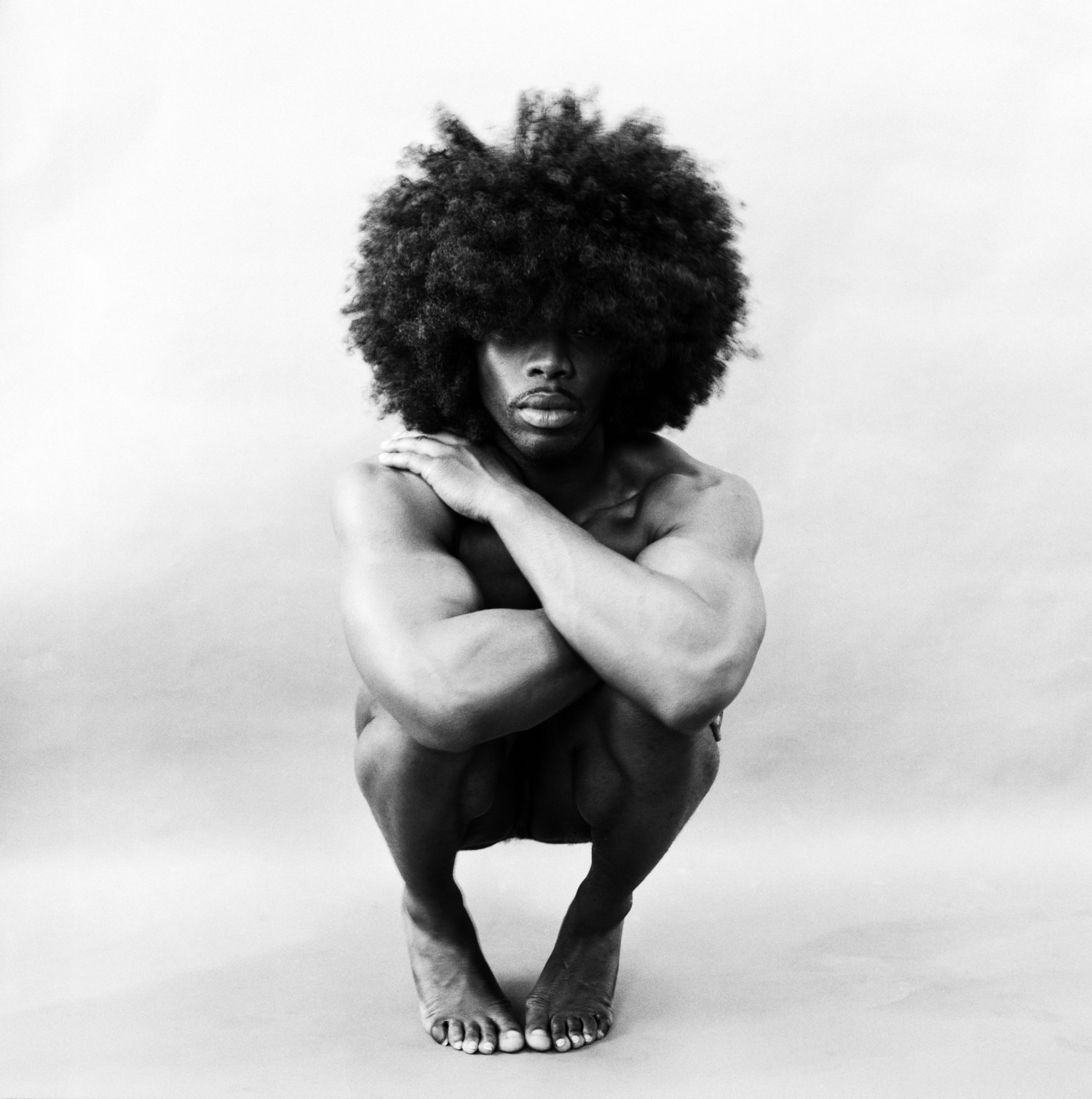
Rotimi Fani-Kayode, Untitled, 1985. Courtesy: Autograph, London © Rotimi Fani-Kayode. Image via Gropius Bau.
Since the ‘70s, theories raised by post-colonial studies have prompted an essential reevaluation of norms perpetuated by Western art history. Recent surges in BLM activism have added newfound significance to both these theories and the subversive artwork accompanying it. Chief among such artwork is that of Nigerian-born photographer Rotimi Fani-Kayode. His photography is representative of an increasingly prominent field of queer, black art—a field which must constantly subvert the pernicious norms imposed upon it by the Western art market. Understanding the subversiveness of Fani-Kayode’s art requires viewers to pay heed to the complex processes of “othering” that face him and, by association, the subjects of his photography.
Othering—one of the central concepts of post-colonial theory—is the phenomenon by which whiteness is constructed as the dominant social norm, like maleness and straightness. It is perpetuated through the process of distancing from its supposed hierarchical opposite: blackness. Yet, post-colonial theory dedicates little consideration to the possibility that people can be simultaneously othered on two counts—on account of both their race and their sexuality.
The doubly-othered nature of Fani-Kayode’s identity speaks clearly through his work. In an interview with the Tate, he explains how his work consciously aims to combat stereotypes of black men being straight, virile and masculine. “I make my pictures homosexual on purpose. Black men from the Third World have not previously revealed […] a certain shocking fact: they can desire each other.” Despite the artist’s intentions, it has proved fairly common for his work to be subjected to either his blackness oder his homosexuality.
I make my pictures homosexual on purpose. Black men from the Third World have not previously revealed […] a certain shocking fact: they can desire each other.
Connections are often drawn between his work and the work of the famous queer photographer Robert Mapplethorpe. Both men were gay and their photography certainly holds striking similarities. Indeed, they shoot predominantly in black and white, with focus on portraiture. Their subjects are almost always nude men frequently of darker complexion. However, the majority of critics and reviewers of their work are nonetheless guilty of embellishing the connection between them. Criticism of Fani-Kayode’s work seldom fails to mention that both he and Mapplethorpe died of AIDS-related complications in 1989, condemning their legacies to an everlasting, melancholic camaraderie in queerness.
Aside from the fact that Fani-Kayode explicitly opposed drawing this connection— Mapplethorpe’s work is often criticised for perpetuating the same stereotypes that Fani-Kayode’s aims to subvert. In an essay published in Male Order: Unwrapping Masculinity, art critic Kobena Mercer expresses concern that Mapplethorpe’s images re-inscribe the “dialectics of white fear and fascination underpinning colonial fantasy”. Similarly, in an article printed in Feminism and Pornography, Judith Butler argued that Mapplethorpe engages a certain racist romanticisation of black men’s “excessive physicality and sexual readiness.”
As a black man, Fani-Kayode’s images are not subjected to such critique as they behave as self-portraiture rendering him both subject and object. Despite being black and insisting his art does not pander to the same stereotypes as Mapplethorpe’s, his work is unable to circumvent these stereotypes entirely. Eloquent theorisations of the male gaze’s history argue that power lies not with the presented, or the presenter but with the viewer. Fani-Kayode’s images—just like Mapplethorpe’s—only serve to remind us of the stereotypes black men are constantly subjected to.
Nevertheless, Fani-Kayode’s photographs retain subversive potential because both he and the men in his photographs possess subjectivity. They are able to define the terms of their own representation and therefore depict their social state of being doubly-othered, queer, black men. It is important to remember that in shaping the story of a photograph, the influence of both its storyteller and their delivery cannot be left out of shot.
A selection of Rotimi Fani-Kayode’s photography can be viewed at Masculinities: Liberation through Photography opening 16 October 2020 through to 10 January 2021 at Gropius Bau.