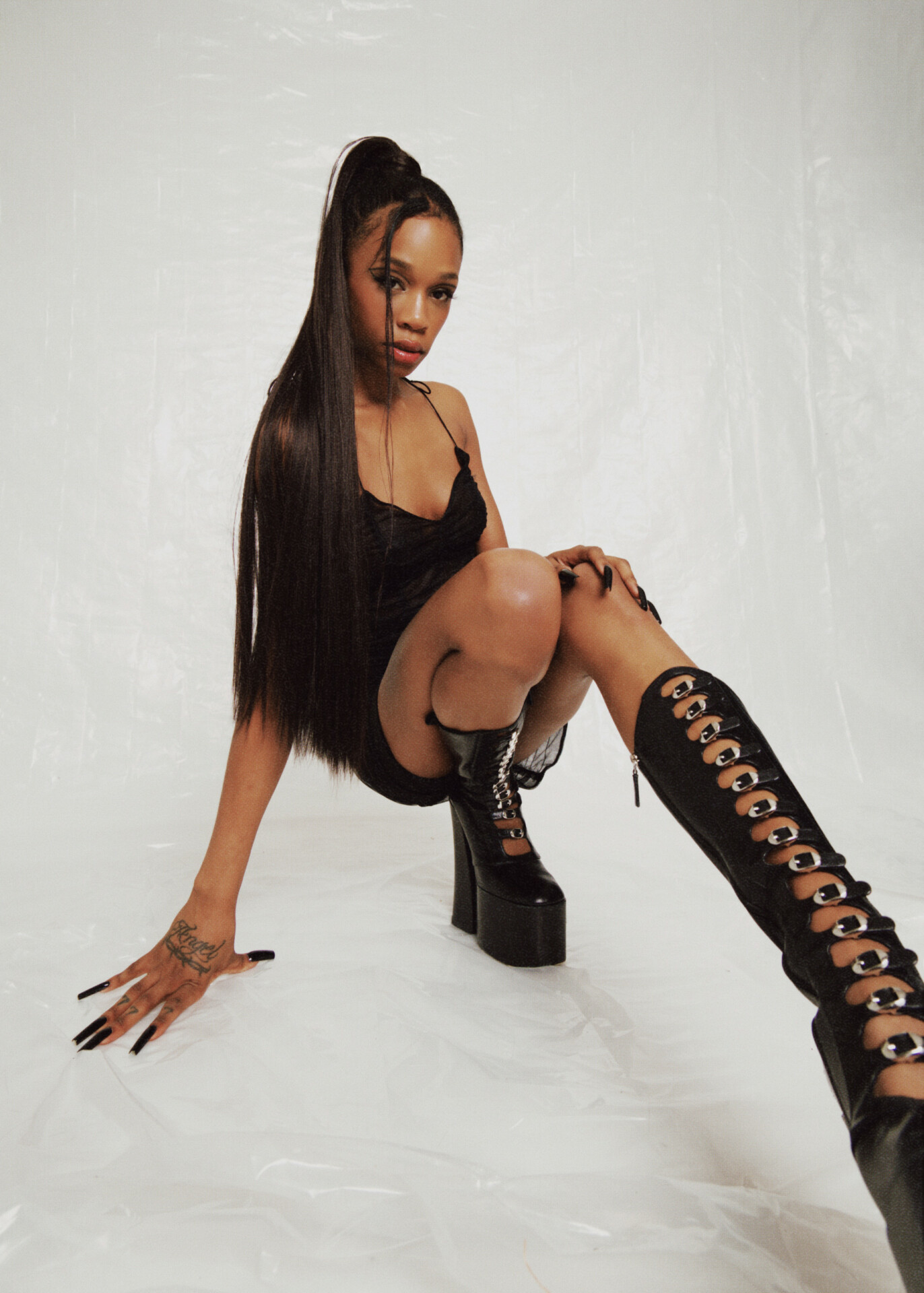
Photography by COUGHS (@coughs)
“It’s a process,” she insists, but indie R&B angel ABRA is learning that she doesn’t have to do everything herself. Despite her independent impulses and DIY disposition, she trusted Boys Noize to co-produce her last single “Unlock It” – and it’s ushered in a new era for the LA-based artist.
“I just wish we didn’t have to be these self-contained gods all the time,” she reflects. In the middle of our interview (we were chatting about getting lost in mental health Instagram rabbit holes), she asks: “Everything always has to be so self-generated, you know?” She poses the question rhetorically, of course – throwing it out into the world without demanding an answer – but her thoughts are open-ended, open to a rejoinder. It’s this same quality that has allowed her music to resonate with so many and continues to inspire her devoted following. A living extension of her music, ABRA is the kind of artist who expresses herself generously, vulnerably, and then risks the implicit question: ‘Am I alone in this?’
The question seems to haunt her tender tracks and feels all the more appropriate given her DIY beginnings: ABRA emerged out of Atlanta writing, recording, and producing her own work, exercising complete creative control over every decision. She traces her creative independence to her itinerant upbringing, which traversed the Atlantic under the direction of her Christian missionary parents – from New York to London to Atlanta, each new stop inflected her artistry. “I don’t ever remember feeling powerful when I was younger. I felt very out of control,” she says. “When I finally had something that I love so much with music, I was like, ‘Don’t even: this is my world and I’ll protect it.’”
And she did: ABRA’s first album Rose (2015) feels as if it were recorded in the patent intimacy of her bedroom closet. Its haunting sensitivity and ethereal sound made it a cult classic – a forlorn monument to the turbulent angst of desire, sung sweetly over 808s. “I used to base all of my confidence in the fact that I was making everything myself,” she shares, “That was a huge thing. For a while, I think I kind of used it as a crutch.” Only ever familiar with artistic isolation and radical self-reliance, ABRA was “really scared to ever be on a label, do things mainstream, involve other people. “But,” she realized, “that was disempowered.”
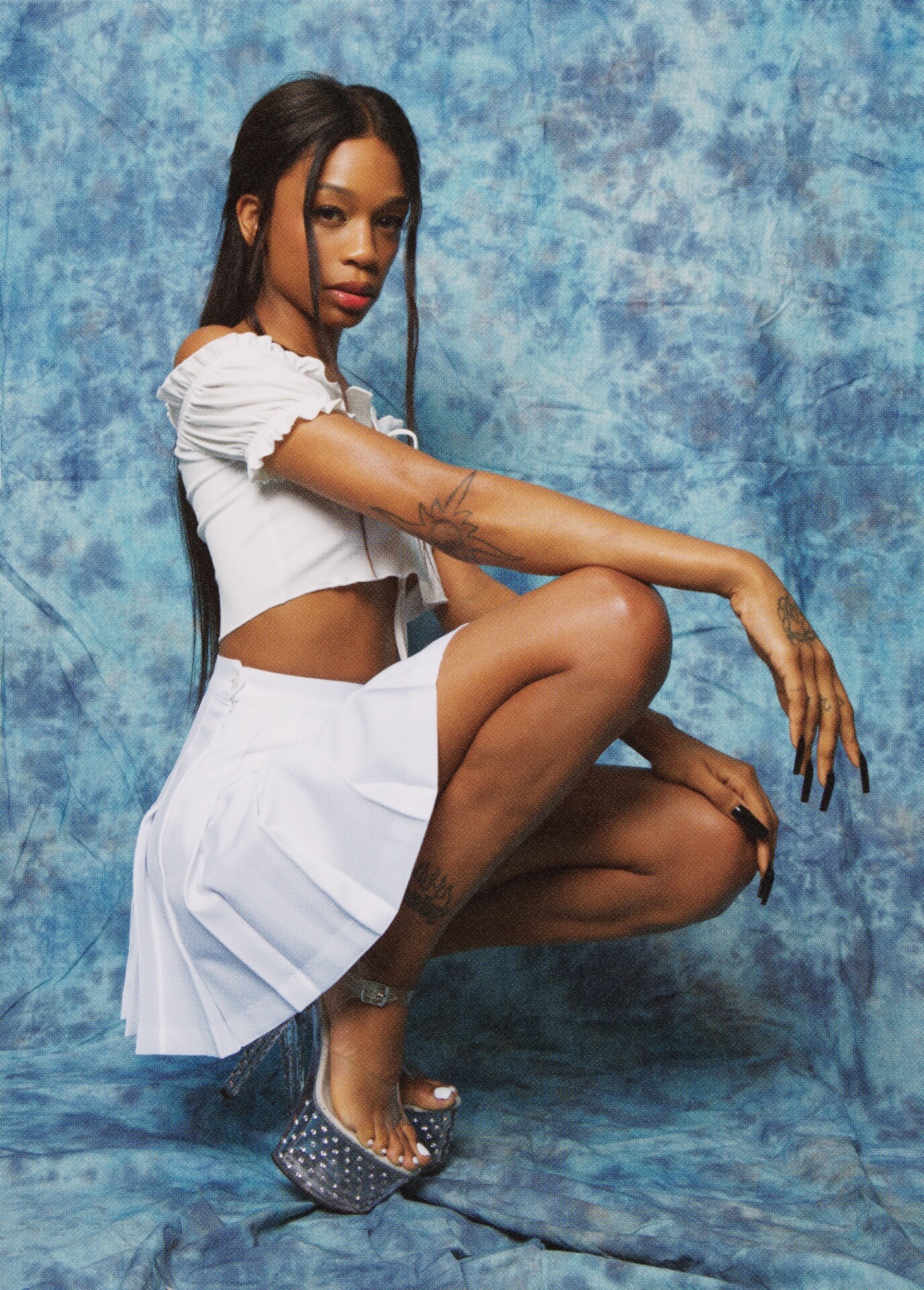
Photography by COUGHS (@coughs)
ABRA’s fierce independence has been tempered by a new creative self-confidence in the immutability of her artistry that she earned by overcoming a “really, really rough period from 2016 to 2019,” during which her creative output slowed. During this time, she starred in Euphoria creator Sam Levinson’s 2018 film Assassination Nation; for mere mortals, this might sound like the pinnacle of validation – but ABRA is relentless in her pursuit of excellence in her craft. “I was writing music through that whole break,” she explains, “but nothing was sticking, nothing was compelling me. I was like, ‘Step it up, bitch, you just have to dig deeper.’”
Then came “Unlock It.”
ABRA describes the track as her “first song back in many senses” – through it, she “unlocked [her]self from a lot of unhealthy thoughts and spaces.” Crucially, it also silenced her doubts: “When I wrote that, I realized that it wasn’t a fluke: Rose wasn’t a fluke, Princess [her 2016 EP] wasn’t. I was like, ‘Oh man, you still got it.’” The Internet’s reigning @darkwaveduchess was back. “It was the light I needed.”
That same light continues to emanate from ABRA herself: she has fortified her connection with herself and cultivated trust in her intuition: “I realized that if I make music that makes ich happy – and I’m like, ‘Wow, I just did that for myself and it’s lit’ – then I’ve done my thing. I hadn’t done that in a long time and I’d forgotten.” It was only by forgetting that she could remember, though, and she describes her current mood as “momentous.” ABRA details how vital it has been for her to get to know herself intimately “so no one else can tell you who you are and manipulate that.”
She’s only been able to find her power, her sound, her anchor, through communing with herself. “I’ve learned how important it is to be connected and trust yourself,” she explains. “That’s something I always had trouble with, I would kind of disassociate from the what my body was telling me.” Not only has ABRA been re-associating with her intuition, but she has been actively celebrating it: “Your body loves you so much and things like anger and sadness, all those things they try to train out of us, they’re actually really helpful!” She describes her experience in feminist terms: “Women have been taught that anger is a disgusting thing – and it’s like, no! I need to be able to feel my anger, I need to be able to feel anxiety about things. We focus on the manifestation and not the idea that maybe we feel these emotions because someone or something is harming us, violating us: our bodies are trying to communicate to us things that we miss because of our minds.” Feelings – those base notes of emotion that reverberate through the body – have allowed ABRA to tune back into herself.
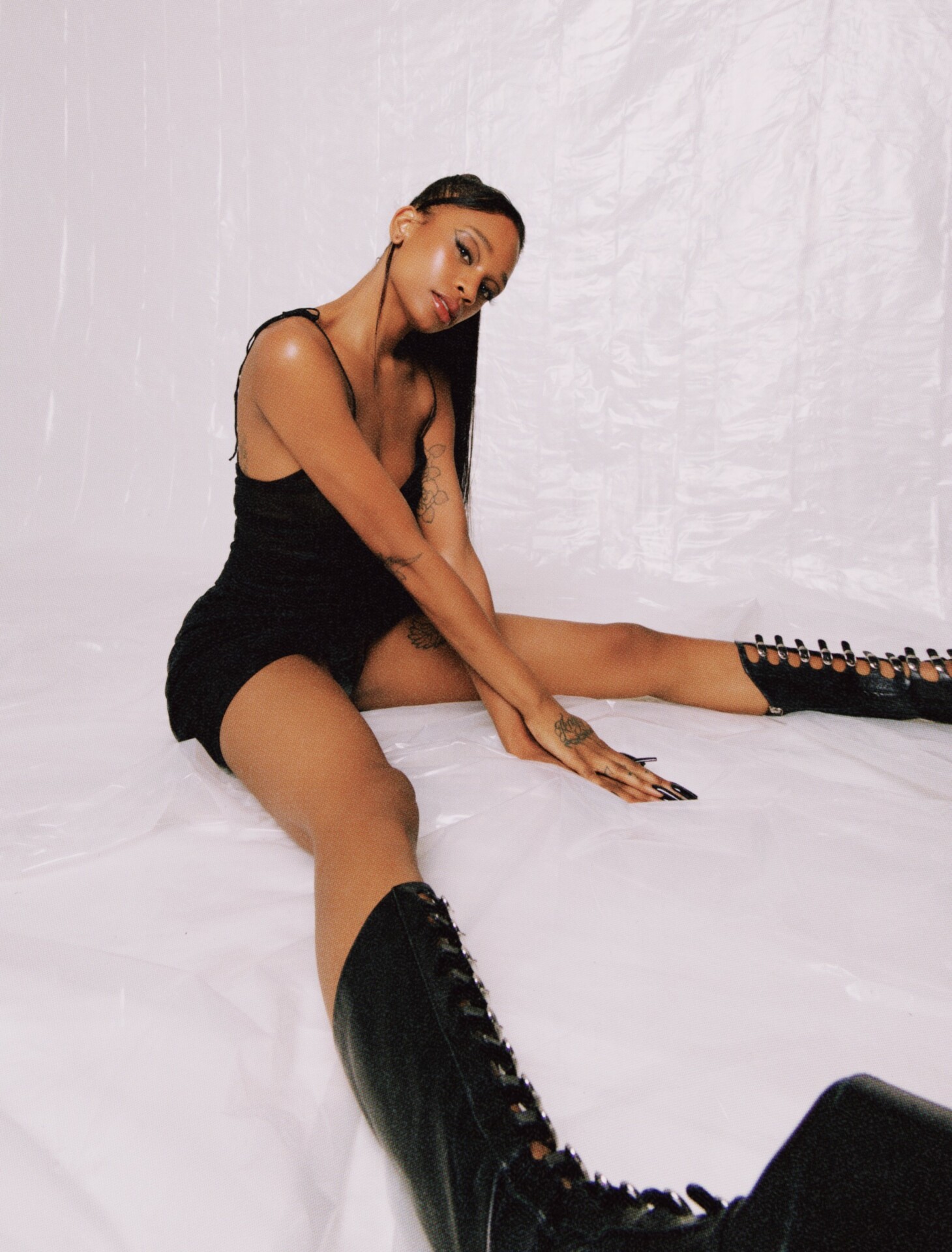
Photography by COUGHS (@coughs)
Recalling her early days with Awful Records – Atlanta’s cagey independent rap label that spawned the careers of artists like Playboi Carti und ILoveMakonnen und Tommy Genesis – ABRA reflects on how far she’s come: “I used to try so hard to be like one of the guys. I wanted to impress them. I just wanted to go about things the way that they did – like a savage and all this stuff. But that’s not where my power was.” She widens the gyre: “We’re taught that a certain kind of power is the standard, but it doesn’t really bring the same confidence as you learning your own, you know?”
“I remember making ‘Fruit’ and when I played it for someone [at Awful], they were like, ‘Oh, no, this is not it,’” she recalls. “But that was my biggest song! If I had listened to them trying to go by ‘This is not hard…’” She trails off because that alternative is almost unthinkable: ‘Fruit’ changed her life (the music video has over 20 million views on YouTube), but also impacted lives of countless others (as evidenced by impassioned viewer comments). “I never used to think that my actions or who I am could affect other people,” she reveals. “But everyone matters and the things you do matter – even if you don’t realize it. Like with ‘Fruit,’ I didn’t know how much it would mean to other people.” Now, ABRA’s at a point where she knows her work resonates: “I do have power, I’m just trying to have some rein on it.”
In 2016, Pitchfork ended its review of ABRA’s last EP Princess with the following: “Behind the nostalgic tropes, there is a confident and self-possessed artist waiting to get out. But it’s a little hard to hear in the cramped space of a bedroom closet.” If working alone as a DIY artist was partially an act of self-protection, then electing to work with others is an act of courage: “We are in a time where there’s a lot of promotion of self and not enough community – or not enough sense that it’s okay to rely on people – that’s a theme that I would like to bring into my music. No matter if I’ve been a DIY or independent artist, I wouldn’t have been able to get here without help. I really want to make sure that I’m able to reciprocate the same amount of care that I received.”
This next phase testifies to ABRA’s solidifying sense of self and fortified intuition. She’s allowing others into her creative process while remaining confident that her distinct artistic vision will endure. “It’s a process,” ABRA insists, and nothing is ever certain: “I guess that’s kind of darkwave – riding through uncertainty and still being like, ‘I’m gonna be fire.’”
Listen to ABRA’s newest track “Honeypot” hier.