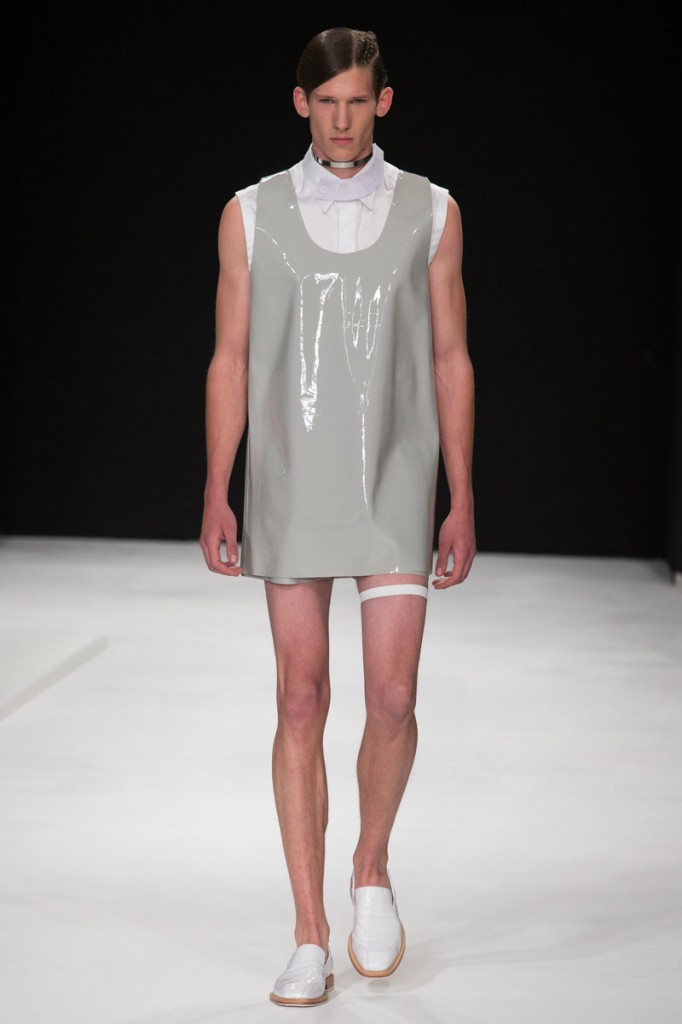
 Xander Zhou SS14
Currently it seems almost as if everyone wants to try the Girlfriend Look. While a paradigm shift in the design DNA of the collections of men’s luxury labels is out of the question, it is suggestive of something more subtle, and it is being played out in front of the general public. Once you look at it from the economic side, one could almost assume that this mainstream is becoming increasingly receptive to symbolic transgressions on the part of men’s fashion.
In fact, LVMH is to become financially involved with the London-based designer J.W. Anderson, the model student of the Girlfriend Look. The label of young Irishman Jonathan William Anderson has only existed since 2008 but is already being sold in over 70 outlets. The LVMH tie-in represents his rise up the ranks to join the most important designers of the future, and accompanies an expansion together with a group that also includes established luxury marques including Louis Vuitton, Céline and Marc Jacobs. For LVMH, it appears to suggest there’s money in androgyny.
After the presentation of his SS14 collection, Anderson, who claims to have only been making “real” menswear for his last three collections, told style.com: “I feel like menswear has gotten to a point for me where it had to be thrown out the window and dragged back in. There’s something that has gone stale for a while in men’s, and I think you have to blow it up – then you’ve spawned a look.” As a result, he has presented above all a playful and elegant version of the man. What next spring will become airy halter tops printed with delicate florals or classic shift dresses were preceded in the current winter collection by architectural bandeau or tank tops, which were worn with hot pants ornamented with ruffles. Endlessly long naked male legs were in jackboots, the ends of which were also decorated with girlish ruffles.
The significant influence of the Girlfriend Look on men’s fashion suggests that the public image of the man is becoming ever more plural. A system of signs that has remained constant over the last 200 years can now be seen to be shifting, albeit slowly; we’re unlikely to see the skirt-wearing man dominating the urban environment in the near future.
Above all, what the emancipation of men’s fashion has achieved to date is that it now follows women’s fashion in its main principles. Both have left modernity behind and find themselves in the present, where they enjoy the freedom to draw from a large canon of individual elements, the meanings of which they then change according to taste. This does not speak for a fashionable resolution to the battle of the sexes – but rather for gender equity.
From the perspective of modern Protestant theory, according to which fashion represents nothing more than a superficial gimmick, you might wonder what kind of progress is represented by the fact that the man is now permitted to be fashionable. But looking at fashion through the eyes of a euphoric theory, then you cannot see modernity from the perspective of the autonomy of the man, but as a period of loss, in which the right to present himself as beautiful and erotic was denied. If you believe John Carl Flügel’s famous 1930 essay on the philosophy of fashion “The Psychology of Clothes” – a Freudian-inspired analysis of people’s fundamental motives for dressing – then adornment is one of the great needs of mankind. There may have been cultures in history which wore no clothes, but there were never any who didn’t make an effort to enhance their appearance. If today’s post-fashion now admits this need for men too, it gifts him nothing less than the joy of his own physicality.
Entnommen aus Sleek 40 “Mann/Junge”