
If I’ve learnt anything from breaking my leg, it’s just how grateful I am for my mobility. I’ve always been active. In fact, I’m practically phobic of a lazy day. When I’m not writing, I’m waitressing and when I’m not waitressing, I’m walking. I suppose I’m walking whilst waitressing too, actually. Not whilst writing though.
I’m desperate to walk again. And, I never thought I’d say it but I wouldn’t mind waitressing either. In my semi-contemplative/semi-comatose bed bound state, I’ve had much time to ruminate yet I’m unable to find the words for the overbearing claustrophobia I feel as a result of not being able to make it down a flight of stairs on my own or carry a bowl of cereal from the counter to the table, let alone shower. I can, however, find words fit to describe my desire for a new pair of shoes.
Shoes are my kryptonite. For good reason. They’re so varied in style. They make or break an outfit. And, as pleasant as it is to walk around barefoot, shoes are truly functional. My logic is: I’ll need a good pair of trainers to walk in when I’m in motion again. My mother’s logic differs as she questions how many pairs of shoes I need. She’s got a point… Nonetheless, I’ve spent hours browsing the web for the right pair of Kiko Kostadinov Asics. I’d also like some square toe black leather boots, even if summer is around the corner.
It’s funny that shoes are on my mind. Perhaps it’s symbolic. Of moving on in life, wanting to be somewhere, embarking on a journey from start to finish – facilitated by a shoe that will carry me, protect me, on my way to normalcy. Whilst near essential, shoes are symbolic. They carry a rich history and cultural context, one that is deeply intertwined not just with sport but with music, politics, geography and community, too.
I ended up on a bit of a deep dive. Whoops. I sure know how to ruin a good thing so apologies in advance.
Approximately 24 billion shoes are produced each year. That’s nearly 66 million pairs every day. Of that, a quarter are sneakers. The footwear industry is responsible for 1.4% of global greenhouse gas emissions. On closer inspection, a study by Massachusetts Institute of Technology revealed that 30 pounds of carbon dioxide is emitted per pair of running shoes manufactured and the energy required to produce said shoes through energy intensive processes – moulding, foaming, heating, binding – could keep a 100 Watt light bulb lit for a week. Don’t forget to factor in the energetic costs of transport. So, whilst footwear might be necessary, the sheer scale of shoe production is a major problem.
Then you have the shoe’s after life. More than 300 million pairs of shoes are thrown out each year. Only 5% of which are recycled. And, the sad reality is that the majority of shoes that are donated end up in landfill, contaminating local environments by leaching chemicals, dyes and metals whilst the synthetic rubbers and plastics that they’re built from take hundreds if not thousands of years to decompose.
Bids for sustainable justice riff on the basics – material innovation, clean tech, transparency, circular roadmaps – and progress is underway. Brands like Veja and All Birds are setting the bar high and offer promising alternatives. Nike, who sell an estimated 780 million pairs of shoes each year, has introduced a handful of projects and programmes including its Move to Zero Journey which allows for used athletic shoes and clothes to be donated for recycling at participating stores to divert materials from landfill and Nike Grind which turns old sportswear into new materials. By 2025, Nike pledges to divert 100% of waste from landfill to an extended supply chain with at least 80% of waste recycled back into products that are made with 25% less fresh water per kilogram in dyeing and finishing processes using clean chemicals.
Dow Inc, a US-based plastic producer, partnered with Sport Singapore (amongst others) to establish a permanent shoe waste collection system that turned disused soles and midsoles that would have ended up in landfill or incinerated into sports surfaces. The project, under the slogan “Others see old shoes, we see the future”, saw 75,000 shoes collected. Unfortunately, there is little evidence to suggest the sports tracks ever came to play and the news provider Reuters, who tracked eleven pairs of donated shoes, found they were exported to and discarded in Indonesia. No wonder we’re so distrusting of green initiatives.
Adidas, who produced 379 million pairs of shoes in 2020, partnered with Parley for the Oceans to produce a line of sneakers made from beach plastic. Upon thorough inspection of a downloadable PDF, it’s apparent that Parley plastic products are made from plastic intersected from beaches, tourist attractions and coastal communities – not from the ocean. Not to mention that less than 20% of the shoe is actually made from Parley Ocean Plastic. I realise I sound a little critical when perhaps I shouldn’t. Parley is a key player in the clean up of ocean plastic and the collaboration with Adidas resulted in the collection of almost 6,000 tonnes of plastic waste.
If we bought less shoes, would brands make less? Yes and no. It’s seemingly complex. Look at Adidas’ Yeezy, for example. There’s a huge surplus of products just collecting dust due to Yeezy’s cancellation. Adidas predicts a €700 million operating loss for 2023 should it write off the unsold sneakers. The brand has to decide whether to rebrand the shoe, donate the goods or destroy them likely through incineration. Adidas would be joining the likes of Nike, Burberry and Louis Vuitton in torching products should they take this route.
How can we reduce the volume of shoes ending up in landfill? Sneakerhead culture, for instance, whilst considered to be a symptom of hyper-consumerism, actually deems sneakers as collectible. It also promotes reuse, resale and vigilant care that ultimately prevents a shoe from ending up in landfill. When a shoe is donated, to charity let’s say, it has a high chance of being exported. If the shoe has lost its pair or is too worn out, where do you think it’ll end up? Some words of wisdom would be to cherish the shoes you do own, try to sell them before throwing them away and if you do donate them, make sure you tie them together.
I realise my tune so far has been less than optimistic. Bare with me.
Aside from the aforementioned, what is being done to lessen the environmental footprint of the footwear industry? I’m particularly excited by the sort of grassroot movements, if you will. You’ve got designers who are breathing new life into old shoes with upcycled collections.
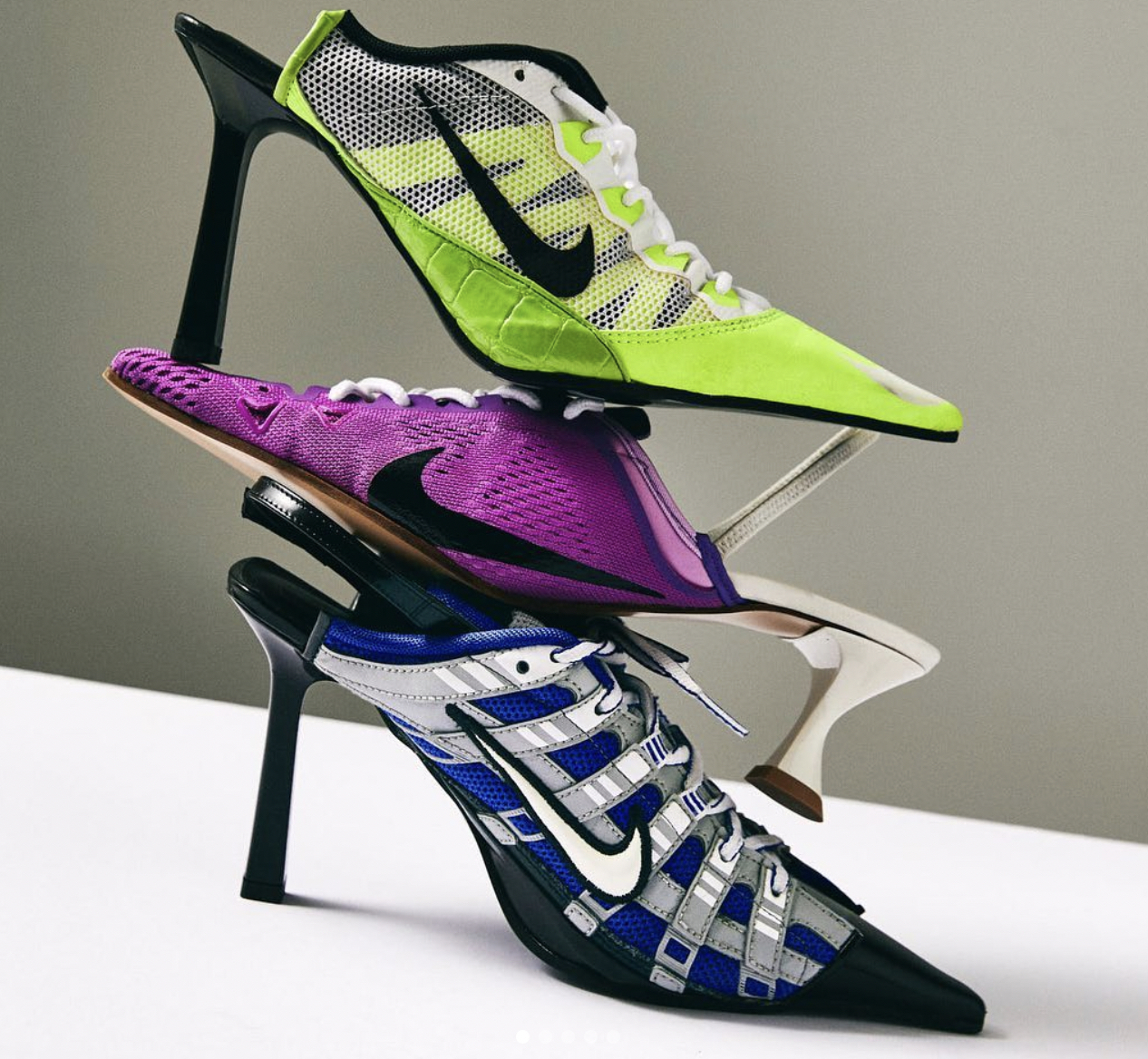
London-based and Romanian-born designer Ancuta Sarca is upgrading old Nike sneakers into dissonant heels, boots and clogs that sit at the nexus of contemporary and classic. Cierra Boyd, the brains behind FriskMeGood, is turning unwanted shoes into retro-futuristic corsets and two pieces. Berlin-based Kurdish artist All Amin, founder of Haram, is upcycling sneakers into Y2K-esque bags. And, Nicole McLaughlin is building shoes out of discarded, well, anything. The infamous upcycler has recently partnered with both Reebok and Vans with her own iterations of classic models from a sustainable stance.
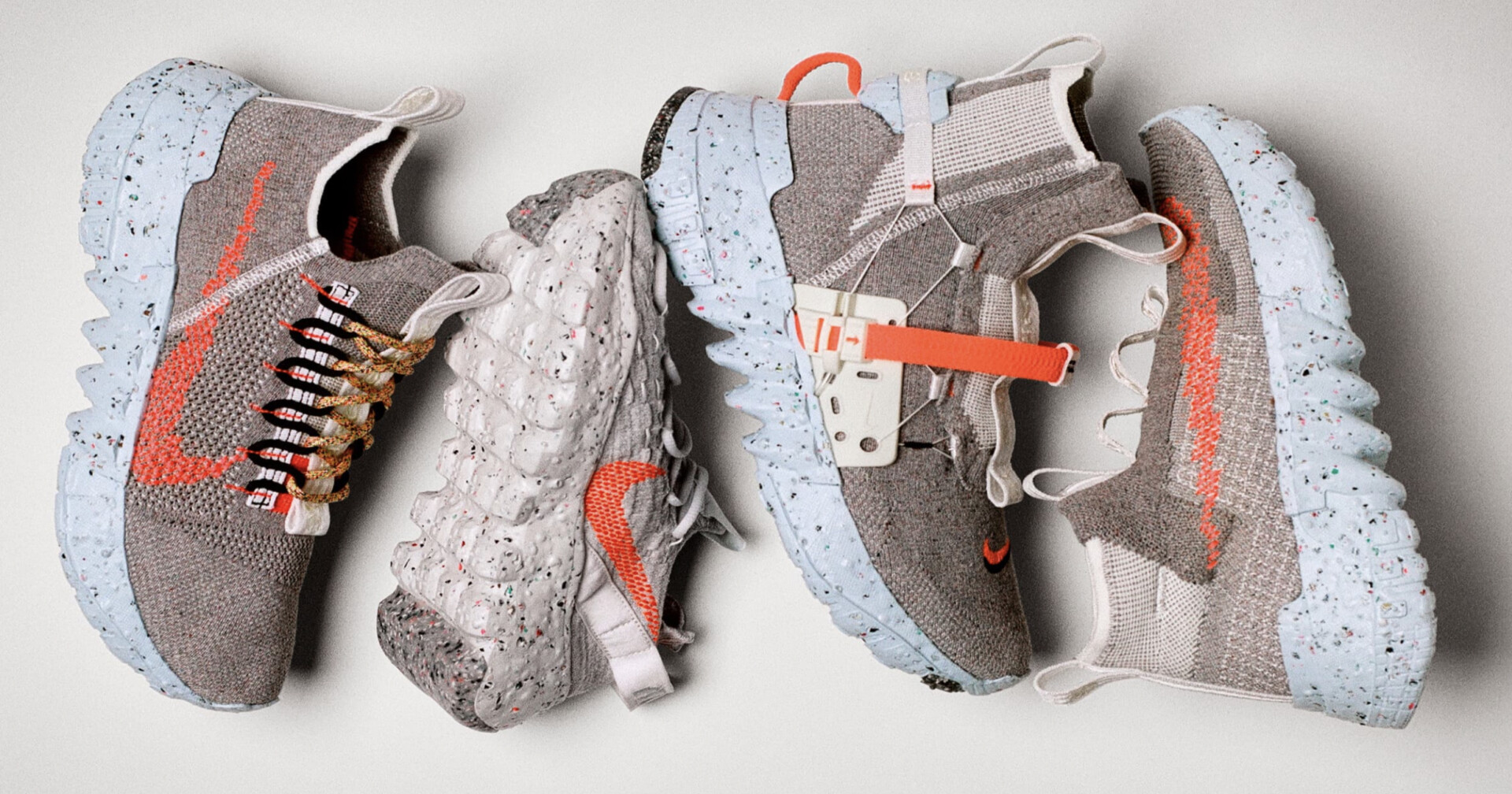
The thing that all these designers have in common is that sustainability is so innate to them that it’s no longer the central thesis. It comes naturally to them to take an eco-approach which allows them to produce something totally unique. As All Amin puts it: “It doesn’t have to look eco to be sustainable.” This might be where Nike is going wrong with their Space Hippies.
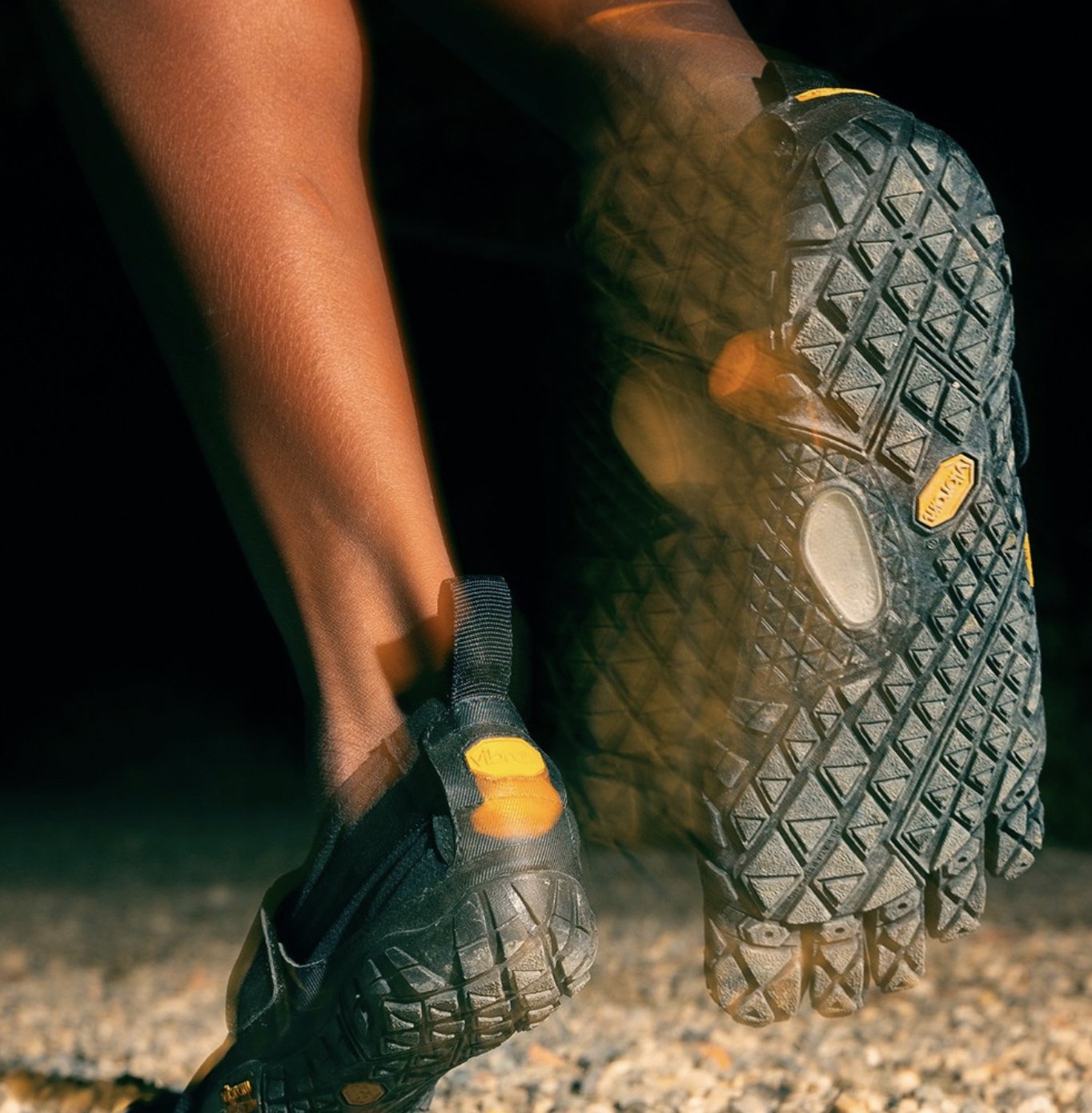
You’ve got companies like Vibram, Miista und SneakerPharm who offer repairs for shoes that are worn out in an effort to extend the lifecycle of a shoe before it is discarded. Theo Jones, a 3D print expert who I spoke to for another piece, spoke about the possibility of incorporating 3D printing into a good’s longevity: “If the sole of a shoe is the first thing to give, perhaps a shoe company might offer a 3D printed sole repair prolonging the life of an already existing product.” And, the resale market – digitally pioneered by names like eBay, Depop and Vinted and physically pioneered by the trusty thrift shop – where you can buy and sell new and used goods including footwear. Innovation and research are also promising avenues. There are many companies like Modern Synthesis, The Ellen MacArthur Foundation, VivoBarefoot und Timberland who are investing time and money into the search for circular material solutions suitable for footwear production.
If each shoe represents its staggering environmental impact, every conscious or subconscious effort we make to sustain the life of a shoe – or abstain from buying another one – is a contribution towards more sustainable consumption. As consumers, we have power to vote with our money. And, here’s hoping, if we do the footwork, the legislature will follow. Ask yourself, how can I lessen the impact of my tread? How can I extend the life of the shoes I do have? Can I be more strategic with my purchasing of shoes if and when necessary? And, in my case, are a pair of Kiko Asics really going to aid my recovery?