Kathryn Bigelow cited you as influence for her work recently.
She does extraordinary work. I haven’t seen “Zero Dark Thirty” yet. I did see “The Hurt Locker” and liked it. Very unusual for a woman. The subject matter – war and everything – seems like a masculine thing, but it’s interesting to see a woman’s perspective, or this particular woman’s attitude towards the subject. You need the woman’s voice to see through the haze and smoke.
Women in your films are mythological, spiritual characters like Lilith, the scarlet woman, Isis… they’re not necessarily always peaceful.
The scarlet woman was the high priestess according to Crowley, and he had a number of these women, and he always had them dye their hair red [laughs]. There was continuity there. Some of them were natural red heads. For me the ideal scarlet woman would be Clara Bow, she had natural red hair. She was the sex bomb full of life and excitement of the silent film days; a star of American late silent. Have you ever seen any Clara Bow? No? Well you’ve missed something! The films still exist. These are all the mythological spiritual side of women. I never made a film about a housewife. The scarlet woman is maybe a little bit like the Whore of Babylon, the mystic whore, not the one who takes money.
One of your unrealised projects is a film version of Gnostic Mass. Will it ever be completed?
I did a film study in black and white. And if I can find the money I would redo it in colour, but I won’t release the black and white. Thirty five millimeter film is very expensive, you see. It’s the professional size and it’s also the best colour, like Agfa or Eastman, whichever, but I can’t afford it myself. It’s a speaking film, too. Most of mine are silent with music but the Gnostic Mass is written by Aleister Crowley, and it has a role for the Priestess, the Priest and the Deacon. There are about five speaking parts. It’s based on Crowley’s text, I didn’t rewrite it but its scripted in a narrative. It’s the equivalent of if you’d film a Catholic mass, there’s nothing obscure about it, there’s a few magical words that you’d have to know what they mean, but most of it is in English.
Do you not work with digital?
I do now, my more recent films that are being shown in Düsseldorf [at Venus & Apollo, the Project space of the Julia Stoschek Foundation] are digital. One is on a friend of mine who committed suicide, [the musician] Elliott Smith. He was 34 when he shot himself. A stupid quarrel over a girlfriend, not a reason to shoot yourself, but he was obsessed with death I’m afraid, because the first record he made of his singing was called Suicide Records. So he had this obsession that led to an early death at 34, but I filmed him singing. It’s the only movie I ever made with live singing, it’s called “Elliot Suicide”. But digital to me is just another means of capturing image.
Thelema is experiencing a revival now, you see it funnelled into music and trends.
It can be picked up and superficially played with, anyone can do it, it isn’t a secret the books are there, there’s no violation of copyright, and if there is, believe me no one is going to get sued for using texts by Crowley.

It’s susceptible to being superficially dealt with, though. How would you recommend approaching it?
If someone is going to do something serious, they have to have the serious inside them. And so I don’t try to influence anybody, they can just do what they want. Which is a Crowley maxim: “do what thou wilt shall be the whole of the law”, which means do what you want – but be careful too.
Charles Manson believed he was the reincarnation of Aleister Crowley. At the time of the murders, the press quickly leaped to linking the Manson Family and the O.T.O. I read recently that James Franco will star and direct a biopic about Jay Sebring, the Manson Family victim.
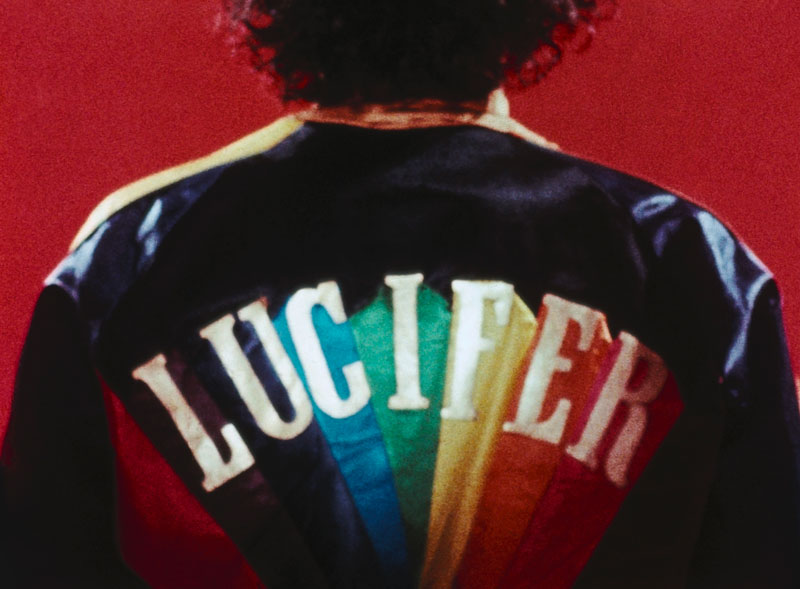
This is public domain, if anyone wants to treat such a disgusting subject… to me Manson is best forgotten. I have a friend who fell under his spell, Bobby Beausoleil, [who starred in “Lucifer Rising”] and he is in prison for life because of his association with Manson. I visited him once in prison, and once was enough. I have nothing to say. What are you going to say? “Cheer up”?
I think it resurfaced recently because some members of the Manson family are going to be released…
Some of the girls have been let out. I’ll find out when I get back to LA. I’ve met Franco, he’s very ambitious, we did something together, worked on his film for 7 For All Mankind.
You are obviously an avid collector of Hollywood ephemera. The rooms downstairs are set up like the rooms housing the collection in your apartment. Can people come and view your home collection?
No, I used to have a place where I had each room designed red and blue and that was my suggestion to them for this show, more or less like at home, but now I keep most of my collection in storage, but it goes out to different places. Like the exhibit here is pretty large for a travelling exhibit.
Two years ago when you came to Berlin and gave a talk it was so crowded; a new
generation is discovering your work. Do you relate to that?
Anyone who wants to do creative things I relate to. I don’t particularly relate to the ones who want to break into the so-called industry, making commercial films. If they want to be an artist and work on the sideline that’s more interesting to me. But I’m glad if I have inspired someone.
Let’s do the photo, I’d like to go with the neon sign of the lips.
Why lips?
The symbol of a Hollywood star…
Taken from Sleek 37, the “Fake/Folk” issue.