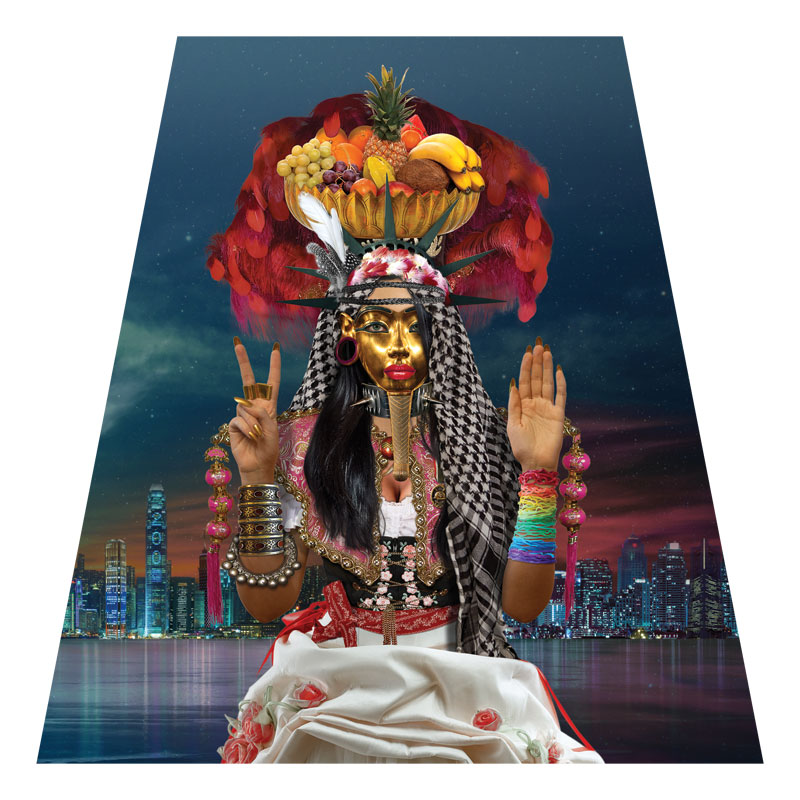
 Talia Link, Witch no. 5, 2012. Digital collage, Inkjet print. 112 x 110 cm. From the Witches Project. Courtesy the artist
What is a Witch?
“A witch is, actually, a successful (in the sense of surviving) deviant,” wrote the avant-garde filmmaker Maya Deren 1947. “Most people survive because they conform… then suddenly you have someone not behaving ‘normally’ and usually they cannot survive, since having rejected the system they go under, so to speak. … but then you get a deviant which survives, and since it does not draw its support from the normal pattern – and since the normal people only consider themselves as natural – the deviant is understood as drawing its support from ‘unknown’, ‘supernatural’ sources.”
In other words, to paraphrase another great female thinker, one is not born a witch. The witch is a construct, the scapegoat on to which society projects illness; they are figures that symbolise insubordination and the transgression of normality, posing a threat with their nonconformity.
The crucial revival of the figure of the witch took place in the 1970s, primarily in activist contexts, when precisely these seditious traits were being appropriated and turned on their heads. The witch became a potent symbol of feminist as well as gay struggles in europe and the US, a path that extends to the witch’s appropriation by the queer community today, where the potential of the image to speak to various strands of non-conformism is recognised.
This reanimation has led scholars to rewrite the obscure history of witch hunts, highlighting the roles of healer, midwife and botanist which her figure also combines, of a woman engaged in an un-materialistic relationship with nature and spirituality. These important (and overlooked) dimensions of the figure, though cited by historians before, were not reinstated and celebrated until the late 1970s, to serve as inspiration for feminist and neo-pagan groups committed to questioning identity and taking action on political and environmental issues. In short, the witch has become a symbol for political potential and social alternatives. It also drew many to embrace witchcraft as a way of life marking their own refutation of societal conditioning; the neo-pagan and Wiccan communities are steadily growing.
That’s not to say that the marginalisation and subjugation of women, or misogyny, are things of the past. Both prevail today, and feminine alterity is still frightening to many who would rather police women’s presence and access to society, as the recent scandalous failure of the Irish government to issue an official apology for the abuse that was the rule in the Magdalene Laundries shows. The practices that took place at the Catholic-run laundries, which housed “fallen women”, echo the writing of Silvia Federici, who situates the institutionalisation of rape and prostitution, as well as the heretic and witch-hunt trials, burnings, and torture at the centre of a methodical subjugation of women and appropriation of their labour.