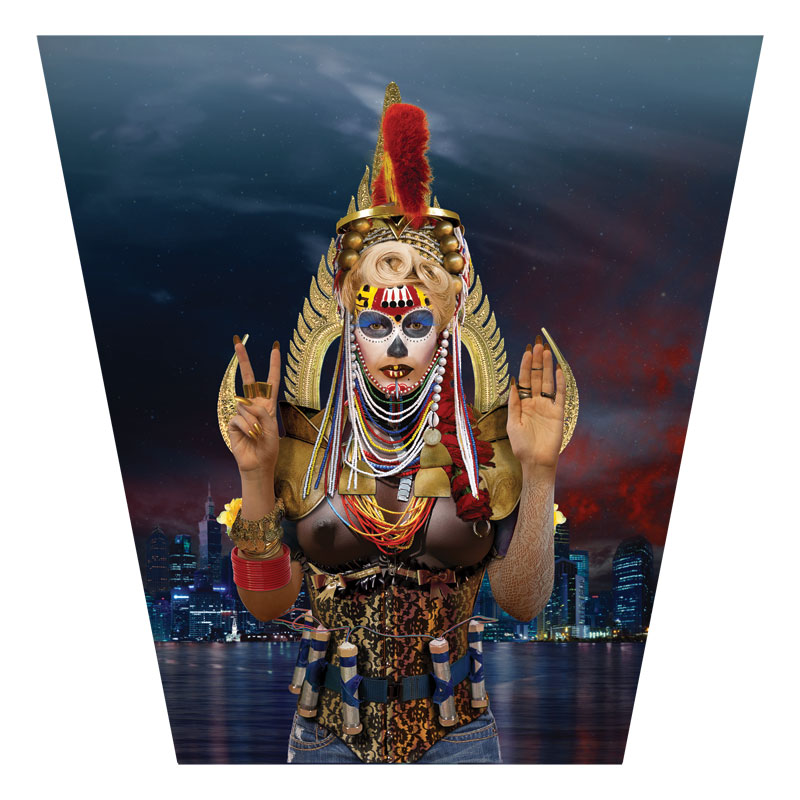
 Talia Link, Witch no.6, 2012. Digital collage, Inkjet print. 112 x 110 cm. From the Witches Project. Courtesy the artist
Stealing The Witch Back
Slander is among the easiest ways to subjugate a person – the outsider is named a madman by his enemies, the threatening woman a witch by hers. But political activists and artists alike have picked up the “witch” signifier throughout the Twentieth Century to prompt a retransmission in the power of naming, and female artists in particular have used to it great effect.
Perhaps the most notable example is Mary Wigman’s “Hexentanz” (Witch Dance) first performed in 1914. In “Witches: Hunted Appropriated empowered Queered”, curator and writer Anna Collin asserts that Wigman, the mother of expressionist dance, “used the figure of the witch to underscore her interest in mysticism, as well as her desire to shake up the male dominated avant-garde. Wigman thus re- establishes the witch as an intrinsically feminine and alien figure… both frightening and fascinating and resolutely indomitable.”
But from sorceress to neo-pagan goddess to healer and activist, with so much baggage in tow, can the figure of the witch still take on new meanings which are relevant and appealing to a younger generation? Based in Tel Aviv but describing herself as a citizen of the World Wide Web, artist Talia Link has recently exhibited her “Witches” series – consisting of seven individual witches, a four-minute video and a gold-plated ring – that was the outcome of ex- tensive research on both the witch as symbol, and symbols in general. Her prerogative: a quest for new femininity by way of re-appropriation via projections, emblems and symbols, digital image processing and… Beyoncé.
I started by looking into different symbols and the affiliations they represent: cultural, ethnic, ideological and religious,” Link says. “Symbols are signifiers of belonging, either chosen by their wearers or forced upon them by others. From punk to fascism, everyone uses symbols to communicate to the rest of the world what group you belong to. Then I asked myself, but how does it relate to the world? What can be done with it?”
Collecting images of countless signifying objects and markers, adapted, projected or im- posed, from African lower-lip plates, tummy- tuck marks, a yellow badge, hula hoops, Indian face paint, a belt rigged with explosives, a dirndl and many more, Link eventually decided to create a new mythology, a universal story that unites all these symbols into one new figure – the witch.
“The witch as it is played in our minds is a projection, and one that was utilised by society to define and police itself,” Link says. It seemed only natural that in order to write a new saga for the figure of the witch, the age-old practice of constructing her myth should once again apply. Her project is therefore an attempt at an historical simulation, meant to reclaim the past. “I believe that in order for women to have adequate representation in culture today, we must claim back our historical images. A strong woman is always portrayed as a witch, marginalised and persecuted as demonic figure. I encourage women to see witches as their predecessors and identify with their centuries-old legacy.”
Her witches are magnificent and beautiful, resembling Yemenite brides in their fantastical decorum; they are ornamented almost beyond recognition, an amalgamation of symbols and projections – some of which are also menacing. Yet their beauty pierces through the layers, bearing testimony to their power. “They are objects laden with all the things our culture wants them to be. Working on the images was a brutal process of cutting heads, reshaping breasts and severing arms, just like it’s done to images of women in digital retouching processes for magazines and advertisements. I wanted to make a female prototype that at- tempts to be whole and fails.”
The visual language of advertising is some- thing that Link is heavily influenced by. “I’m the kind of person who never zaps away during commercial breaks on TV, I love it.” Art, for her, has to make use of the language and techniques of this day and age; it is something people are familiar with, a universal language that they immediately recognise.
If mass media is largely responsible for the dissemination of female images as skinny, light- skinned creatures with surprised expressions and pouting mouths, with this series, Link tries to use media’s very identifiable, persuasive visual language to create a new signifier that is at once seductive and enthralling, but also im- perfect and even frightening, something that allows for women to identify themselves with. And just like any other group, the witches needed their very own symbol.
“‘Use the V’ is my slogan. The V sign exists all over the world, but it means different things in different countries and contexts. It can be the sign for victory or peace, a simple greeting or female genitalia. everyone makes the gesture of the V,” she says, raising her right hand, showing another art work from the series: a ring on her middle finger which pushes the index finger slightly to the side to form the V sign. “It’s a universal sign that takes on different meanings, and so are the witches in my series, who are hybrids from all cultures, while the only thing they have in common is that they’re all women.” Link propagates the complete appropriation of the witch as a female role model and the V sign as her symbol, partially inventing its history, while using uncannily familiar visual language.
“Beauty is another aspect,” she goes on. “Women were and always will be objectified. You can’t just erase that and say we should be ugly. What we must do, however, is break the formula which prescribes that for women to be beautiful also means being submissive and subjugated.” Indeed, there is no formula for a new femininity, but Beyoncé is, for Talia Link, a huge role model. “To me she’s like a shaman, the way she dances in a trance, yet fully in control, half naked in her leotard. She is powerful and sexy and I appreciate the fact that there’s a generation of little girls out there grow- ing up with her image as their role model.”
The time has come to construct a new femininity, to write a new history for women. Forget the broomstick and the black cat, and in the opening words of Link’s promotional video for her witches series – “Use the V”.
Taken from Sleek 37 “Fake/Folk”
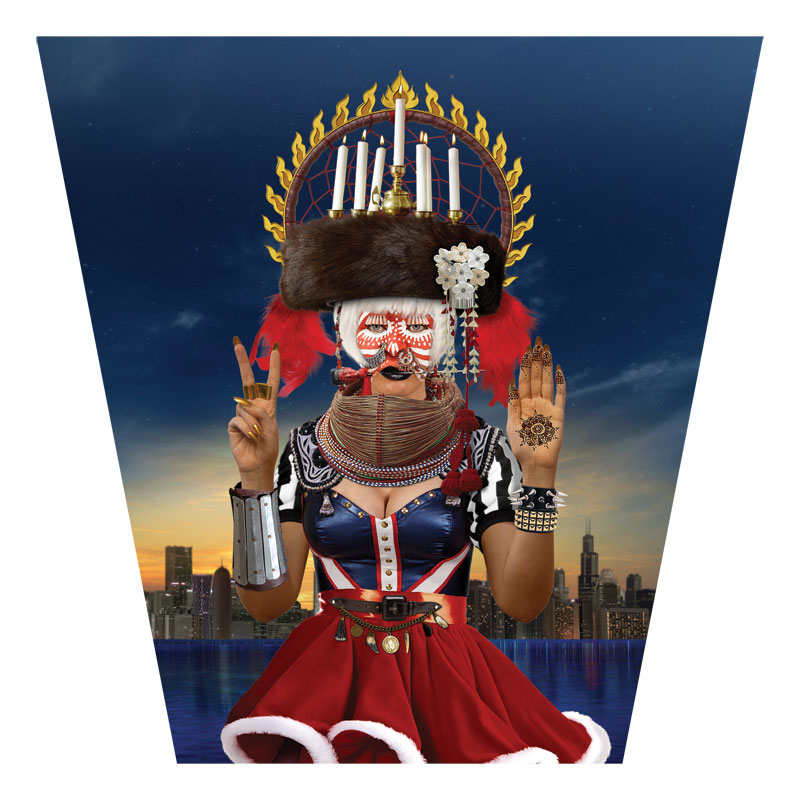 Talia Link, Witch no. 4, 2012. Digital collage, Inkjet print. 112 x 110 cm. From the Witches Project. Courtesy the artist