3. In The Rearview Of The DeLorean
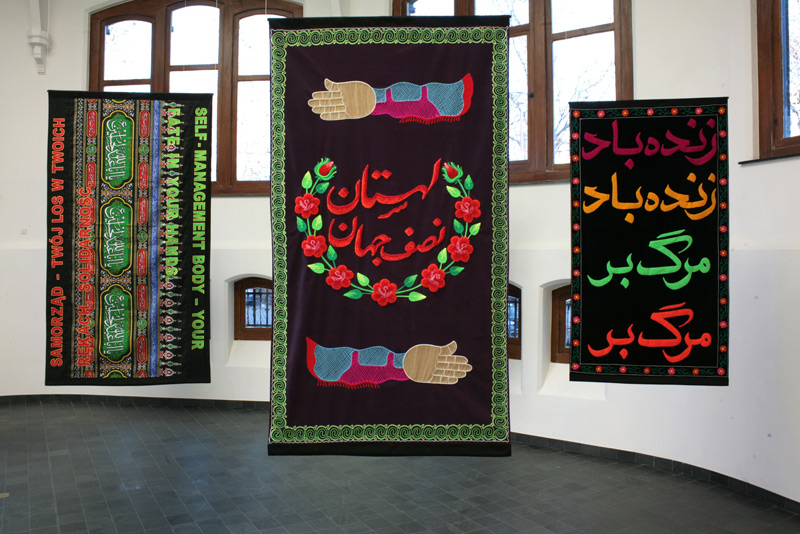
A main strategy to that end – and a defining characteristic of Slav and Tatars practice – is, as above, the collapse of time, or even a call for an escape, a vacation, an extended trip away from its clutches altogether. This engineering of what might be called a time machine of desire is not atavistic, retrograde or even Luddite, though an emphasis on crafts, artisanship and a slow, deliberate approach are central to what Slavs and Tatars do. Rather – in a long-term campaign to “cultivate complexity” – they preach the anti-modern, a concept pioneered by French philosopher Antoine Compagnon, which implies “[going] forward but with an eye in the rearview mirror” (as Jean-Paul Sartre said of Baudelaire).
The anti-modern is not the negation of the modern, but its transcendence; an anti-modernist is not someone who opposes the modern, but is perhaps a modernist at odds with the modern age, conceptualizing it in ways that offer alternatives to it. The idea is full of all the re- words, except the misguided revival or retro; it takes the past and reconfigures, reinterprets it and resuscitates it. Resuscitation is particularly salient concept: the word implies breathing life into old concepts, bringing them back from the dead and colliding disparate or incommensurate ideas from the past with the present in the hope of making them more “urgent”.
By dint of resuscitation, Slavs and Tatars reconfigure what the future can mean, geometrically complicate it, or locate coordinates by triangulating space-time. Slavs and Tatars refer to Walter Benjamin’s Angel of History, thrust forward with her back to the future, or the Malagasy language, a tongue from Madagascar which uses “behind” to speak of the future and “in front of” to speak of the past.
4. Present Perfect-ion and Past Simple
Petroleum may be one of the substances flowing out of the Caspian and through the focus-region of Slavs and Tatars’ work, but language is the oil greasing the time machine’s gears. In their oeuvre, multilingual puns, wordplay, transliteration and transubstantiation (over and above translation) outline the revolving doorway to that other country of the past.
As a defining factor in so many ethnic identifications in the region and the battleground of many a cultural conflict, language, languages and the rotating alphabets of Eurasia (Latin, Cyrillic, Persian, Georgian, Armenian, etc.) are a useful platform for bringing unrelated elements together in Slavs and Tatars’ work. After all, where more peacefully can the past, present, and potential future co-exist than in a paragraph? And how more easily to travel to a faraway land or place than through reading?
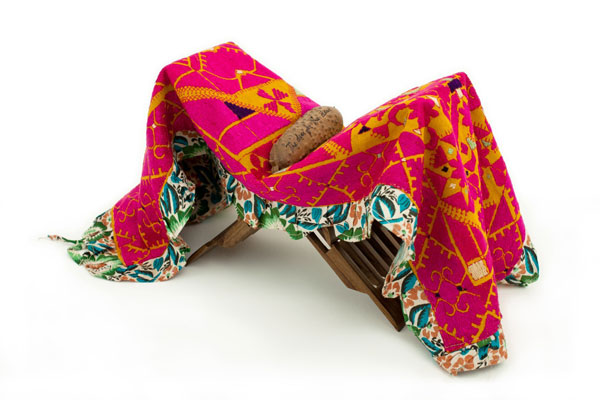
In Slavs and Tatars appearances this year there is an attempt to further promote contemplation and radicalize books and reading. A number of works refer formally to the rahle, a traditional X-shaped bookstand common to Central Asian Islam for holy books. In a recent work for the 2012 New Museum triennial entitled “Prayway”, Slavs and Tatars combined the shape of the rahle with that of a vernacular seating area known as the takht (river bed), making a “collision of the sacred and the profane”. But as exhibition-goers lounged upon it, it appeared more than anything like a flying carpet.
Question is, was it heading toward the past or the future, or levitating in the present?
See more from Slavs and Tatars during Berlin Art Week at Kraupa-Tuskany, and at Project 98: Slavs and Tatars “Beyonsense”, as part of the Projects series of the Museum of Modern Art in New York, autumn 2012.