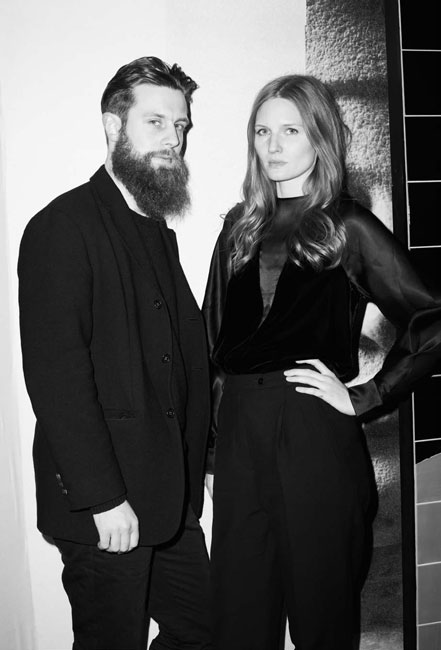
 “I’ve got a weird obsession with Germany,” says Londoner Lowell Delaney. “Nobody in England seems to share this with me but…I just love the food here!” It’s a winter’s day in Berlin, and Delaney, one half of the label Trager Delaney, is exploring the Hauptstadt with her design partner, Kim Trager, originally from rural Denmark.
“The other thing I love is the fact that Berlin is not about the extras or the bullshit,” she continues. “It’s about being straight down the line, and breeding creativity within that.” Having only set up their own label in 2012 it’s clear the pair also favour graft over posturing. Since they began they’ve had their SS13 lookbook modelled by fashion favourite Arizona Muse, made their London Fashion Week debut with their SS15 collection and been featured in the pages of Vogue, Elle and Dazed & Confused. Though the pair met on the knitwear course at Central Saint Martins, both had very different routes into fashion. While Kim Trager had a family connection to clothes (his grandmother claims to have brought jeans to Denmark in the Seventies), he instead opted to join the Royal Danish Hussars. After leaving the army, the Dane arrived in London with the intention of persuading someone to give him an internship in the business (he almost succeeded at the studio of Roland Mouret). A series of similarly ballsy moves later and he was graduating alongside witty English rose, Lowell Delaney, whose teenage summers were spent sewing, “or drawing obsessively, like a freak”, and who worked at Céline, Sonia Rykiel and Alexander Wang before starting the label with Trager.
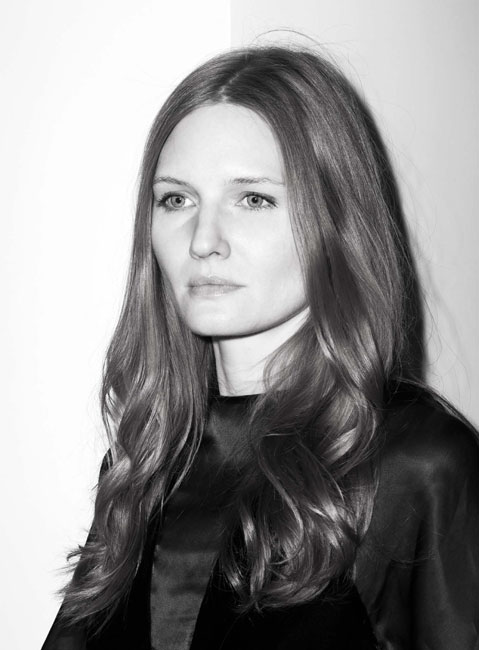
The couple (whose relationship is purely professional) tend to work in synchrony, as if they share the same brain: “It’s like we’ve morphed into the same person,” Delaney laughs. Each designer’s research process, though carried out separately, frequently produces a similar result. For example, with their SS15 collection, the pair explored the everyday outfits worn in the Russian countryside. “It came down to a kind of cultural normcore,” explains Trager. “ Just something so basic, yet with a twist of something so raw that it’s good again.” They cite Russian teenagers in Ellesse sweatshirts and supermarket flip-flops as influences, mirroring a trend among many luxury brands such Céline and Givenchy, where the feeling of the ordinary is creeping into their sumptuous silhouettes.
The smartly feminine and unfussy collection also referenced Russia’s art, in the form of bright Constructivist colours and shapes, as well as a prints featuring delicacies such as cauliflowers, oysters and broccoli.
Having a developed a mutual interest in fabric during their university years, the pair are obsessed by the possibilities different materials can lend their designs. In many ways, it’s this attention to detail that has singled them out as a particularly luxurious label. “I think knitwear, for us, was never really about knitwear, but just the way you control fabric. It’s what we still love today, whether it’s a beautiful silk, or our recent ‘puff’ print,” says Delaney. Yet it’s far from being the easiest route for a young design company to use, as they have learned the hard way: “We realised if you want to use your own fabric it’s fucking expensive.”

It’s not an easy time for anyone to be setting up a company, but Trager and Delaney have plenty of enthusiasm. “Lots of people warned us,” Delaney explains. “But we didn’t listen!” This self-belief is why the pair continue to earn rave reviews for their pared-down, elegant designs: their focus on the end product, despite any obstacles from the business side of things. “The good thing is you go in completely blindfolded. You have no clue what’s going to happen,” Trager says.
As a brand, Trager Delaney are committed to innovation, and have some exciting developments for 2015 in the pipeline. “What we set out to do in the beginning is to do something different in the fashion industry. We are in the process of doing that, from the next season onwards,” Delaney tells Sleek, while keeping quiet about the details, only revealing that: “it’ll be different!”
It’s a strategy that’s symptomatic of young designers enjoying the early fruits of their success. Having learned important lessons from their first few years finding their feet, there’s a need to build upon those foundations while moving in new directions: “We know what we are good at, and we know what people want from us,” says Delaney. “And we know we can cut away the bullshit. We just can’t wait to make it all happen!”
Text von Josie Thaddeus-Johns
Photography by Jonas Lindström
More: Read other Print Features
Buy Sleek 45