An echo chamber is a comfortable place. It keeps us occupied and engaged in discussion without running the risk of being wrong – a dreadful feeling that would be. And exhausting, too. Surely it’s safer to surround ourselves with like-minded people? In her commentary, which is as sharp as it is astute, Marie von den Benken sheds light on the pitfalls of comfortable certainties.

Blazer DOLCE & GABBANA by YOOX, Leggings GIVENCHY by YOOX, Boots GIANVITO ROSSI by YOOX
I consider myself a curious person. Probably most people do. I mean, they consider themselves curious, not me. But that’s only to be expected. Nobody stands in front of the mirror in the morning and thinks: Right, today I’d like to understand as little as possible, instantly judge everything and then lecture as many complete strangers as I can with my newly acquired pseudo-knowledge.
Nevertheless, we consider ourselves exceptionally well-informed. And above all: objective. Naturally, we’re constantly looking beyond the edge of our own plate. That very edge which, in popular jargon, has come to symbolise open-mindedness towards the world. The one we regularly and proudly peer over in order to present ourselves as particularly balanced and credible. The one that has thereby become a sort of moral exercise: above all, it’s the others who ought to glance over it more often. After all, we’ve long since mastered the exercise ourselves. We’ve already made ourselves comfortable on the winners’ podium of argumentation. We’re just waiting for the trophy presentation.
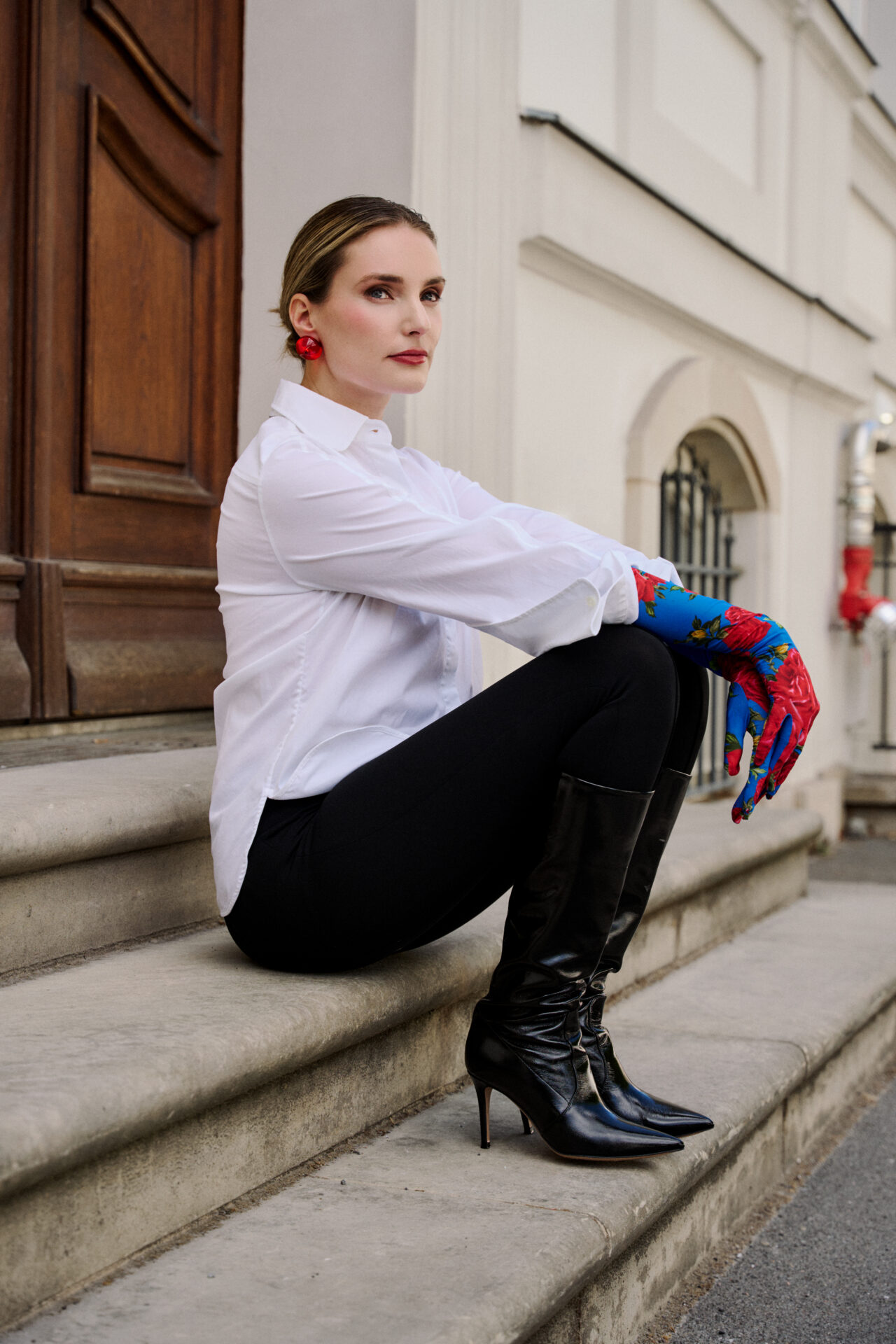
Shirt BRUNELLO CUCINELLI by YOOX, Leggings, GIVENCHY by YOOX, Boots GIANVITO ROSSI by YOOX, Gloves MAGDA BURTYM by YOOX
I consider myself a curious person. Probably most people do. I mean, they consider themselves curious, not me. But that’s only to be expected. Nobody stands in front of the mirror in the morning and thinks: Right, today I’d like to understand as little as possible, instantly judge everything and then lecture as many complete strangers as I can with my newly acquired pseudo-knowledge.
Nevertheless, we consider ourselves exceptionally well-informed. And above all: objective. Naturally, we’re constantly looking beyond the edge of our own plate. That very edge which, in popular jargon, has come to symbolise open-mindedness towards the world. The one we regularly and proudly peer over in order to present ourselves as particularly balanced and credible. The one that has thereby become a sort of moral exercise: above all, it’s the others who ought to glance over it more often. After all, we’ve long since mastered the exercise ourselves. We’ve already made ourselves comfortable on the winners’ podium of argumentation. We’re just waiting for the trophy presentation.

Dress ALBERTA FERRETTI by YOOX, Boots LIU JO by YOOX
An obvious example? Take feminism. Here, this mechanism can be observed under laboratory conditions. By now, it’s about as socially accepted as Friedrich Merz: Well, he’s here now. Let’s just hope he doesn’t do too much damage. Everyone is in favour of equality, especially the men, of course. Often, however, only until a woman displays precisely the qualities we admire in men. Then, suddenly, the semantic fine-tuning begins. A determined man is regarded as a strong leader; a determined woman as complicated. Male outbursts are astonishingly often interpreted as authority; female ones as a loss of control. Yet curiosity as to why we interpret female anger differently from male anger remains surprisingly limited.
When it comes to issues such as anti-Semitism, this lack of curiosity can sometimes even become dangerous. Hardly any other topic prompts so many people to speak with such absolute certainty about matters of which they know surprisingly little. Germany used to be a country of 80 million national football coaches. Today, we have 80 million Middle East experts. Most of them with a distance-learning degree from TikTok University. Summa cum louder.
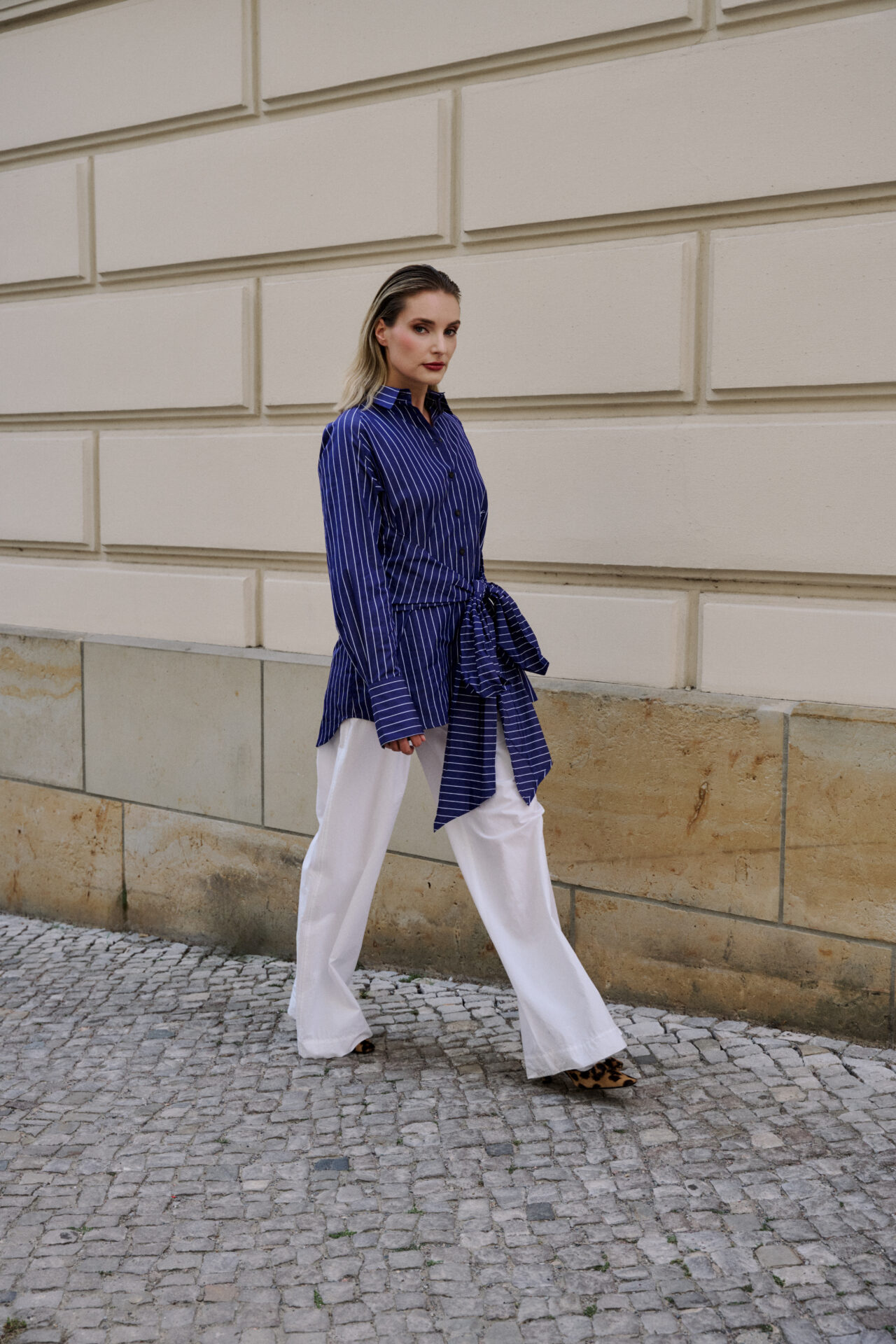
Pants BRUNELLO CUCINELLI, Shirt FERRAGAMO, Shoes FERRAGAMO
Anti-Semitism thrives on projections. On oversimplifications. On stereotypes that are older than the people who perpetuate them in public discourse. Expertise is replaced by affiliation: people use terms that signal belonging within their own circles, and mistake the expected outrage for insight. And, of course, for validation: if those I dislike vehemently disagree with me, then I must be right.
And then there is the supposed life outside one’s own bubble. As a token gesture, we follow a few people who think differently. Listen to a podcast about a reality foreign to our own and, hey presto!, consider ourselves free of prejudice. Often, however, curiosity is like a visit to the zoo: safe distance, a brief stay, then back into our own enclosure. After all, we don’t want to be late for feeding time. Back to the strangers who serve up our daily feed.
We’ve proudly taken a look at a different reality, but haven’t processed it, thought it through or even allowed it to affect us. Yet genuine engagement doesn’t require us to end up with a different opinion. It merely requires us to risk having our own opinion changed.
We confuse stance with insight, categorisation with understanding, and recognising a bubble with bursting our own. Perhaps curiosity is revealed less in how many unfamiliar perspectives we consume, and more in whether we can endure a thought without automatically passing judgement on the person who formulated it.
ABOUT Marie von den Benken is an author and columnist writing on social and political debates, media and pop culture. Her articles appear in publications including ntv, the FAZ and DIE ZEIT.
CREDITS
Fotografie von Leon Grunau
Styling von Karola Kulcsar
Kreativleitung Antonia Dipner
Produktion Johanna Erdl
Hair & Make-up Sydney Raab
Produktionsassistent/in Ruby Stein