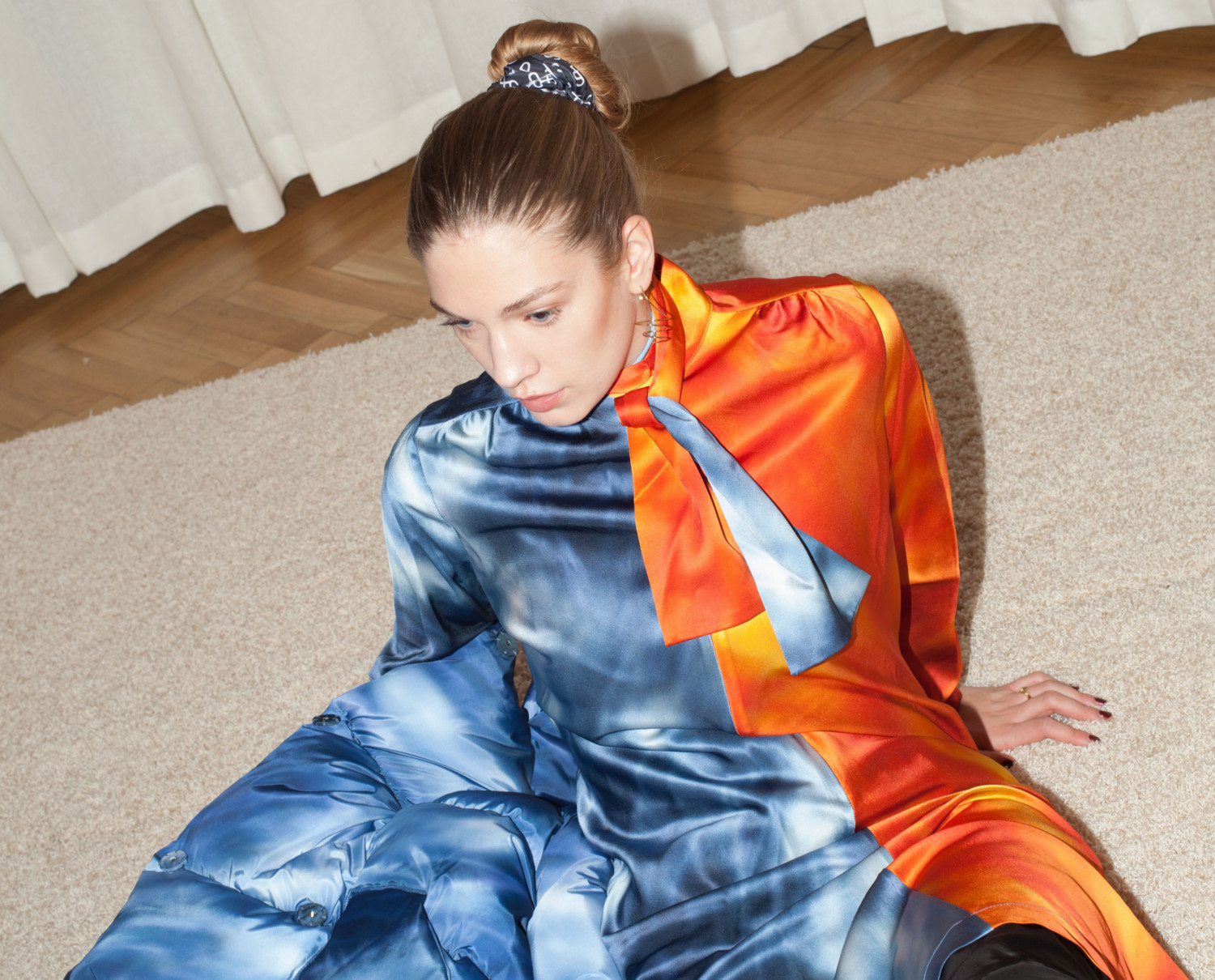
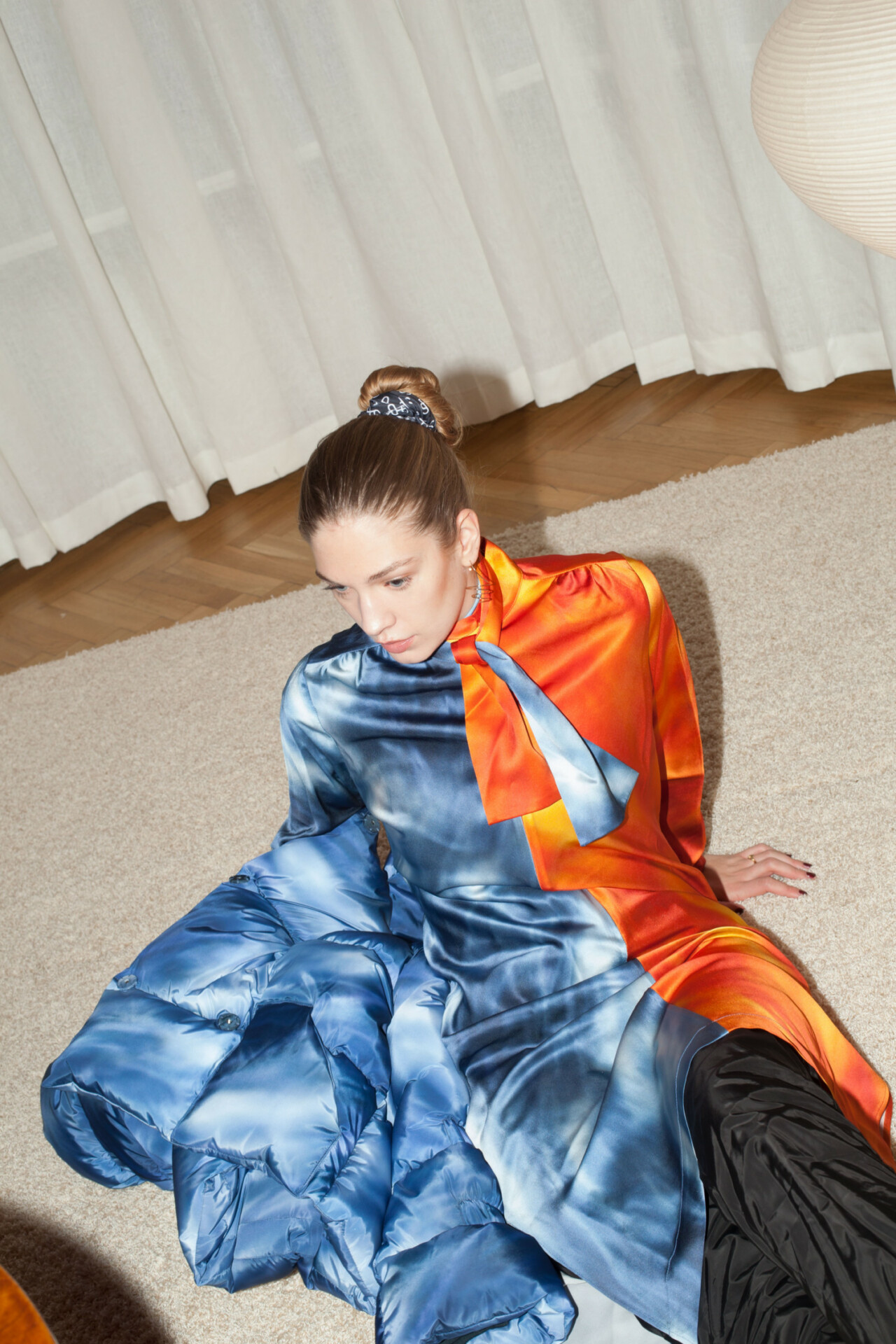
Photography by Joséphine Löchen
A decade ago, the fashion industry was ruled by elite labels in Paris, London, New York and Milan – but not anymore. Thanks to social media, the business has democratised, and a crop of new brands has subsequently arrived demanding consumers’ attention in the high-end luxury market.
Free from the obligations that come with working for one of the major fashion houses, they have built international cult followings with an irreverence that’s kept them hotly tipped. Some play with the stereotype of the self-obsessed millennial, with many of them creating a world in their own image. For others, the traditional hallmarks of success in fashion, like showing at fashion weeks or expanding production, are not their only goals. What they all have in common, however, is that each of them brings a buzz that only occurs when designers have small teams that allow them to call alle the shots, thereby setting the agenda for fashion that people actually want to buy.
Cathrine Saks & Barbara Potts
Saks Potts
Ignoring the dominance of Scandinavian minimalism with glamour and colour
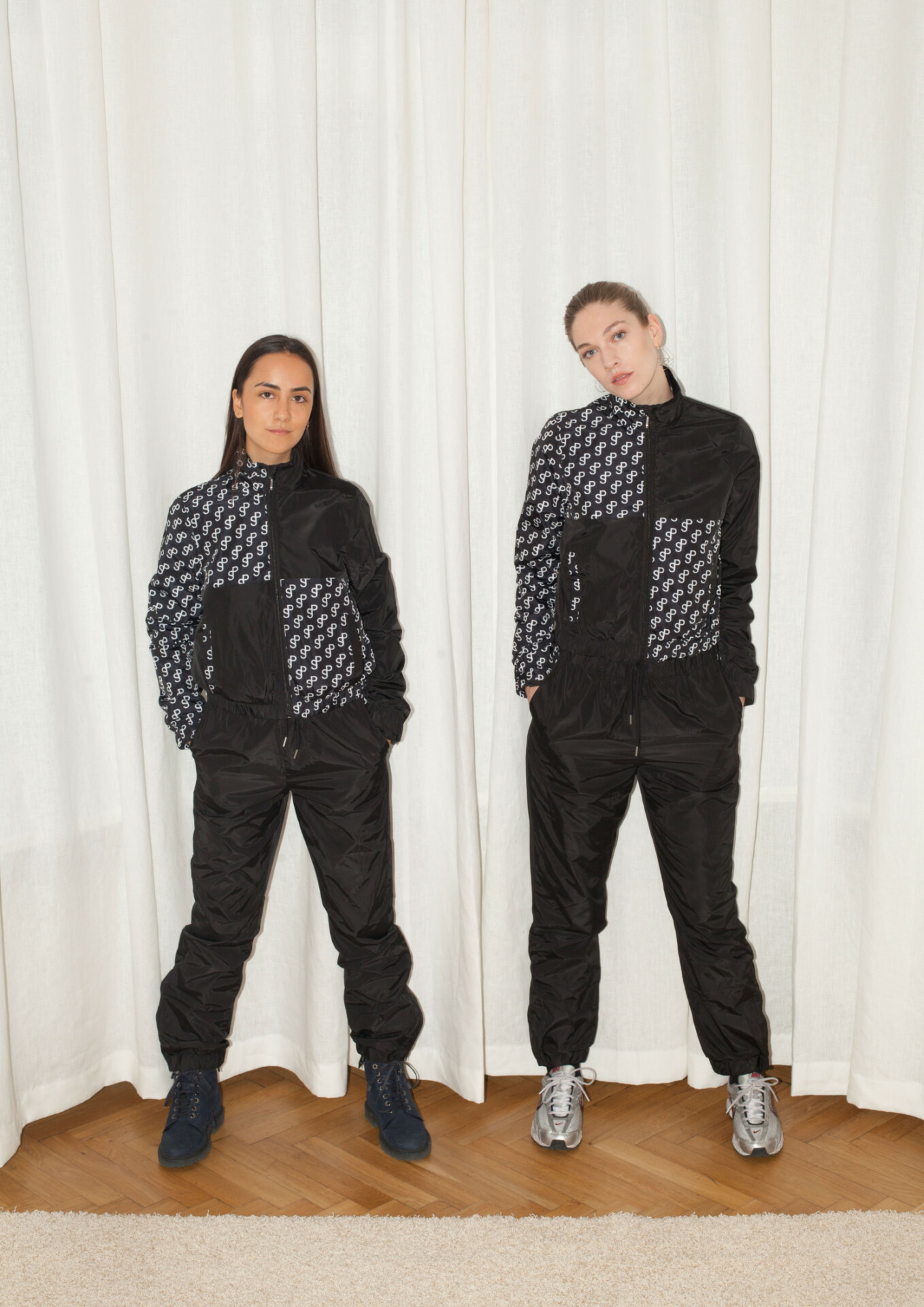
Photography by Joséphine Löchen.
The weather in Copenhagen is cold and grey, so friends Cathrine Saks and Barbara Potts decided that their clothing shouldn’t be. Both born in 1993, they started their brand, Saks Potts, 5 years ago because they couldn’t find a coat they liked. “It’s so cold here all the time that you often wear a jacket inside and outside,” Potts says. “It was so boring at that time because it was just a lot of dark colours and simple silhouettes. We wanted to challenge that a bit, and create outerwear that had more personality and was fun.”
They succeeded. Having sold their first coats to friends in 2015, these women were soon attending New York Fashion Week wearing the colour-blocked shearling design now beloved by celebrities including Kendall Jenner and Cardi B – and proving to be the Paris showroom appointment that everyone wanted to attend.
Perhaps as a result of their success, Copenhagen’s style outlook has also changed. A slew of Danish designers have started embracing a fun and far less serious approach. “You can see it all over Copenhagen right now because everyone is pretty colourful and designers are designing quite brightly,” Saks explains. “It is nice to see that because we love colours and we love prints.”
Having grown up tech-literate, Saks Potts credit their success to the way that social media has helped level the playing field for new brands. “An exciting thing about the fashion industry right now is the democracy social media has brought,” Potts says. “It is not just big brands that dominate the industry and say how things should go. It is also smaller brands, like us, who decide how we want to do a fashion show and what it can consist of.”
Cosmia Gadient and Christa Bösch
Ottolinger
The Swiss duo creating decadent destruction from Berlin
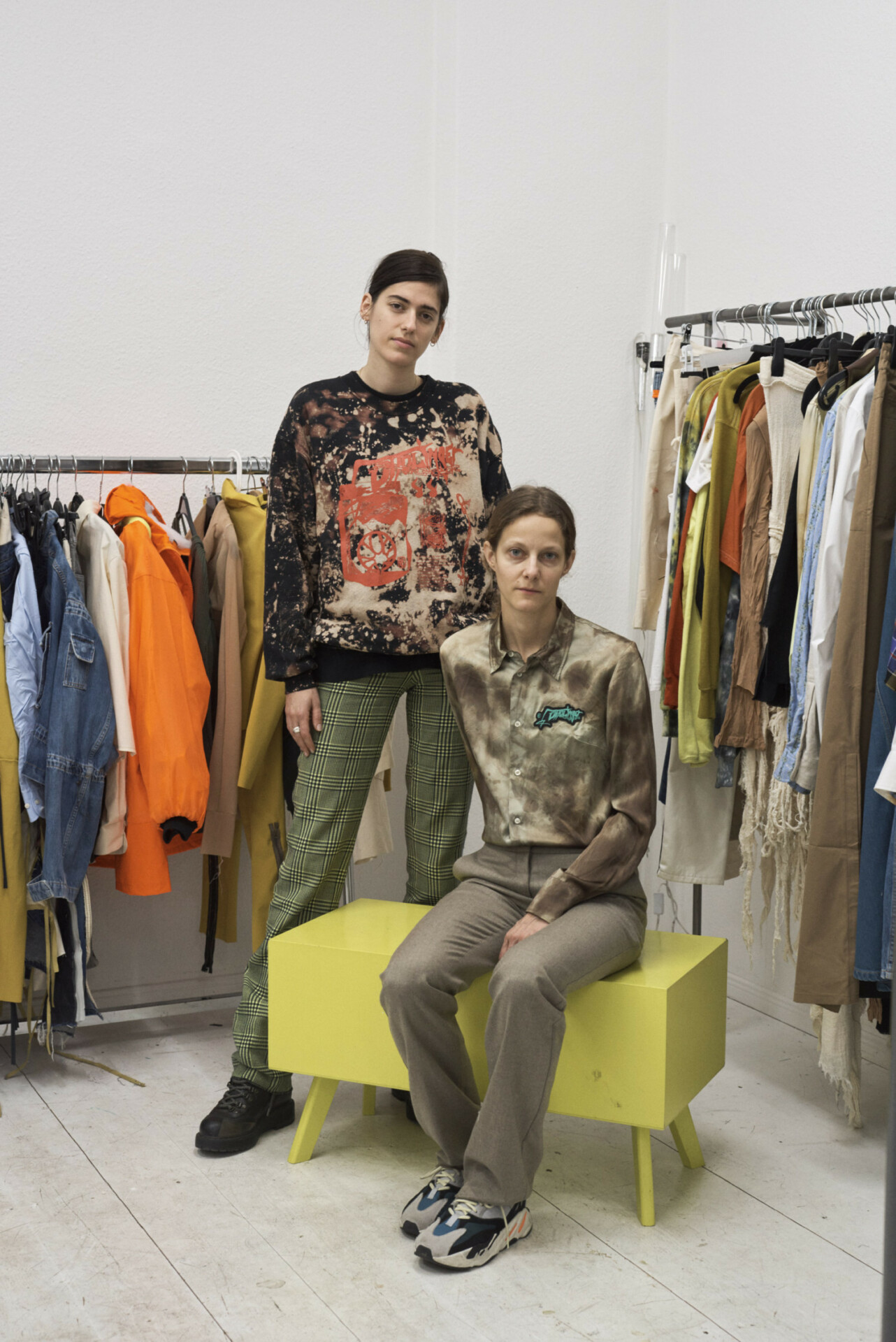
Photography by Sarah Blais.
Cosima Gadient and Christa Bösch describe their creative partnership as a love story. “We met during our studies at the fashion school in Basel, Switzerland and always liked each other’s aesthetics and work. One day we went out for drinks and didn’t stop talking about our views on fashion and life in general,” they say. Gadient and Bösch are so in sync that they work on everything together and cannot tell where one person’s thought ends and the other’s begins. “When we do something together rather than individually, it instantly gets better,” they say.
The Swiss duo have carved out their signature style with a mix of elegant tailoring contrasted by deconstruction into an art. For them, destruction is a way of understanding the world around them. “We like the feeling of burning and ripping,” Ottolinger says. “There is a moment of nature and things can happen that you can’t predict. Fire moves in its own way, but always in a very beautiful way.” Post-apocalyptic themes are part of their demand for newness in fashion. “After the apocalypse is space for building up something new, to think and find new ways.”
It is also a reaction to the changing landscape of the luxury industry. “We are in a very interesting time,” they say. “Technology and social media made a big change in the industry – people have more access and everything goes faster.”
Although they always show at Paris Fashion Week, Ottolinger draws a lot of inspiration for their line from their adopted home, Berlin. The young and creative atmosphere makes it easy to form collaborations, like when they recently teamed up with Germany-based record label PAN for their Spring/Summer 2019 show.
Anton Belinskiy
Anton Belinskiy
Political criticism meets the runway in Ukraine


Photography by Julie Poly.
Anton Belinskiy’s eponymous line never shied away from politics. During the 2013 Euromaidan riots, which saw Ukrainians taking to the streets of Kiev to protest the government, Belinskiy shot his Spring/ Summer 2014 garments among the armoured guards and protesters in the city’s main square. The models wore red tears on their faces to make it clear where Belinskiy stood on the issue. He did the shoot to “showcase the situation, which was really tense and was worrying a lot of people.”
While the Ukrainian designer doesn’t fault other designers for their lack of political engagement, speak- ing out about issues has become part of his identity. “I don’t think fashion necessarily has to be responsible for talking about politics,” Belinskiy says. “But in my country there’s a lot of corruption and it’s something that connects with me.” His dissent is woven into the details of his work, like the brown puffer jackets in his Spring/ Summer 2018 collection, which mimic the leather sofas in the Ukrainian parliament.
Having started out in fashion while still in school (his Euromaidan images were taken when he was just 16-years-old), Belinskiy was originally focused on creating something that no one had seen before. However, between childhood nostalgia and drawing inspiration from his home country, he found his strength was working with personal references.
“In the men’s Fall/Winter 2019 collection, we used my childhood albums, old photos of my parents and relatives. School subjects and my personal memories,” he says. Those familiar with his work will recognise the recurring shades of blue and yellow, the same as those in the Ukrainian flag, which represent, “sky above the head and wheat under the feet,” the designer explains.
Belinskiy recently made the jump from showing in Kiev to unveiling his collections at Paris Fashion Week. While the move is a major step in helping him connect with global press and buyers, the Ukrainian designer credits his mother with the strategy: “My mom told me, ever since I was young, that Paris is the capital of fashion.”
Shanel Campbell
Shanel
She’s from the Bronx and she’s dressed Solange Knowles and Issa Rae
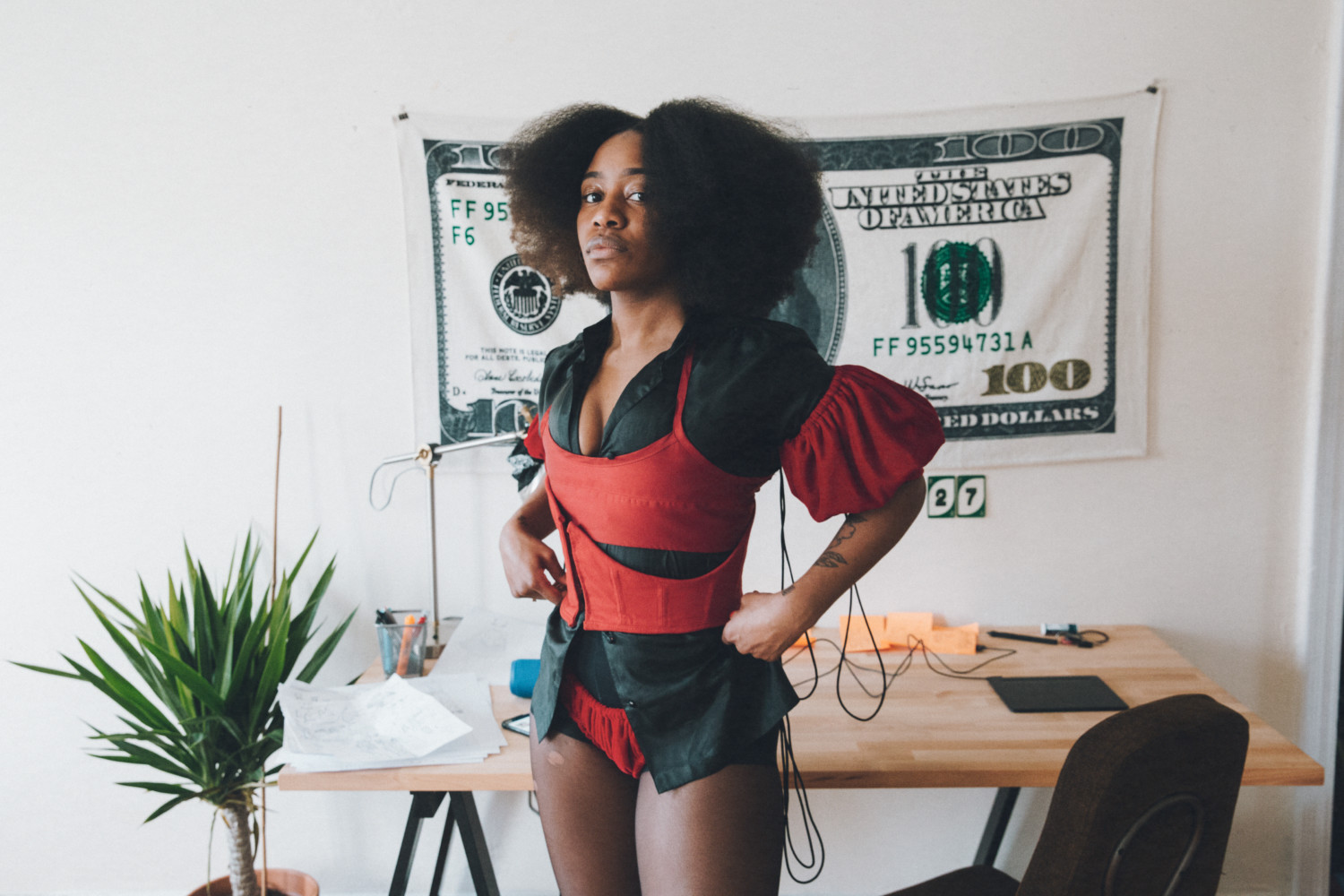
Photography by Justin French.
Last May, when Solange Knowles wore a bandeau bag and sleeves designed by Parsons’ fashion student Shanel Campbell to the university’s benefit ball, suddenly, the only thing New York’s fashion scene could talk about was Camp- bell. “I knew there would be attention if she tagged me in things, but I didn’t expect so much recognition from working with her,” Campbell says. Although the singer’s endorsement put a spotlight on the Bronx designer, it’s Campbell’s first collection at New York Fashion Week in September that’s sustained the hype.
Campbell unapologetically challenges the under-representation of black women in fashion. While it is becoming more diverse, progress is still slow. Last September, for example, in an issue guest edited by Beyoncé, American Vogue’s cover was, for the first time in the publication’s 126-year history, shot by a black photographer, 23-year-old Tyler Mitchell. “My brand is a physical representation, through clothing, of all of the things in my head that I have seen and heard, moving through New York City and growing up in America and being a black woman and moving through spaces,” Campbell says. For her first presentation in New York, she used Instagram to cast 17 models of colour, featuring a mix of natural hair and bright neon braided styles. Her designs pair romantic details like princess sleeves, corsets and ruffles, with industrial elements like bungee cords and sporty quilting.
Although Campbell has entered the New York fashion calendar, she doesn’t feel pressured to show the standard minimum of two collections per year. “I am more inspired by the way music artists debut their work,” she says. “It is usually one album a year or one every two years, and it creates a craving for what you do.” Instead of over-extending her young brand, Campbell wants to drive momentum with collaborations and periodic drops. So far, this business model has not held her back. Both Ariana Grande and Dua Lipa’s styling teams have commissioned her, and last June, Issa Rae wore one of Campbell’s designs while hosting the 2018 CFDA fashion awards, making Rae the event’s first black female presenter in its 37-year history – another ‘late first’.
Josephine Jones
Josephine Jones
Bringing back wearable ultra-feminine style

Photography by Wendy Huynh.
“As a trans woman who uses fashion in a fluid way, I find my clothes are unapologetically feminine because I’ve only been on estrogen for 5 years and I am excited – I think I will always be excited – by the privilege to be feminine,” says Josephine Jones.
Heading up her eponymous label in Bermondsey, South London, Jones’ collection harks back to the styles of the Sixties and Seventies, with flowing chi on and delicate patterns.
Unisex lines have been gaining popularity as part of a more inclusive fashion industry, but Jones, who modelled through her transition, sees the benefit in varied tailoring styles that allow people to work with their bodies instead of against them. This stems from experience: Jones started out as a menswear model, appearing in presentations and club nights hosted by Charles Jeffrey Loverboy – who also has a label, and now models womenswear. “I work on the bias a lot,” she says. “I like to think that my designs move with people’s bodies, not corseted, but comfy, in an elegant way.”
e designer showed her graduate Spring/Sum- mer 2019 collection, Sweet Dreams, at her alma mater, Goldsmiths, University of London, in June 2018, and is developing her enterprise by making fabrics and prints herself. Like many modern creatives, however, the 22-year-old designer is learning not to push herself too far. Having turned down an invitation from the British Fashion Council to use one of their showrooms, Jones showed her second collection at New Art Gallery instead of being part of the main September London Fashion Week calendar. In her own words: “I am very aware that I am 22 and still modelling, and I don’t think that if you don’t do something by 21, the door is ever closed if you are passionate about what you do.”
Claire Yurika Davis
Hanger
The London brand making lustrous, sustainable clothing using latex and hemp
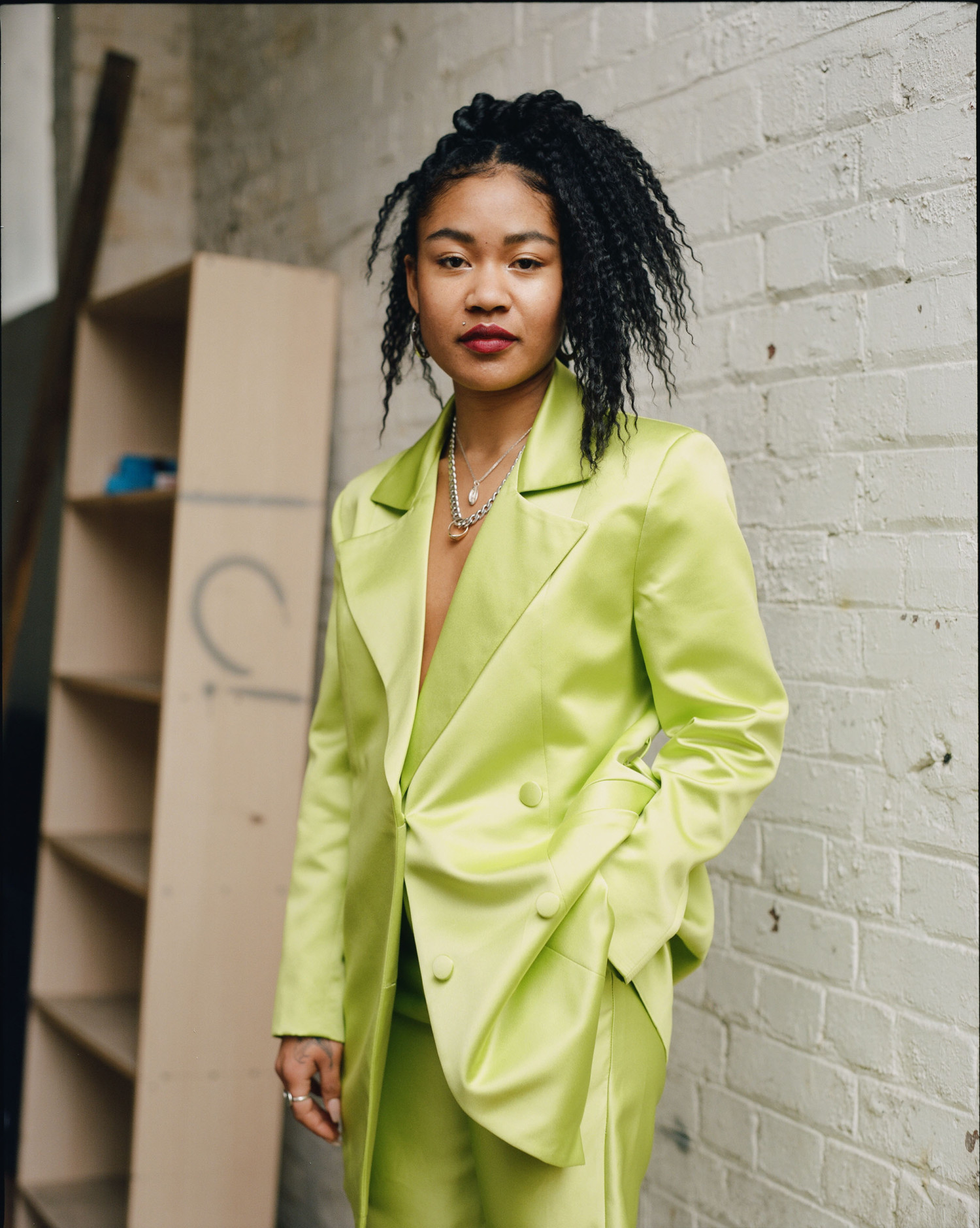
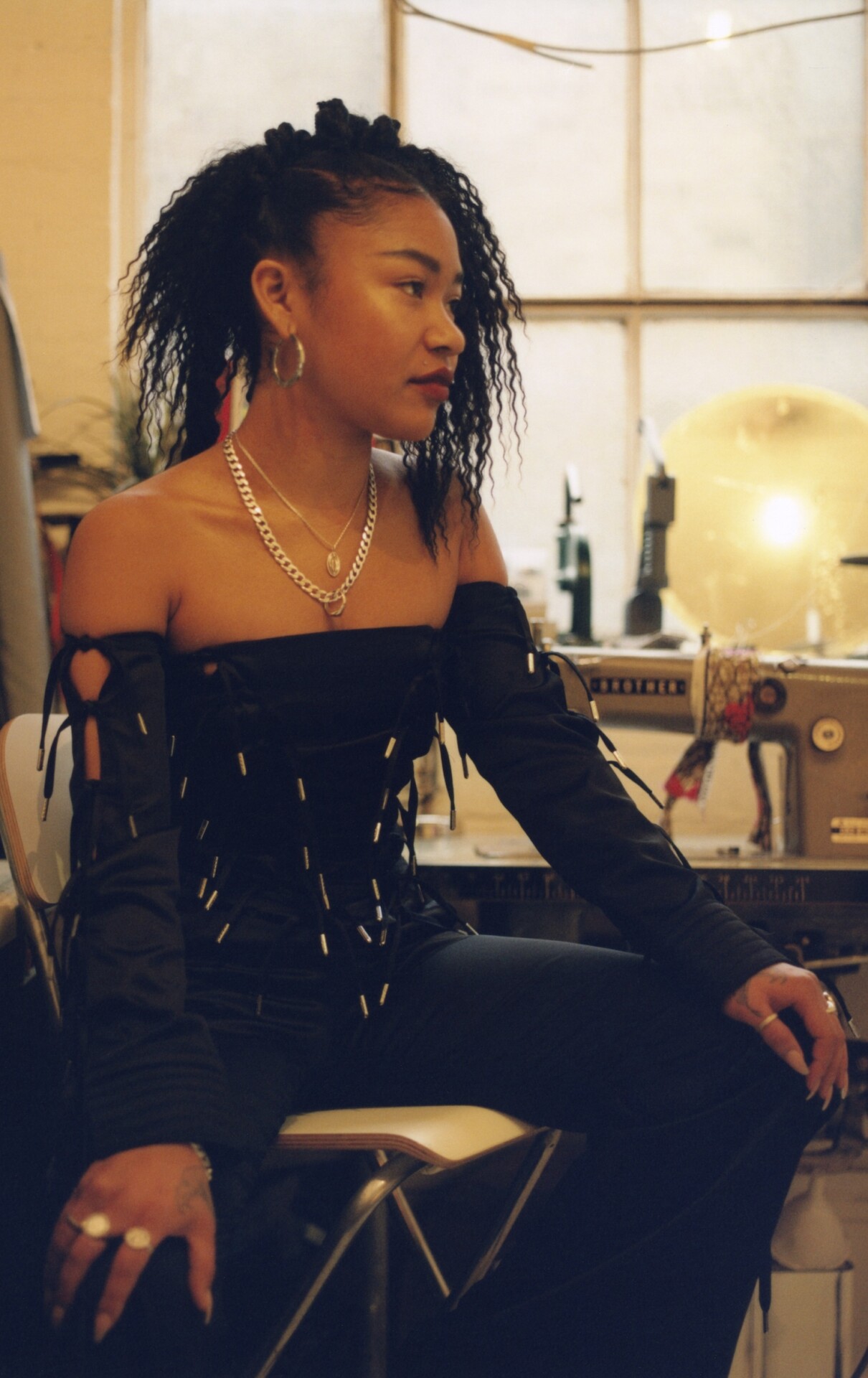
Photography by Wendy Huynh.
“Latex is an everyday fabric for me,” quips Claire Yurika Davis, the British-Japanese designer behind Hanger, the brand bring- ing high-gloss plastic fashion to the streets of London. While the rubber material conjures thoughts of fetish wear,
alternative that can be dressed up or down. “If you have a latex jacket, no cow had to die for [it] and it didn’t have to go through different tanning processes with chemicals that are bad for the environment,” she insists.
Sustainability is a big part of Hanger. Although latex is often marketed alongside plastic garments like PVC, when sourced naturally (i.e. from rubber trees), it’s a renewable and biodegradable resource that can be placed alongside fruit and veg in compost piles. Hanger’s production is also very ‘slow fashion’ (an environmentally-conscious industry movement favouring quality), as the latex work is done by hand from its London studio. “When you start out, it is easy to control where you are getting your fabrics,” Davis says. “Sustainability should not be a unique selling point, everybody should be doing it anyway.”
For her latest collection, inspired by Japanese forest bathing, she is adding a new sustainable fabric to her repertoire: hemp. Davis, a self-proclaimed “massive fan” of weed for personal use, believes that cannabis’ myriad of potential uses, from medicine to fashion, should be recognised. “Weed is obviously having a big moment with legalisation,” she says. “But the UK is so behind and I reckon it will be for a little bit.” Despite Davis’ love for cannabis, Hanger is not about to ditch its futuristic aesthetic to make scratchy brown clothing. e new collection will see waterproof, coated hemp in the brand’s signature colourways of electric green and yellow. “ e way that people classically use it makes it look like a sack, [otherwise] it is always in beige, eco [or] hippy colours. I am making a point of having it look nice,” she says.