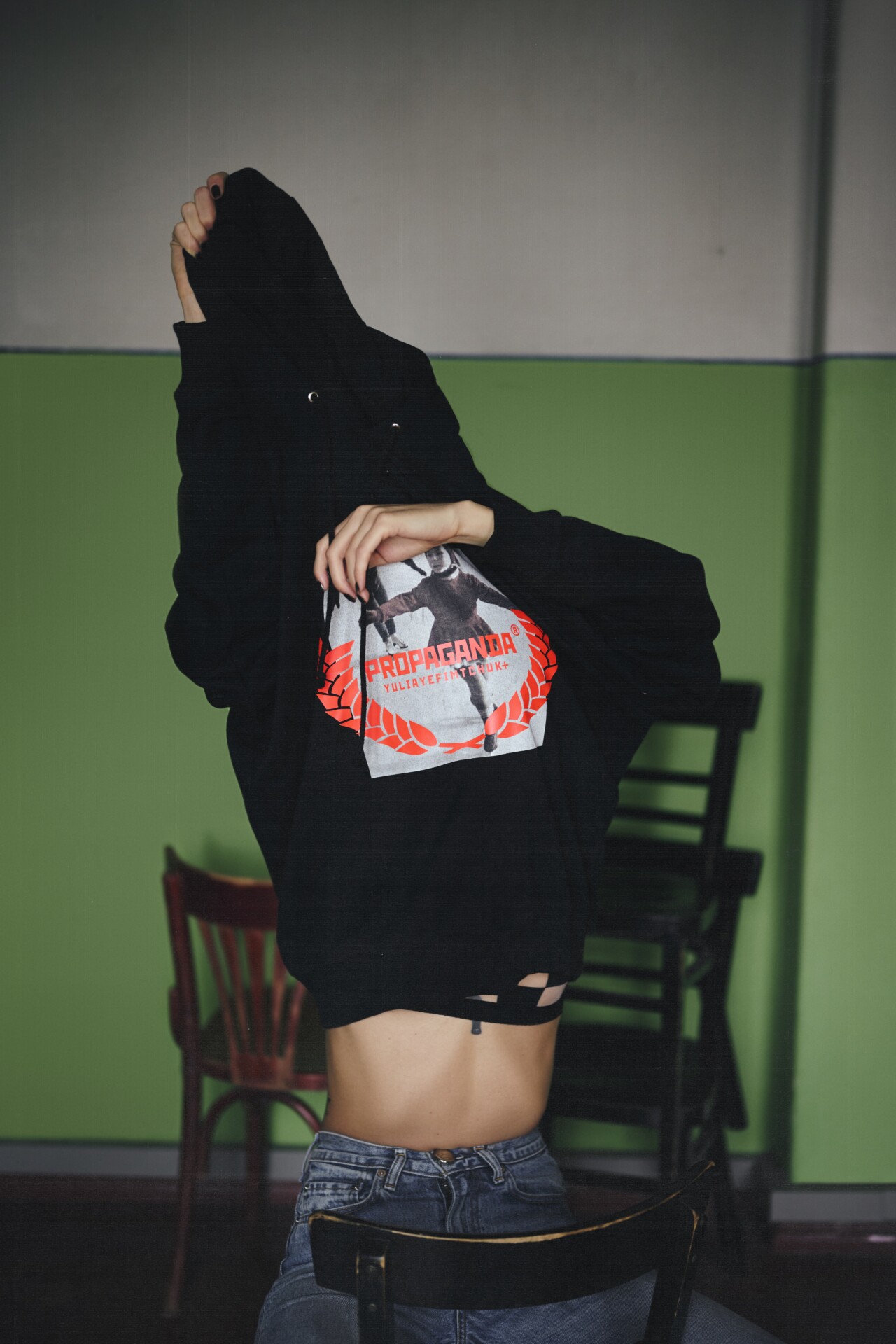
Yulia wears TOP SPORTMAX HOODIE YULIA YEFIMTCHUK PANTS Levi’s
When I was a child, I dreamed of an ideal world without borders; a world where people live in harmony with nature and with each other,” says Yulia Yefimtchuk, one of the most radical, political and well-known designers in recent Ukraine. After graduating from Kyiv’s Institute of Decorative and Applied Art and Design in 2010, Yefimtchuk began her career as a fashion designer. Gathering inspiration from the restraint of Soviet-era lifestyle, her designs became an open reappraisal of old systems while turning them to the future.
Growing up in Eighties rural Ukraine, the designer witnessed the visual reform politics of perestroika: a movement palpable through the propaganda posters on the streets and in communities. “You don’t need to be a journalist or politician to explain exactly what propaganda is,” she points out. “For me, propaganda is the management and manipulation of the masses through the use of all possible resources. And it’s everywhere. I don’t trust anyone, I don’t give in to manipulation. I only trust myself. After all, if you believe the parables in the Bible, then Adam and Eve were already subjected to manipulation and the power of propaganda when they encountered the fruit of Paradise.”
“Searching for the truth is difficult,” Yefimtchuk admits. “I was born in a state that no longer exists: the USSR. My father was a graphic artist who created propaganda slogans and posters.” Soon after leaving art college, Yefimtchuk developed a deep interest in the graphical aspect of posters – an interest that exposed her to the political landscape of the time. Upon further exploration, she discovered a radical approach to both thinking and designing. “To use slogans such as ‘PEACE TO THE WORLD’ in this situation of war is blatant cynicism, but such is the essence of a person. We are all cynics to some extent, just not everyone can admit it to themselves.”


Images Courtesy of Yulia Yefimtchuk
Like most artists, Yefimtchuk’s work communicates emotions and feelings: conscious or subconscious. “My design practice utilises linguistic expressions and slogans,” she explains, when asked about her process. “Using such unconscious affirmations allows me to explore how clothes can talk, how they can provoke and ask questions. As an artist, I also want to convey my concerns and worries in the hope of connecting with others. It’s a kind of non-verbal communication between me and the world. This is an artistic technique that I found for myself. It was not chosen unconsciously.”
“Over the last few years, fashion and art have become less about expression and more about commerce, about becoming a crowd. I think about that a lot now. Perhaps this approach is the answer to the political system we have today. It’s not news that the current political system is beginning to crack. So, maybe we are on the verge of something new?,” she questions.
“Sometimes we come to a dead end. Everything changes and moves too quickly, no one has time to enjoy ideas and be creative. The only thing I know for certain is that in the future, everything will be worse with individualism in the world.”

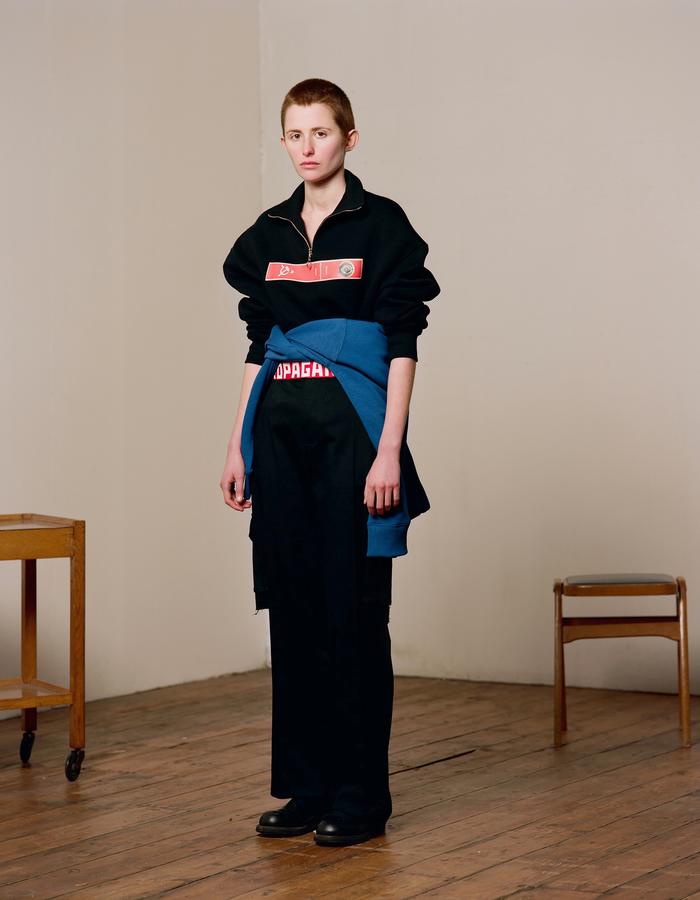
In our conversation, Yefimtchuk reflects on a time before this conflict. “I often think about how people were not killed with rockets and weapons in Ukraine. I remember how I lived. Still, almost one year on, I cannot believe this is happening in the 21st century. Among the death and destruction, one of the most difficult things to adapt to is the lack of electricity. This is something that we’re all so dependent on, without even realising. If you want to continue to work, you need maximum time management. Such conditions force you to quickly learn self organisation. In my situation, I don’t have light for eight hours a day. I plan what I’ll do when there is light and I plan what I’ll do when there is no light. In such a structure, you find yourself devoting more time to yourself, your thoughts and communication with your loved ones.”
Being such a radical and forward-thinking artist, I wonder what her thoughts are on freedom. “To me, freedom and solidarity do not exist. They’re abstract terms, empty words. Pure solidarity is not possible because we are all selfish by nature. In Ukraine, everyone became adults this year, especially the children and young people. They’ve lost their youth and their innocence. War is a psychological trauma that you have to live with, alongside all of the perpetual fears and phobias it brings. It is hard to think about such a cruel reality.”
As our conversation comes to a close, Yefimtchuk says one final, crucial thing: “In spite of the hardships, I believe this war will not break the youth. It cannot and will not break their possibility to dream.”
Kredite
Photography: Anastasiia Rychko
Hair & Makeup Artist: Alisa Fun
Styling: Joana Zibat
Styling-Assistenten: Sophia Friedl und Tim Escher
Zu finden in SLEEK 76 FREEDOM. Erhältlich als Print- und Digitalausgabe hier.