Over the last decade there has been a surprising resurgence of interest in representational painting, particularly of the human figure. George Rouy (b. 1994, Kent, UK) is one artist taking part in this exciting re-engagement, a blending of abstraction and representation that revises the narratives of art history.
To describe Rouy’s work as solely figurative would be to miss a vital aspect. In his hands, the figure is removed from the idea of an observed body. Instead, his emotionally rich exploration expresses what a body feels like to inhabit and share space with. I spoke to Rouy about the mental and physical processes that underpin his practice. We discuss how these have changed and developed over the last year as he delves into re-exploring group scenes and pushes his conception of the figure further into the abstract.
Rouy’s personal re-engagement with the figure came in 2015 towards the end of his studies at London’s Camberwell College of Arts. During his time at Camberwell the focus was largely on modes of expression more closely associated with post-conceptual art. “In many ways, I found this environment really exciting but deep down I have always had this calling to paint and pursue the figure. I remember being nine years old, coming back from the National Gallery and being so pumped to paint. As a painter, there can be this magical space from which you make your decisions – an intuitive, emotionally weighted space that isn’t so cerebral.”
Rouy’s relationship to the body is deeply intuitive. Rouy stretches and distorts the human figure, subtly and skilfully leaning into the abstract, revealing the lived-experience of a body through an expansive sensory lens. He describes his works as snapshots of psychic states. “When you stretch or enlarge a form and see the movement of the paint on the canvas you add this psychological rhythm to it. Feelings like warmth, shakiness or numbness, they can all be recreated on the canvas – so too can a body’s aura, that intuitive aspect of meeting someone. That abstract moment of engagement and what that feels like in your own body is something that I’ve always found exciting to explore. In this way, my work is about my own anatomy.”

Carry Me, 2021, Acrylic and Oil on Canvas
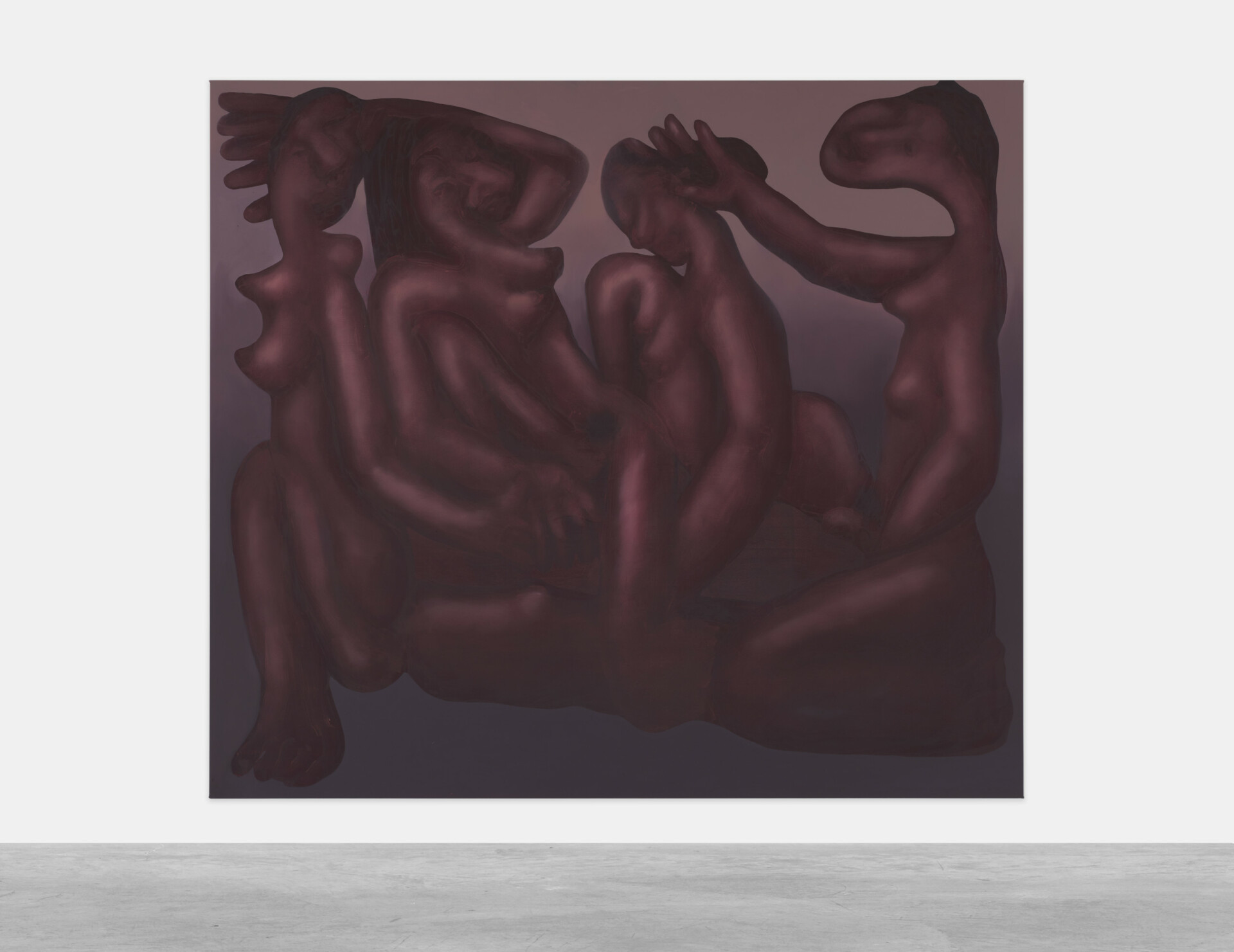
Contradiction, Resolution and Belief, 2019, Acrylic on Canvas
We sit and chat on the balcony at Hannah Barry gallery in London, where Rouy is represented. Inside hangs ‘Carry Me’, a striking example of one of his latest ventures into depicting group scenes. Recently on show at Art Basel, the piece hints at a sexual interaction between variously distorted forms. Artfully, Rouy maintains the cohesion of a group scene, alluding to digital distortion in the form of a stretched out facial representation that floats candidly in a sea of smudged abstraction and primordial brush strokes.
“I’m depicting group scenes again but from a different angle,” he explains. “Defacing one figure but then including a face on another, abstracting another figure until it no longer looks human – but still showing them as being part of the same world.”
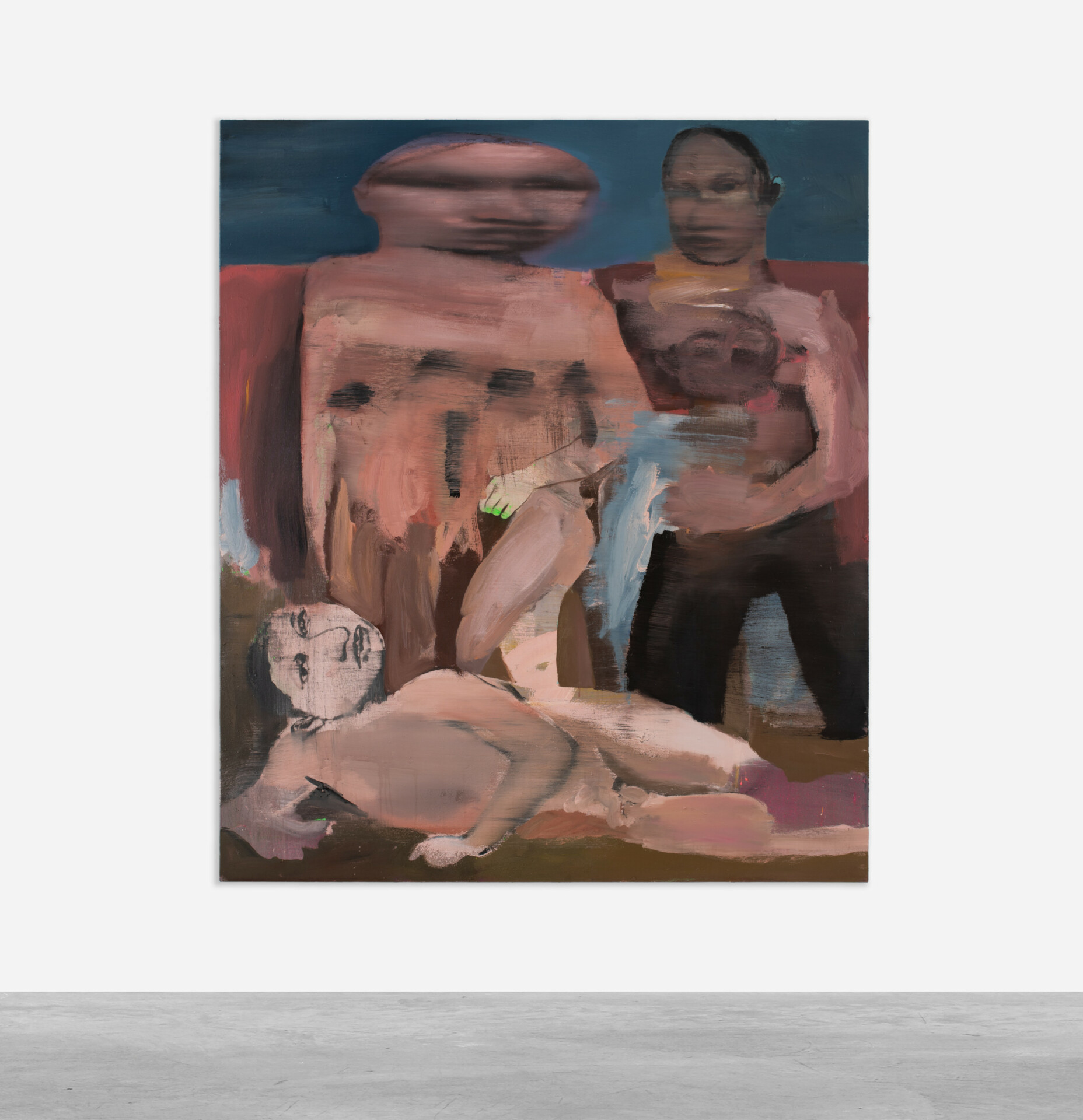
Future Proof, 2021, Acrylic and Oil on Canvas
Previously Rouy’s figures have been dream-like and almost sculptural in form [see his series ‘Maelstrom’ presented in 2020 at Peres Projects, Berlin]. Over the last couple of years his work has entered an exciting new space, one darker and more complex – a response to living through these disturbing times. “I am reacting to the time. Things aren’t pretty at the moment and I’m exploring that with the work.”
Now, in his new exhibition at Peres Projects, we see Rouy defacing figures and combining styles. He is renegotiating the balance between figurative and abstract forms of expression in his art. Rouy navigates how to approach group dynamics within this new style. “Defacing figures in the context of group scenes has given me a new relationship to space on the canvas. I have started allowing areas of the canvas to remain empty and other parts to be chaotic,” he explains. “In my most recent works there is the suggestion of an interaction as group scenes imply a narrative. Although there doesn’t have to be a clear narrative, the space around the chaos must accommodate the chaos enough to avoid creating jarring contradictions that alienate the viewer. I want the work to feel concentrated and intense rather than crowded.” He cites British artist Cecily Brown, with her almost purely abstract approach to the figure, as being a big influence on him. “I feel really inspired by painters who can achieve that level of abstraction while still retaining the form. It’s a difficult balance to get right.”
A large part of Rouy’s ability to achieve this balance in his own work results from his mysterious and intuitive process in the studio, which he describes as being very physical. “There is an unconscious relationship that I have between my mind and body when I work on art. Mostly I get an emotional sense of an image in my head first. I focus on what the painting feels like rather than a potential narrative. It’s an emotional space but it isn’t autobiographical.”
The fruits of Rouy’s recent labour will be revealed this Friday, 25th March at the opening of his solo exhibition ‘Shit Mirror’ at Peres Projects, Berlin.
George Rouy’s ‘Shit Mirror’ at Peres Projects:
Karl-Marx-Allee 82 10243 Berlin
March 25 – April 22, 2022
Opening Friday, March 25, 6PM–8PM