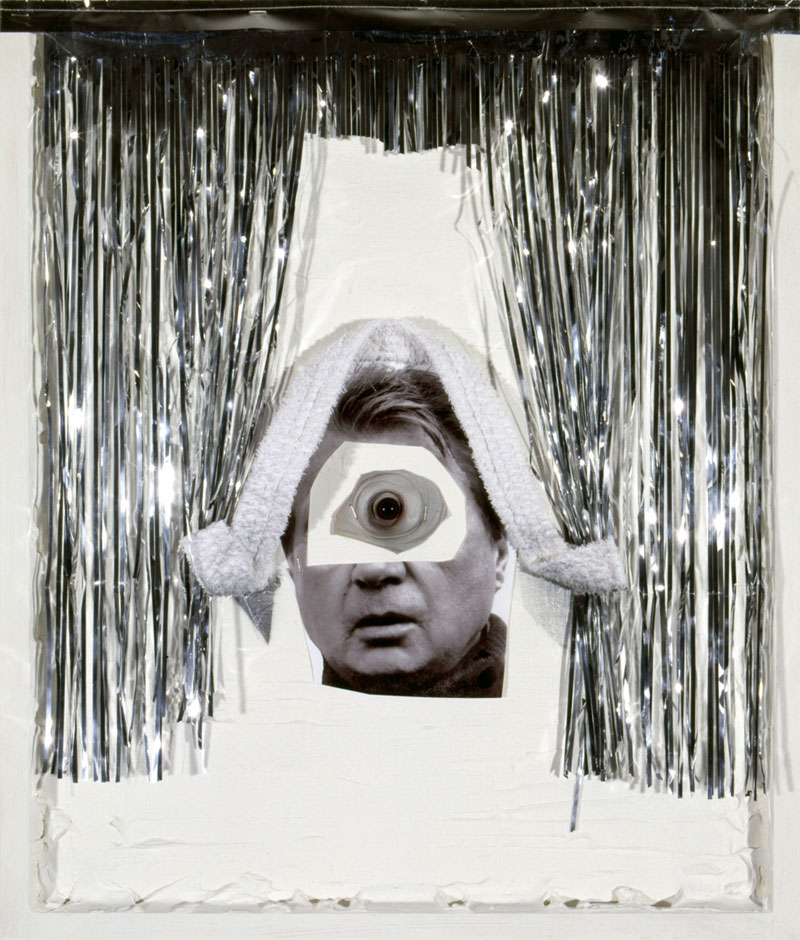
The exhibition “Flagrant Delight”, curated by Dirk Snauwaert and shown at Lisbon’s Culturgest, offers an insight into the multifaceted work of Rosemarie Trockel – but don’t dare call it a retrospective! In the early 1980s, Trockel proposed an alternative to the rigid formalism and expressive painting that dominated the artistic context at the time. Today, the fundamental principles of her practice still involve the notions of liberty and going beyond the limits of academicism, conventional associations and knowledge of language, as well as avant-garde forms and symbols. And this also extends to negating the notion of a retrospective survey, a withdrawal entirely in keeping with her claim that she has always felt more “interest in internal contradiction and incoherence”.
The idea of an all-encompassing retrospective exhibition is indeed at odds with Trockel’s penchant for “incompleteness”, “opacity” and an open and non-systematic aesthetic language and practice. Her metaphorical and associative working method is the basis for the poetic visual language she herself champions.
The show overlaps with another exhibition of the German artist’s work, at The New Museum, New York. Entitled “Rosemarie Trockel: A Cosmos”, the New York show presents an imaginary universe in which Trockel’s own artwork from the past thirty years is juxtaposed with objects and artefacts from different eras and cultures that map many of her artistic interests.
Trockel’s feminist focus tends towards subverting the idea of the transparent, rational and seamless nature of reality, against which she pits opacity, inefficiency, error, disorder, disorganization, obscurity and complexity – an aspect that both exhibitions highlight. Trockel has organized “Flagrant Delight” according medium: sculptures, collages, ceramics and textiles (wool paintings). However, this seemingly categorical approach becomes a diverse and free inventory of the possibilities and limitations of each medium; indeed, even the faintest hint of categorization is thwarted at every turn.
The exhibitions are a link, a gesture towards the possible development of new relationships. And this too, in a similar vein, is how this retrospective exhibition can and should be interpreted.
“Flagrant Delight” is held in collaboration between WIELS Contemporary Art Centre, Brussels, Culturgest, Lisbon and Museion, Bolzano.
Culturgest
Until 6 January 2013
and
“Rosemarie Trockel: A Cosmos”
New Museum, New York
Until 20 January 2013