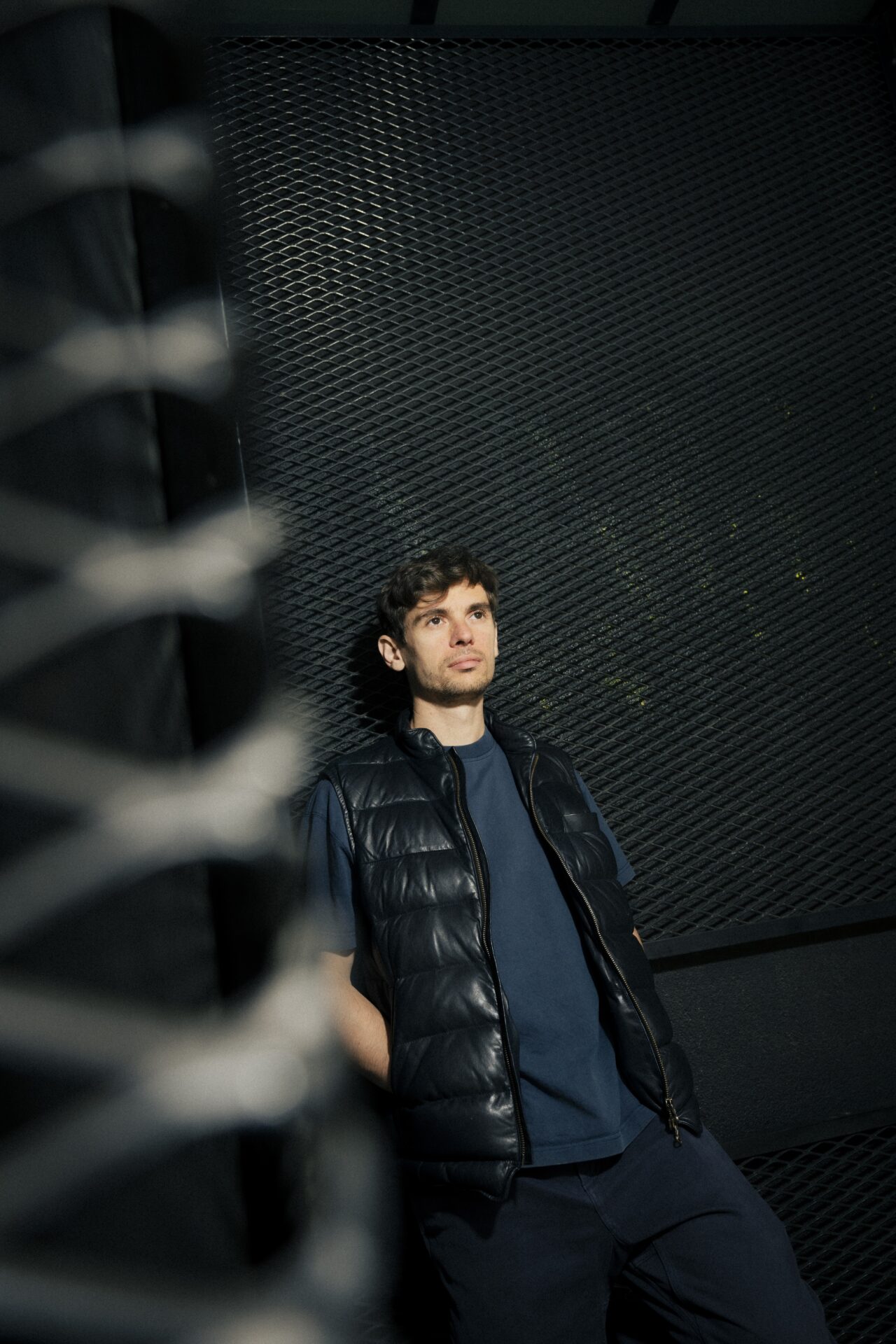
Photography by Christoph Liebentritt.
FEDOR HOLZ has won more than $50 million in live poker tournaments over the course of his career. He is a co-founder of Pokercode and is currently building a venture capital fund.
FEDOR HOLZ knows the game inside out and has enjoyed extraordinary success as a result. But what truly fascinates him about poker is the deeper question behind it all: how do you make the right decision even when you can never know everything?
Looking back, there is one moment that Holz describes as his finest hour and it has little to do with what one might imagine as the pinnacle of a poker career. It was not the evening he won a tournament worth several million dollars in prize money. It was what came afterwards. Two or three months after ending his full-time career, Holz sat back down at the table. He still had the same precision, knowledge and skill as before, but his state of mind had changed. He no longer cared about the money. He no longer cared about the outcome. And that, precisely, was why he played better than ever before. “Thinking too much about money takes you out of the flow. I’ve always made my best decisions when I was fully immersed in the game,” recalls Holz. Fedor Holz, born in Saarbrücken in 1993, is Germany’s most successful poker player. More than $50 million in live 42 SLEEK 89 THE MATHEMATICS OF FREEDOM tournament winnings, two World Series of Poker bracelets. In 2016 alone, he won $16 million, briefly becoming the world’s top tournament player. Today he is a general partner in a venture capital fund, co-founder of a poker academy, and one of the most unconventional thinkers to emerge from the world of professional sport. Not because he is exceptionally wealthy, but because he reflects on decisions, risk and failure in ways that go far beyond the techniques of his original field of play.
It began rather unremarkably. Holz was fifteen when he started playing poker with friends. “We met almost every week, and it was just great fun to play.” It sounds trivial, but it is an important detail: the starting point was not ambition, but the joy of the game. That distinction runs through his entire way of thinking. What followed was an unusual transformation. Holz did not simply begin playing more – he began to understand the game systematically. Game theory, opponent analysis, situational deduction. He approached poker the way a scientist approaches a field of research: what tactics can I deduce from this specific situation? What is my opponent doing, and why? “It’s not that different from other sports – football clubs also prepare specifically for their opponents,” he says. But what distinguishes poker from most other competitive systems is its epistemic core: every decision is made under conditions of uncertainty. You can calculate probabilities and recognise patterns but complete information is structurally impossible. For most people, this creates anxiety. For Holz, it is the most fascinating aspect of all, because: “You learn that incomplete information doesn’t mean you can’t make assumptions. Eventually you develop a sense of what your opponent might have. Life, too, comes with incomplete information. You don’t know what the future holds. That helps me enormously with investment decisions, for example – and simply in everyday life.” At some point, Holz began asking himself a question that few professional players consider: what are the factors beyond the game itself? Together with nutritionists, sports scientists and a mental coach, he built a support team around himself like a professional athlete – at a time when hardly anyone in the poker world was doing so. “If you really want to perform at your best for thirteen or fourteen hours, you have to think about everything that goes into it.” This conviction is fundamental to Holz: playfulness and seriousness are not opposites; they depend on one another. So where is the line between play and profession? “If you want to do it at the highest level,” he says, “then more and more areas and considerations come into play.” The boundary, it turns out, is not where seriousness begins. It is where joy ends.
When Holz set his record in 2016, he was twenty-three years old. What followed was not the classic narrative of triumph – arrival, calm, enjoyment. Instead, it marked an inner reorientation. In the years that followed, he built Pok- ercode, a platform through which he shares his knowledge. He also began investing in other players. And he lost, again and again. This is not a side note, but a central chapter of his biography. “In my career as a poker player, I’ve probably lost money in 80 per cent of tournaments.” That sentence deserves a pause. One of the world’s best poker players loses four out of five tournaments. That is not failure – it is the nature of the game. “Even if you’re better than the competition, the variance is still huge. So in the remaining 20 per cent of tournaments, you have to win more than you lose in all the others.” Over time, this creates an ability to deal with defeat. Emotional resilience is Holz’s preferred term – and he does not use it as a buzzword, but as the description of a concrete skill. “I’d say I’m now a very emotionally resilient person. The game has helped me enormously in that respect.” When he was twenty-two, he had around a million euros – and lost half of it within ten months. It wasn’t due to poor play, just variance. “It weighed heavily on me, but it was also one of the most important learning experiences,” he says, touching on a lesson in proportion: calibrating your own tolerance for risk before taking it, not afterwards.
Today, Holz is building a venture capital fund that invests in some of the world’s best early-stage investors. He draws on the same patterns he learned at the poker table – spotting talent, assessing character, comparing personality types. “The world’s top fifty players combine very different approaches. Some are highly analytical, others very intuitive. But there are four or five types that can be compared very well.” Investing, he says, follows a similar logic: how do you make decisions when everything is still uncertain? How do you deal with setbacks? How do you calibrate your self-image against reality? When asked whether he can read investors the same way he reads poker players, he answers without hesitation: “There are a great many similarities. In poker, players actively try to conceal things. If someone wants to sell me something, they might sugar-coat it a little but they’re usually not try- ing to present themselves as a completely different person. That actually makes it easier.” He answers the question of whether total immersion in a game can destroy a person – not through loss, but through the world of the game itself – in an unexpected way. He does not see escapism or addiction as inherent to poker, but rather as symptoms of something else. “When I was seventeen or eighteen, I definitely used poker as an escape. But that had nothing to do with the game – it was about the real world.” Then that sentence that may be the clearest distillation of his worldview: “The best learning experience was losing money I shouldn’t have lost.” Precision in assessing one’s own risk, joy as a prerequisite for performance, and gratitude for mistakes – if you listen to Fedor Holz long enough, that is the real model for success. Not: playing to win. But: playing because you genuinely want to understand the game. “I got up and enjoyed doing it,” he says of his career. “I hardly ever had to discipline myself. When that changed, I stopped.” It sounds simple – and perhaps it is.
As featured in SLEEK #89 – PLAY