Recently, I saw this exhibition called “The Overview Effect”. And I immediately wondered what was meant by that. A thought I carried with me on a rainy morning during Berlin Art Week, driving a little way outside the city. The sky was grey and low, the kind of Berlin day that makes everything feel slightly suspended. Then I arrived at Wilhelm Hallen.
During Berlin Art Week, The Foundry at Wilhelm Hallen becomes a space for a different kind of perspective, one that asks us to look at the world as if we had just seen it from space. I entered through a dark passageway, with daylight filtering in from somewhere ahead. And then, there it was: The Overview Effect. Inside, the atmosphere changed, it was like switching spheres for a moment.
Curated by American-born, Berlin-based curator and writer Anna Carnick for The Foundry, Bocci’s exhibition space at Wilhelm Hallen, the exhibition brings together around twenty designers and artists from across the globe. And just like we observe in nature, their practices become beautiful in their individuality. For example, in material, scale, and technique, they all share a common concern: how do we reconnect with the world we inhabit, and with one another?
Besides Carnick, there was Johannes Schön, Bocci’s Director of Brand and Cultural Strategy. They both guided me through the exhibition. Their calmness was almost contagious. There was no sense of being rushed from one artwork to the next. Instead, the exhibition seemed to ask for the opposite: slow down, look again, allow yourself to wonder a bit. Now my thoughts from the morning were starting to form an answer.
The Overview Effect describes a profound shift astronauts experience when looking back at Earth from space. From that distance, borders begin to blur. Countries become indistinguishable. What remains is one small, fragile, luminous planet suspended in an immense darkness.
Remember the iconic 1968 photograph Earthrise, taken by Apollo 8 astronaut William Anders? An image in which Earth appears almost impossibly delicate against the lunar landscape. The exhibition takes that feeling and brings it back down to Earth. Carnick told me that the idea for the exhibition began with her own fascination with this phenomenon after reading about it: “Do we really have to leave Earth to understand how interconnected we are?”
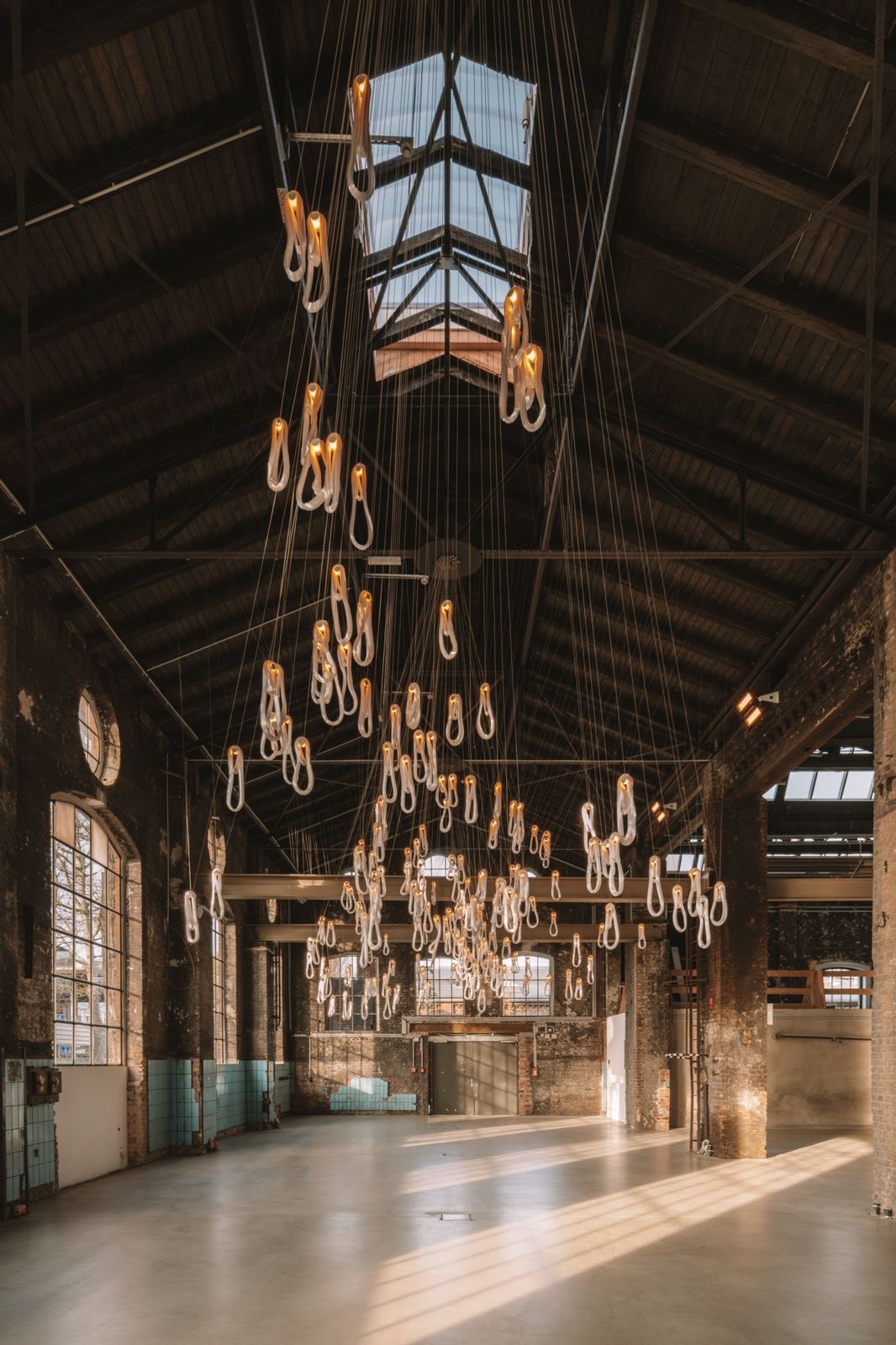
The exhibition allows us to answer that from terra firma. And talking about terrain, the first thing I noticed was that the exhibited artwork was built around a whole 1,680-square-metre creative space. These huge brick-patterned walls still evoked the iron factory that once occupied the historic hall. It was interesting how its architecture naturally lends itself to openness, scale, and transparency.
Yet, in combination with the static walls, the exhibition created a magical rupture. Soft, semi-transparent sheets of fabric hang through the space, creating pathways and fragments of rooms. It felt a little like looking through clouds. They moved gently as visitors passed, sometimes catching the light, sometimes obscuring what lay beyond. You rarely see an entire artwork immediately. Instead, you catch glimpses: the edge of a form, a silhouette, a texture. In this way, visual stimuli were created, naturally sparking a desire to discover what lay behind them. Within the entire universe theme, this feeling was a little like a wormhole, pulling you into the full depth of the exhibition.
Exhibition designer Chris Leeuw conceived the installation precisely as a constellation of relationships rather than a sequence of isolated objects. The fabrics dissolve conventional boundaries between works and encourage visitors to move through shifting perspectives and scales.
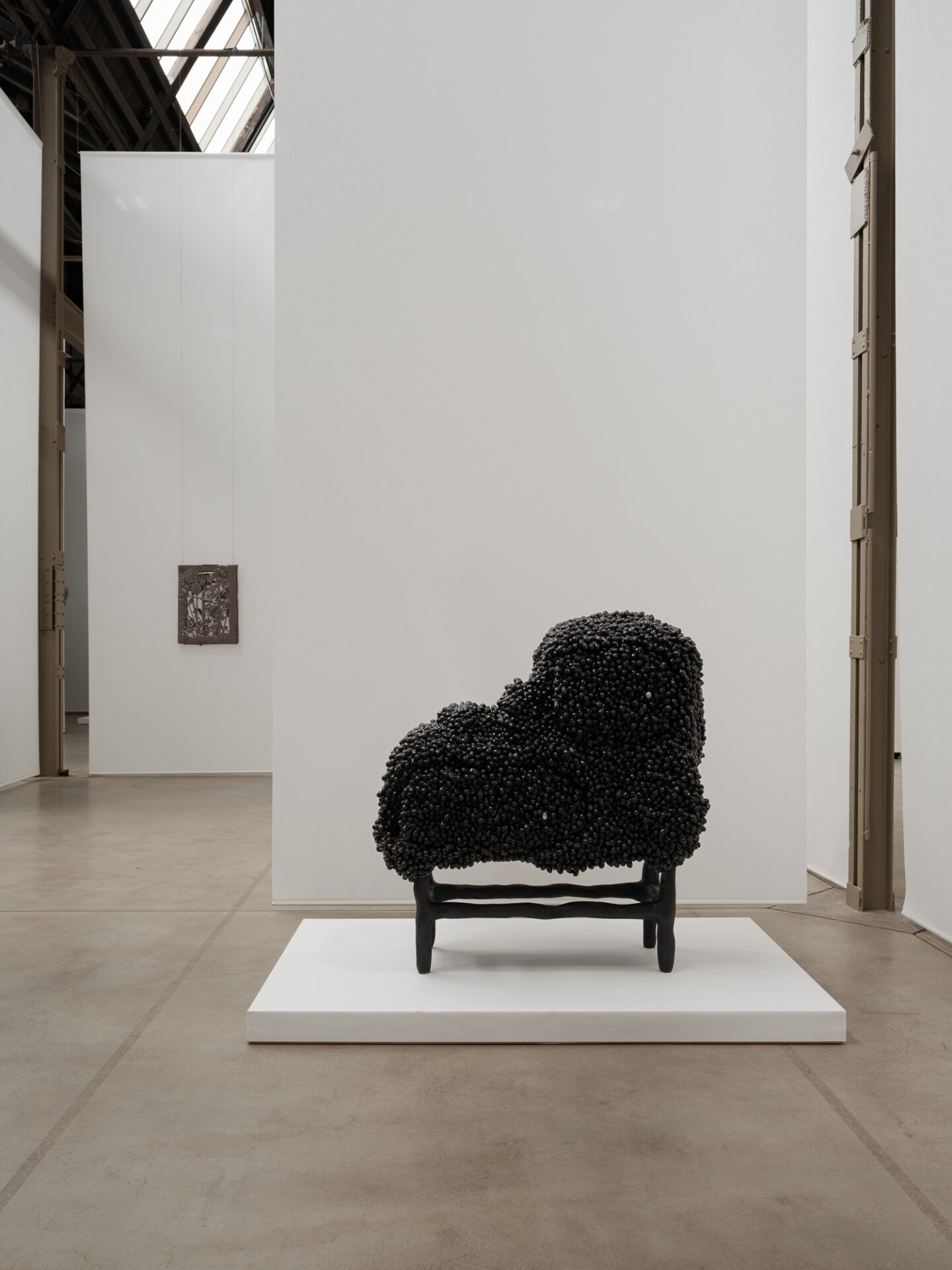
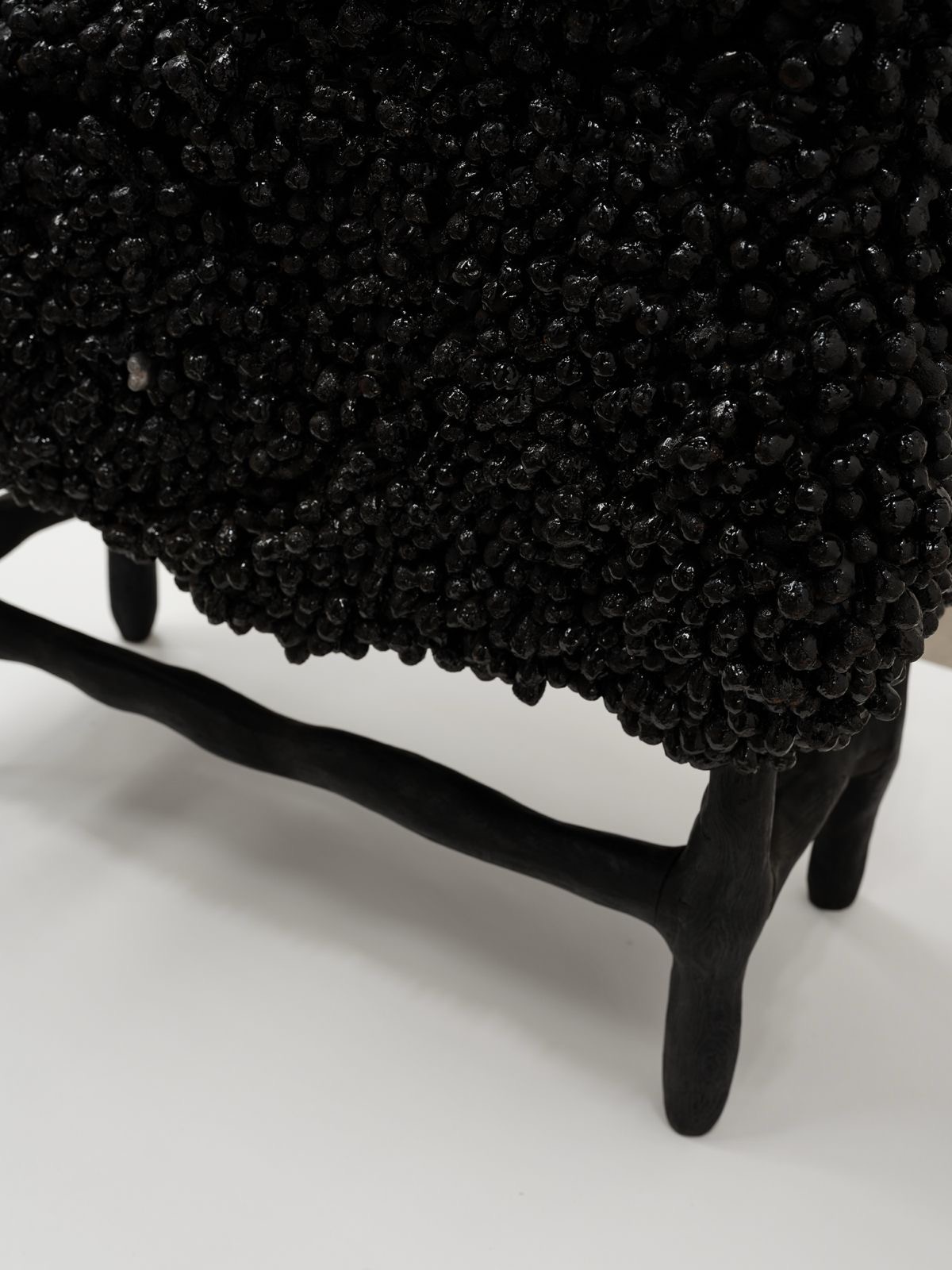
Imagine turning one corner and seeing the back of an artwork before you see its front. A movement in the fabric reveals another room. Something catches your eye in the distance, only to disappear again as you walk closer. You are constantly being invited to look twice. Take Marlène Huissoud, whose work explores humanity’s relationship with the wider living world by collaborating with insects. Her Cocoon works are made from accumulated silkworm cocoons, treated with a thin layer of natural honeybee bio-resin. Crucially, the process avoids killing the silkworm, questioning the conventions of traditional silk production.
Standing in front of her Black Sheep Cocoon Cabinet, the material immediately demands attention. Dark, almost otherworldly, it has the appearance of something between furniture, sculpture, and an organic relic. And then there is the smell. Honey. Suddenly, the work becomes more than something to look at. It becomes something you experience physically. The insects are no longer an abstract part of an ecosystem somewhere outside our field of vision. They are right there, embedded in the object. I realised that nature and design form a powerful symbiosis here, communicating more strongly together than they ever could alone.
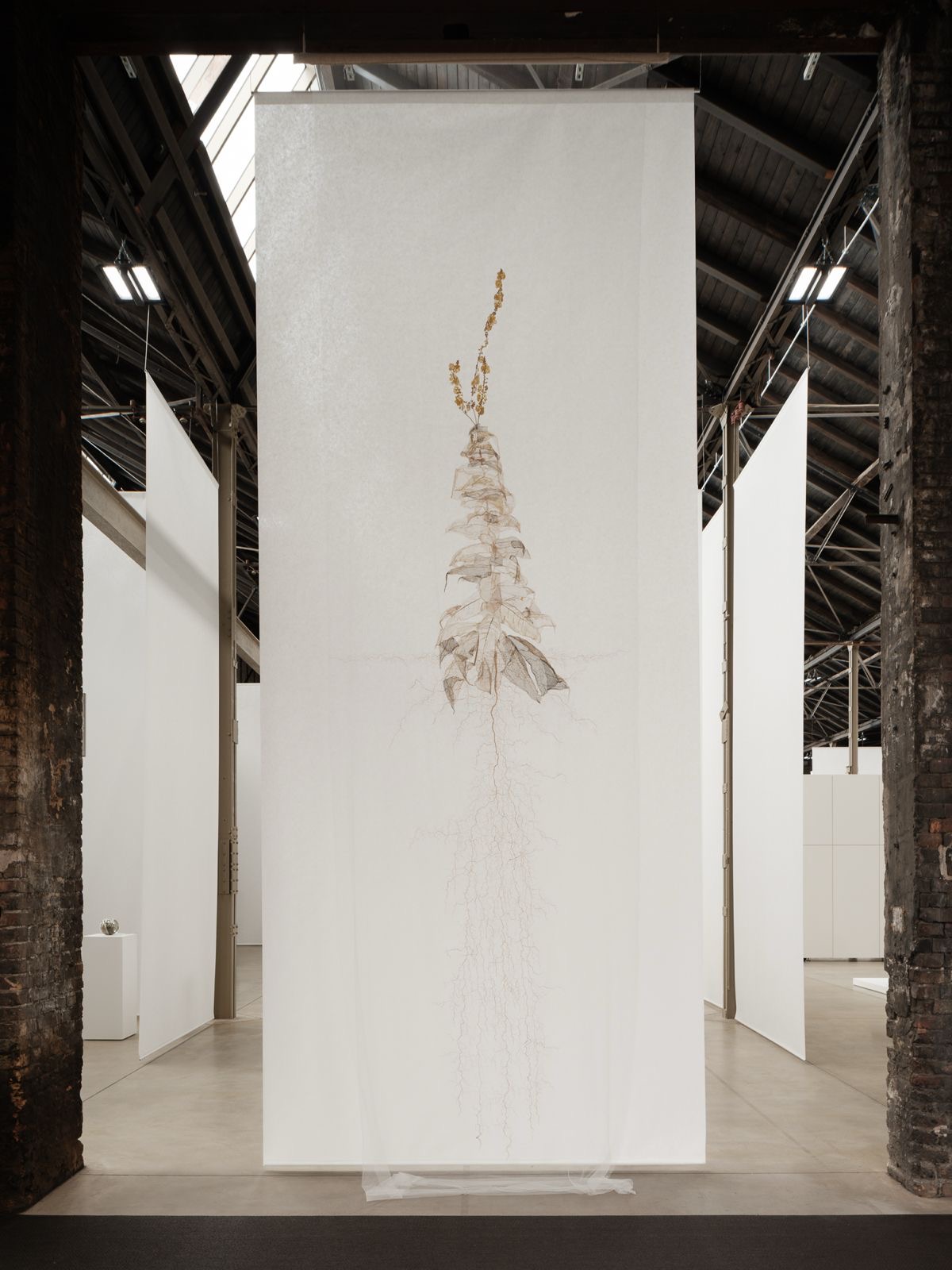
Further inside, Marjolein Hessels brings that relationship with nature into something quieter. Her embroidered Verbascum thapsus depicts a plant in its own natural colours, created using pigments derived from the plant itself through an infusion technique also used in herbal medicine.
At first glance, it is simply beautiful. Then you read about it. And the flower changes. Hessels’ work asks us to reconsider a world in which humans so often occupy centre stage, while plants, animals, oceans, and rivers remain secondary. Her work becomes a reminder that the planet is not a backdrop to human life. It is the system that makes that life possible. You are drawn in by something visually compelling. Only then does the question arrive. What am I actually looking at? And what is it asking of me?
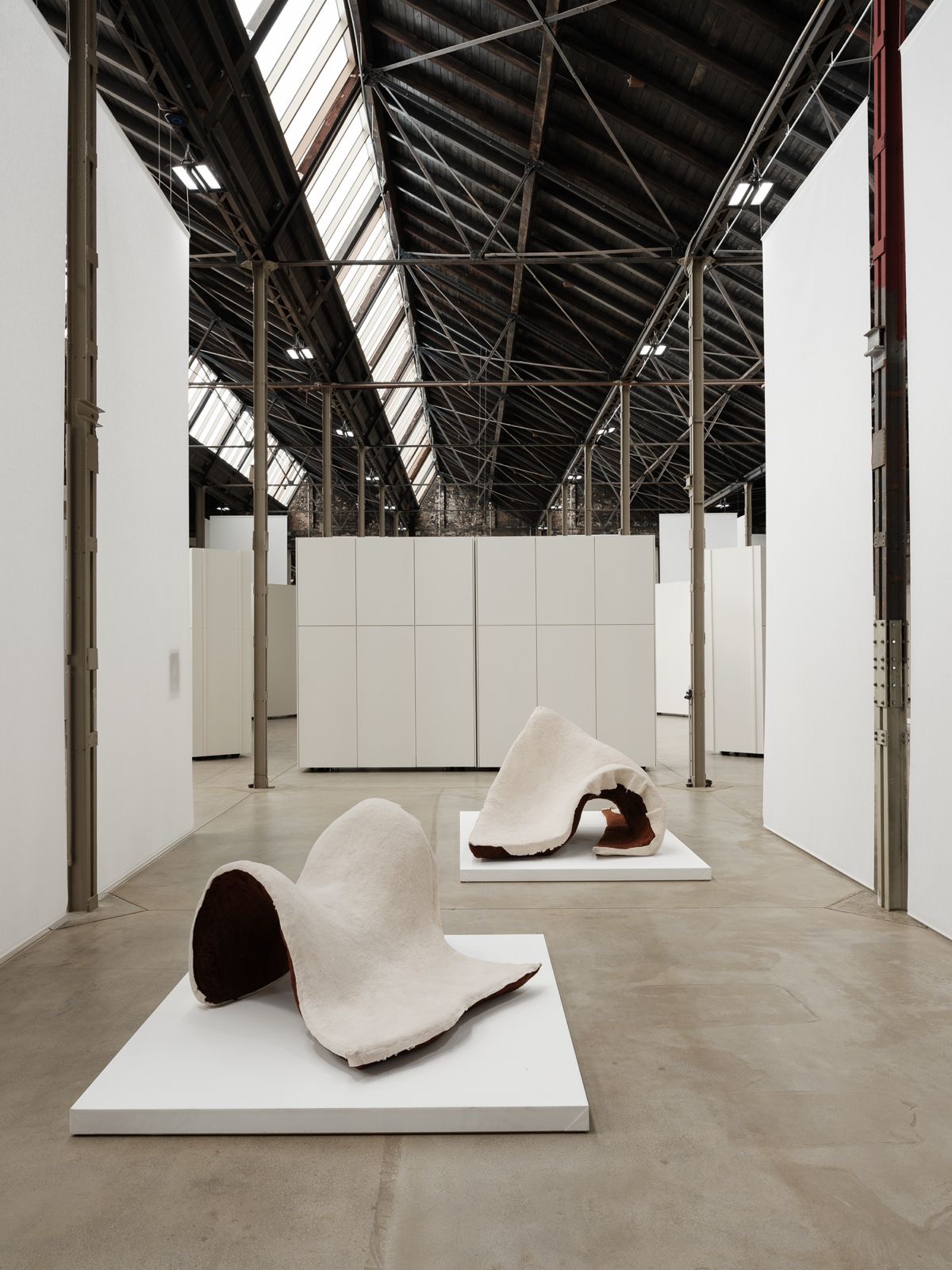
That question becomes even more intimate in the work of South African artist and designer Christine Jacobs. Born and raised on a Merino sheep farm, Jacobs’ relationship with landscape is deeply personal. Her felted wool Scape structures emerge from an intuitive dialogue with the land surrounding her family farm and take on soft, almost womb-like forms. They seem to cradle rather than confront you.
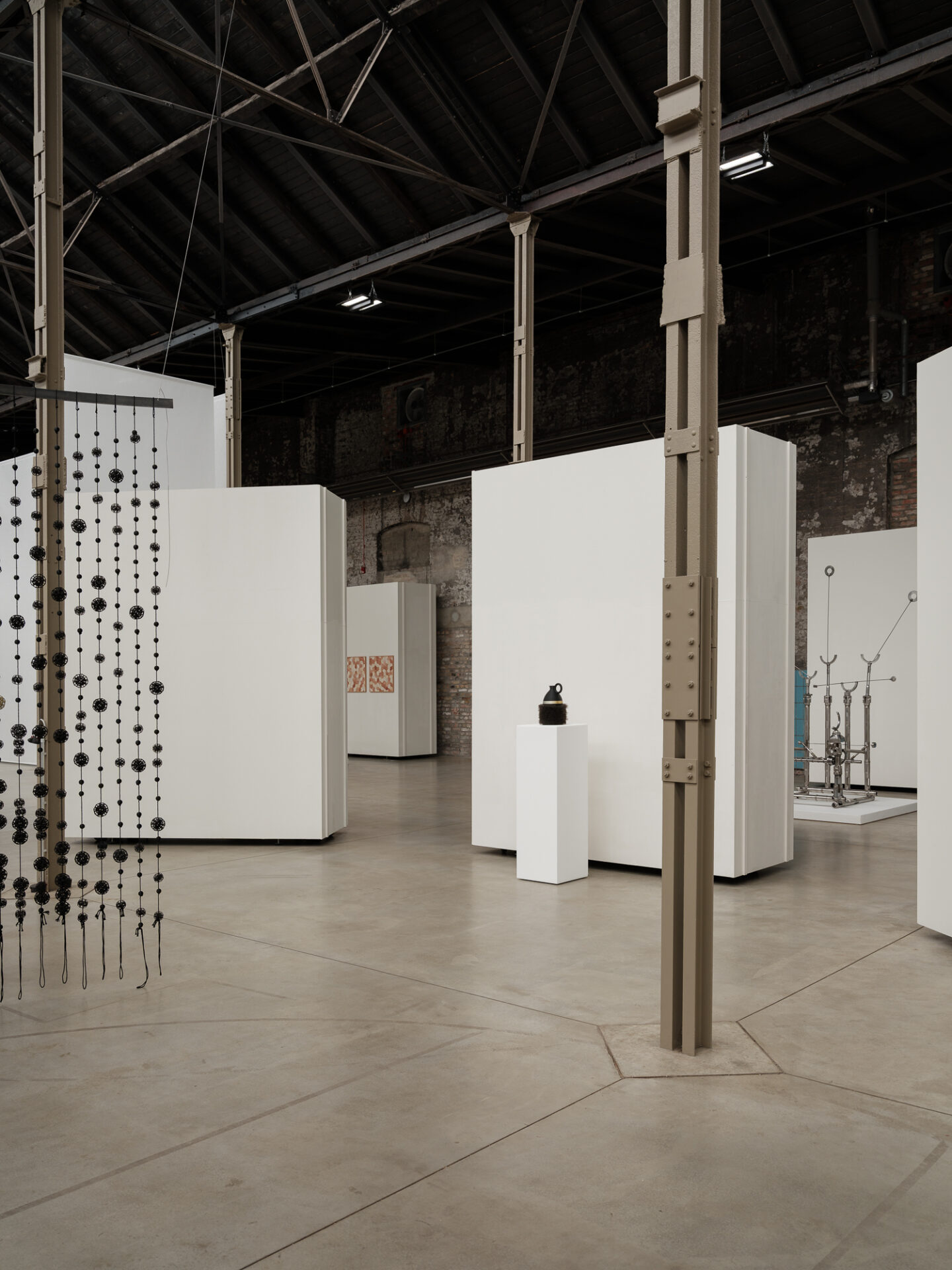
After the industrial architecture of Wilhelm Hallen, there is something striking about encountering these soft landscapes inside such a vast former factory. The contrast makes the works feel almost protective, as if, within this enormous building, they have created small spaces in which to pause.
Coming back to the Overview Effect, another meaningful layer was added: changing where we believe we stand. As I wandered around the exhibition, everything felt like walking along a path through a landscape. You see something. You wonder. You move towards it. Something else appears. And that makes the exhibition feel remarkably coherent despite the diversity of the artists. There are designers working with wool, silk, plants, insects, and other materials; practices coming from Europe, Asia, Africa, North America, and beyond. Yet the exhibition does not attempt to flatten these differences into one universal aesthetic. Instead, it allows them to form a kind of network. Carnick deliberately selected practitioners who could offer fresh perspectives, artists who, like astronauts looking back at Earth, might help us see familiar things from an unfamiliar angle.
Towards the end of the exhibition, the atmosphere shifts again. You encounter a large golden work by the Chilean studio gt2p, punctured with openings. It feels like a final destination, something waiting at the end of the path. And it carries the exhibition’s most direct question: What is your hope for the future of the planet?
With that, the curators invited the visitors to write their answer on a small note and place it into one of the openings. After everything that came before, the plants, the insects, the landscapes, the translucent walls, the shifting perspectives, the gesture feels so mindful. Write down your hope. Put it somewhere. Leave it behind for someone else to find.
Johannes Schön spoke about the difficulty of remaining optimistic in a moment defined by war, political instability, and so much division. Yet his optimism is not naïve. It comes from paying attention to the small things: the beauty of nature, the possibilities of making, the ways people can still connect. That spirit runs through The Overview Effect. It is hopeful, without pretending that everything is fine.
Perhaps the most beautiful thing about the exhibition is that it never actually tries to recreate outer space. I mean, there are no spectacular simulations of galaxies or rockets. Instead, it creates something much more subtle: a change in attention.
The semi-transparent walls make you notice what is usually hidden. And the materials make you think about where things come from, while every artist asks us to reconsider our position within nature rather than outside it. And by the time you reach the final work, the idea of looking down at Earth from space feels more like a state of mind, far removed from just a scientific phenomenon. We are reminded that we share the same planet, the same fragile systems, the same limited amount of time. I found my answer. The Overview Effect is about learning to see what is already around us differently.
The Overview Effect is on view September 4–13, 2026 at The Foundry, Wilhelm Hallen, Kopenhagener Str. 60–68, 13407 Berlin.